Ralph John, Akiyama Takuya, Coleman Heather D, Mansfield Shawn D
Department of Biochemistry, Enzyme Institute, University of Wisconsin-Madison, 1710 University Avenue, Madison, WI 53726 USA ; Department of Biological Systems Engineering, University of Wisconsin-Madison, 460 Henry Mall, Madison, WI 53706 USA ; DOE Great Lakes Bioenergy Research Center, and Wisconsin Bioenergy Initiative, University of Wisconsin-Madison, Madison, WI 53706 USA.
Wood Chemistry Laboratory, Department of Biomaterial Sciences, the University of Tokyo, Bunkyo-ku Tokyo, 113-8657 Japan.
Bioenergy Res. 2012;5(4):1009-1019. doi: 10.1007/s12155-012-9218-y.
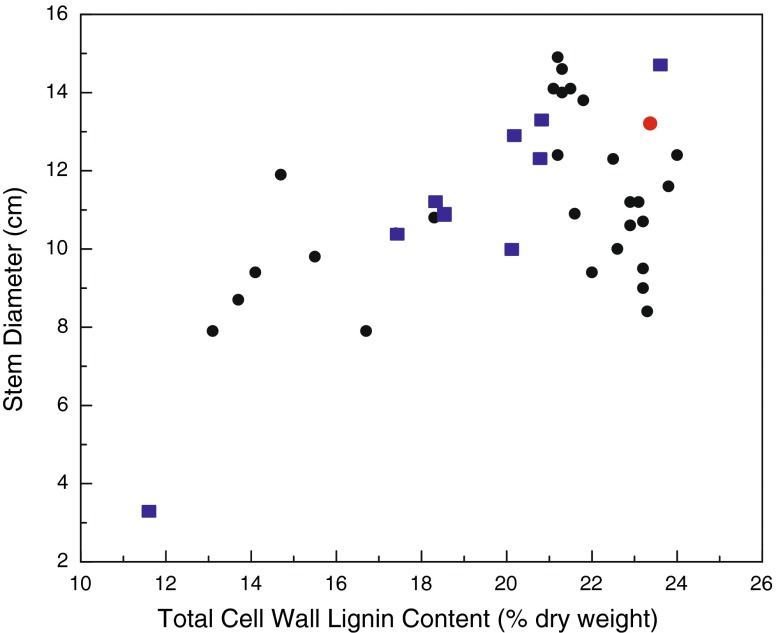
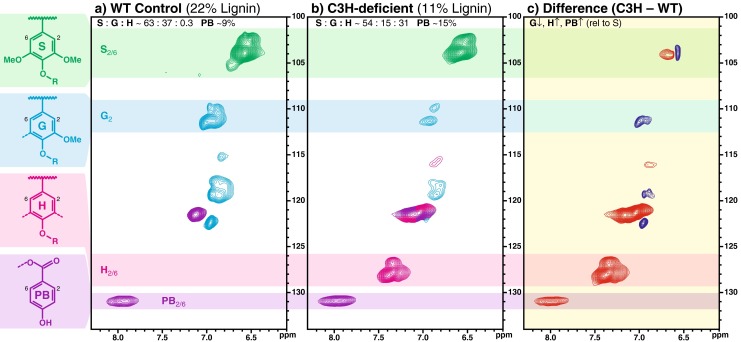
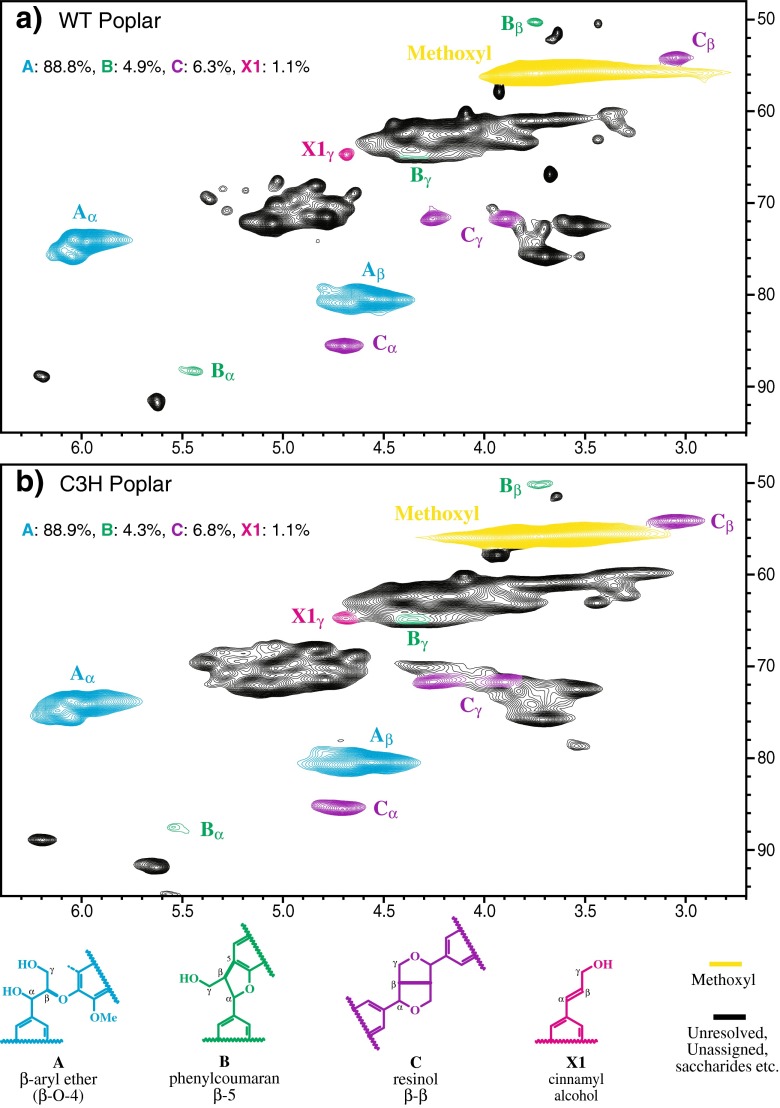
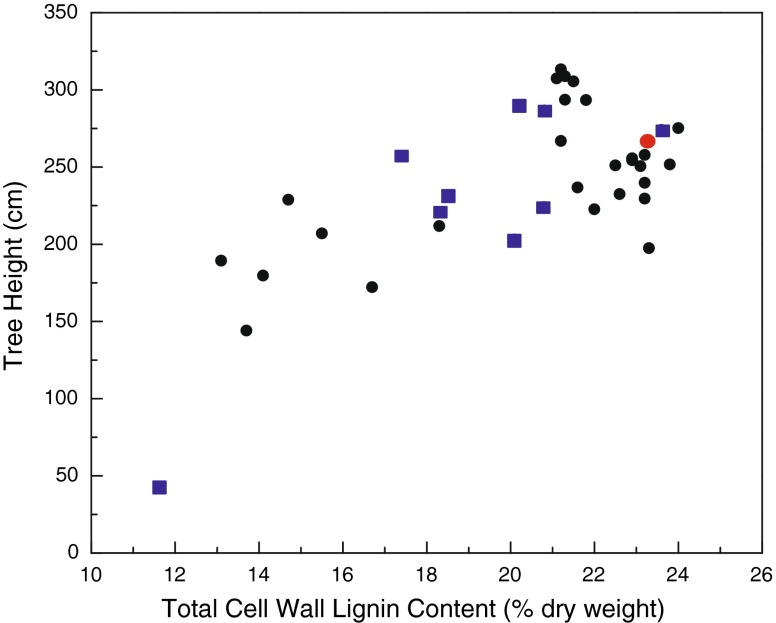
The lignin structural ramifications of coumarate 3-hydroxylase (C3H) downregulation have not been addressed in hardwoods. Such information is required to accompany an assessment of the digestibility and bioenergy performance characteristics of poplar, in particular. Structurally rich 2D NMR methods were applied to the entire lignin fraction to delineate lignin -hydroxyphenyl:guaiacyl:syringyl (H:G:S) levels and linkage distribution changes (and to compare with traditional degradative analyses). C3H downregulation reduced lignin levels by half and markedly increased the proportion of H units relative to the normally dominant G and S units. Relative stem H unit levels were up by ∼ 100-fold to ∼ 31 %, almost totally at the expense of G units; differences in the lignin interunit linkage distributions were more subtle. The H level in the most drastically C3H-downregulated transgenic poplar falls well beyond the H:G:S compositional bounds of normal angiosperms. The response observed here, in poplar, differs markedly from that reported for alfalfa where the S:G ratio remained almost constant even at substantial H levels, highlighting the often differing responses among plant species.
在硬木中,香豆酸3 - 羟化酶(C3H)下调对木质素结构的影响尚未得到研究。特别是在评估杨树的消化率和生物能源性能特征时,需要此类信息。采用结构丰富的二维核磁共振方法对整个木质素部分进行分析,以确定木质素中对羟基苯基:愈创木基:紫丁香基(H:G:S)的水平以及连接分布变化(并与传统降解分析进行比较)。C3H下调使木质素水平降低了一半,并显著增加了H单元相对于通常占主导地位的G和S单元的比例。相对茎部H单元水平提高了约100倍,达到约31%,几乎完全是以G单元为代价;木质素单元间连接分布的差异更为细微。在C3H下调最显著的转基因杨树中,H水平远远超出了正常被子植物的H:G:S组成范围。这里在杨树中观察到的反应与苜蓿中报道的反应明显不同,在苜蓿中,即使H水平很高,S:G比率仍几乎保持不变,这突出了不同植物物种之间常常存在不同反应。