
基于片上微环的光子分数微分器的综合理论模型。
A comprehensive theoretical model for on-chip microring-based photonic fractional differentiators.
作者信息
Jin Boyuan, Yuan Jinhui, Wang Kuiru, Sang Xinzhu, Yan Binbin, Wu Qiang, Li Feng, Zhou Xian, Zhou Guiyao, Yu Chongxiu, Lu Chao, Yaw Tam Hwa, Wai P K A
机构信息
State Key Laboratory of Information Photonics and Optical Communications, Beijing University of Posts and Telecommunications, P.O. Box 72 (BUPT), Beijing 100876, China.
Department of Electrical and Computer Engineering, University of Nebraska-Lincoln, Lincoln, Nebraska 68588, United States.
出版信息
Sci Rep. 2015 Sep 18;5:14216. doi: 10.1038/srep14216.
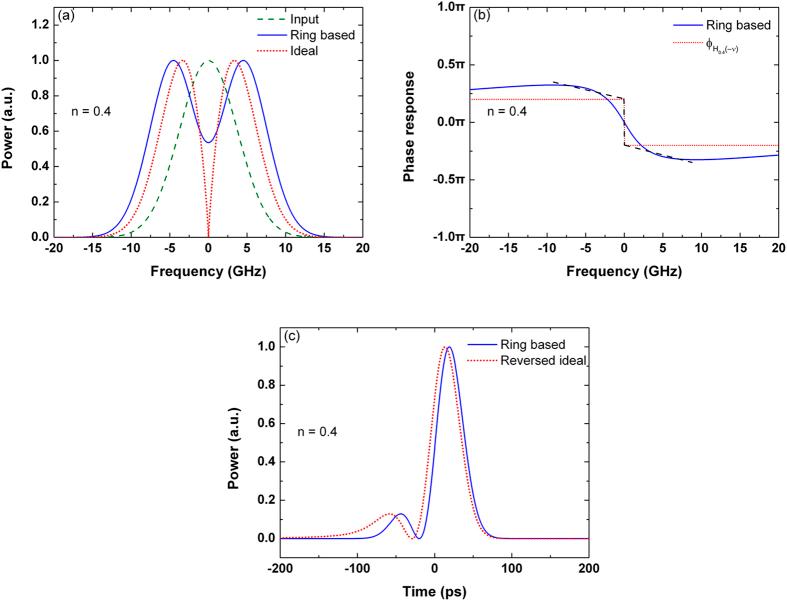
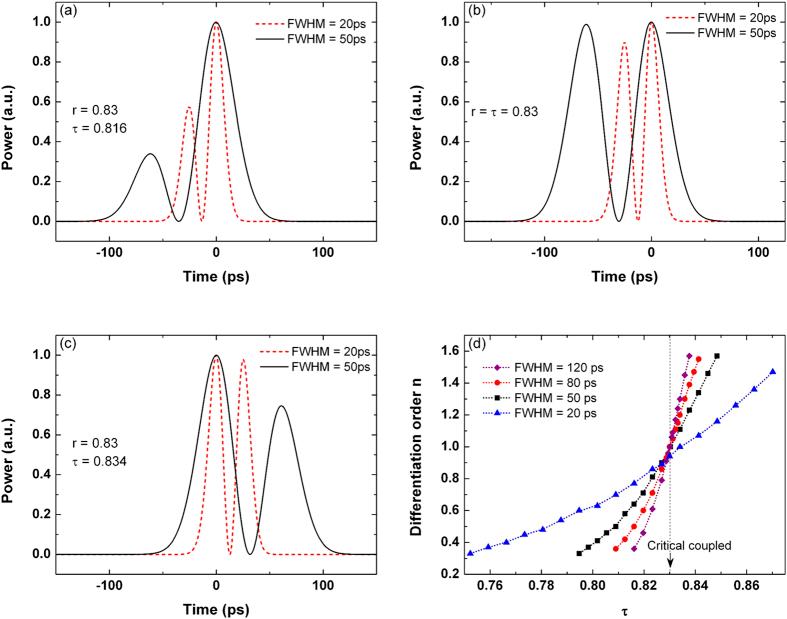
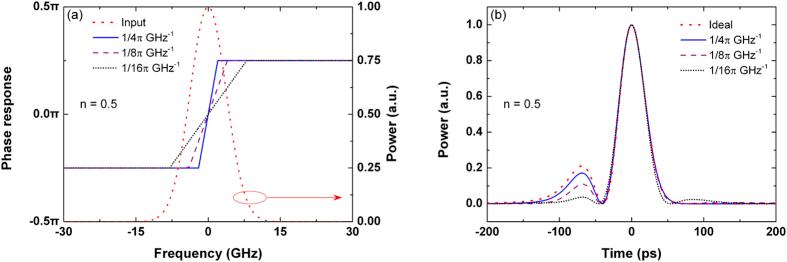
Microring-based photonic fractional differentiators play an important role in the on-chip all-optical signal processing. Unfortunately, the previous works do not consider the time-reversal and the time delay characteristics of the microring-based fractional differentiator. They also do not include the effect of input pulse width on the output. In particular, it cannot explain why the microring-based differentiator with the differentiation order n > 1 has larger output deviation than that with n < 1, and why the microring-based differentiator cannot reproduce the three-peak output waveform of an ideal differentiator with n > 1. In this paper, a comprehensive theoretical model is proposed. The critically-coupled microring resonator is modeled as an ideal first-order differentiator, while the under-coupled and over-coupled resonators are modeled as the time-reversed ideal fractional differentiators. Traditionally, the over-coupled microring resonators are used to form the differentiators with 1 < n < 2. However, we demonstrate that smaller fitting error can be obtained if the over-coupled microring resonator is fitted by an ideal differentiator with n < 1. The time delay of the differentiator is also considered. Finally, the influences of some key factors on the output waveform and deviation are discussed. The proposed theoretical model is beneficial for the design and application of the microring-based fractional differentiators.
基于微环的光子分数微分器在片上全光信号处理中起着重要作用。不幸的是,以往的工作没有考虑基于微环的分数微分器的时间反转和时间延迟特性。它们也没有考虑输入脉冲宽度对输出的影响。特别是,它无法解释为什么微分阶数n>1的基于微环的微分器比n<1的具有更大的输出偏差,以及为什么基于微环的微分器不能重现n>1的理想微分器的三峰输出波形。本文提出了一个综合理论模型。将临界耦合微环谐振器建模为理想的一阶微分器,而欠耦合和过耦合谐振器则建模为时间反转的理想分数微分器。传统上,过耦合微环谐振器用于形成1<n<2的微分器。然而,我们证明,如果用过耦合微环谐振器拟合n<1的理想微分器,可以获得更小的拟合误差。还考虑了微分器的时间延迟。最后,讨论了一些关键因素对输出波形和偏差的影响。所提出的理论模型有利于基于微环的分数微分器的设计和应用。







 Zotero 插件