
miR-200c在调控乳腺癌干细胞及其乳腺上皮对应细胞自我更新中的关键作用。
Essential role of miR-200c in regulating self-renewal of breast cancer stem cells and their counterparts of mammary epithelium.
作者信息
Feng Zhong-Ming, Qiu Jun, Chen Xie-Wan, Liao Rong-Xia, Liao Xing-Yun, Zhang Lu-Ping, Chen Xu, Li Yan, Chen Zheng-Tang, Sun Jian-Guo
机构信息
Cancer Institute of PLA, Xinqiao Hospital, Third Military Medical University, Chongqing, 400037, P. R. China.
Department of Medical English, College of Basic Medicine, Third Military Medical University, Chongqing, 400038, P. R. China.
出版信息
BMC Cancer. 2015 Sep 23;15:645. doi: 10.1186/s12885-015-1655-5.
BACKGROUND
Breast cancer stem cells (BCSCs) have been reported as the origin of breast cancer and the radical cause of drug resistance, relapse and metastasis in breast cancer. BCSCs could be derived from mutated mammary epithelial stem cells (MaSCs). Therefore, comparing the molecular differences between BCSCs and MaSCs may clarify the mechanism underlying breast carcinogenesis and the targets for gene therapy. Specifically, the distinct miRNome data of BCSCs and MaSCs need to be analyzed to find out the key miRNAs and reveal their roles in regulating the stemness of BCSCs.
METHODS
MUC1(-)ESA(+) cells were isolated from normal mammary epithelial cell line MCF-10A by fluorescence-activated cell sorting (FACS) and tested for stemness by clonogenic assay and multi-potential differentiation experiments. The miRNA profiles of MaSCs, BCSCs and breast cancer MCF-7 cells were compared to obtain the candidate miRNAs that may regulate breast tumorigenesis. An miRNA consecutively upregulated from MaSCs to BCSCs to MCF-7 cells, miR-200c, was chosen to determine its role in regulating the stemness of BCSCs and MaSCs in vitro and in vivo. Based on bioinformatics, the targets of miR-200c were validated by dual-luciferase report system, western blot and rescue experiments.
RESULTS
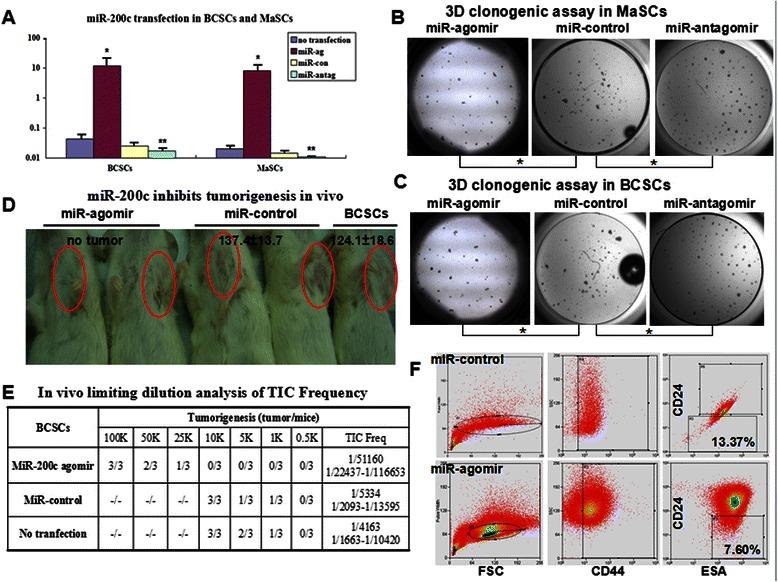
In a 2-D clonogenic assay, MUC1(-)ESA(+) cells gave rise to multiple morphological colonies, including luminal colonies, myoepithelial colonies and mixed colonies. The clonogenic potential of MUC1(-)ESA(+) (61.5 ± 3.87 %) was significantly higher than that of non-stem MCF-10A cells (53.5 ± 3.42 %) (P < 0.05). In a 3-D matrigel culture, MUC1(-)ESA(+) cells grew into mammospheres with duct-like structures. A total of 12 miRNAs of interest were identified, 8 of which were upregulated and 4 downregulated in BCSCs compared with MaSCs. In gain- and lost-of-function assays, miR-200c was sufficient to inhibit the self-renewal of BCSCs and MaSCs in vitro and the growth of BCSCs in vivo. Furthermore, miR-200c negatively regulated programmed cell death 10 (PDCD10) in BCSCs and MaSCs. PDCD10 could rescue the tumorigenesis inhibited by miR-200c in BCSCs.
DISCUSSION
Accumulating evidence shows that there is a milignant transformation from MaSCs into BCSCs. The underlying mechanism remains unclear. In present study, miRNA profiles between MaSCs and BCSCs were obtained. Then miRNA-200c, downregulated in both MaSCs and BCSCs, were verified as anti-oncogene, and played essential role in regulating self-renewal of both kinds of stem-like cells. These findings reveal a novel insights of breast tumorigenesis.
CONCLUSIONS
PDCD10 is a target gene of miR-200c and also a possible mechanism by which miR-200c plays a role in regulating the stemness of BCSCs and MaSCs.
背景
乳腺癌干细胞(BCSCs)被报道为乳腺癌的起源以及乳腺癌耐药、复发和转移的根本原因。BCSCs可能源自突变的乳腺上皮干细胞(MaSCs)。因此,比较BCSCs和MaSCs之间的分子差异可能会阐明乳腺癌发生的机制以及基因治疗的靶点。具体而言,需要分析BCSCs和MaSCs不同的微小RNA组数据,以找出关键的微小RNA并揭示它们在调节BCSCs干性中的作用。
方法
通过荧光激活细胞分选(FACS)从正常乳腺上皮细胞系MCF-10A中分离出MUC1(-)ESA(+)细胞,并通过克隆形成试验和多能分化实验检测其干性。比较MaSCs、BCSCs和乳腺癌MCF-7细胞的微小RNA谱,以获得可能调节乳腺肿瘤发生的候选微小RNA。选择一个从MaSCs到BCSCs再到MCF-7细胞连续上调的微小RNA miR-200c,以确定其在体外和体内调节BCSCs和MaSCs干性中的作用。基于生物信息学,通过双荧光素酶报告系统、蛋白质印迹和拯救实验验证miR-200c的靶标。
结果
在二维克隆形成试验中,MUC1(-)ESA(+)细胞形成了多种形态的集落,包括管腔样集落、肌上皮集落和混合集落。MUC1(-)ESA(+)细胞的克隆形成潜力(61.5±3.87%)显著高于非干细胞MCF-10A细胞(53.5±3.42%)(P<0.05)。在三维基质胶培养中,MUC1(-)ESA(+)细胞生长成具有导管样结构的乳腺球。共鉴定出12个感兴趣的微小RNA,其中8个在BCSCs中相对于MaSCs上调,4个下调。在功能获得和功能丧失试验中,miR-200c足以在体外抑制BCSCs和MaSCs的自我更新以及在体内抑制BCSCs的生长。此外,miR-200c在BCSCs和MaSCs中负向调节程序性细胞死亡10(PDCD10)。PDCD10可以拯救miR-200c在BCSCs中抑制的肿瘤发生。
讨论
越来越多的证据表明存在从MaSCs到BCSCs的恶性转化。其潜在机制仍不清楚。在本研究中,获得了MaSCs和BCSCs之间的微小RNA谱。然后,在MaSCs和BCSCs中均下调的miRNA-200c被验证为抑癌基因,并在调节两种干细胞样细胞的自我更新中起重要作用。这些发现揭示了乳腺肿瘤发生的新见解。
结论
PDCD10是miR-200c的靶基因,也是miR-200c在调节BCSCs和MaSCs干性中发挥作用的可能机制。


 Zotero 插件