Moscatelli Alessandro, Hayward Vincent, Wexler Mark, Ernst Marc O
Department of Cognitive Neuroscience, University of Bielefeld, Bielefeld, Germany.
Cognitive Interaction Technology Centre of Excellence, University of Bielefeld, Bielefeld, Germany.
Sci Rep. 2015 Sep 28;5:14584. doi: 10.1038/srep14584.
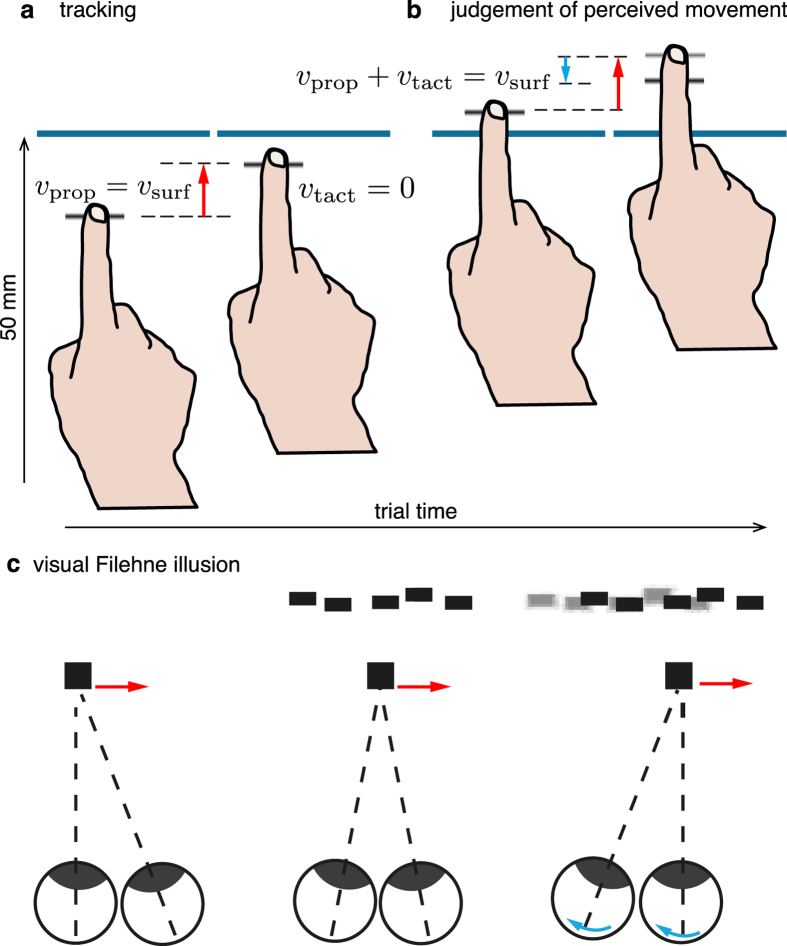
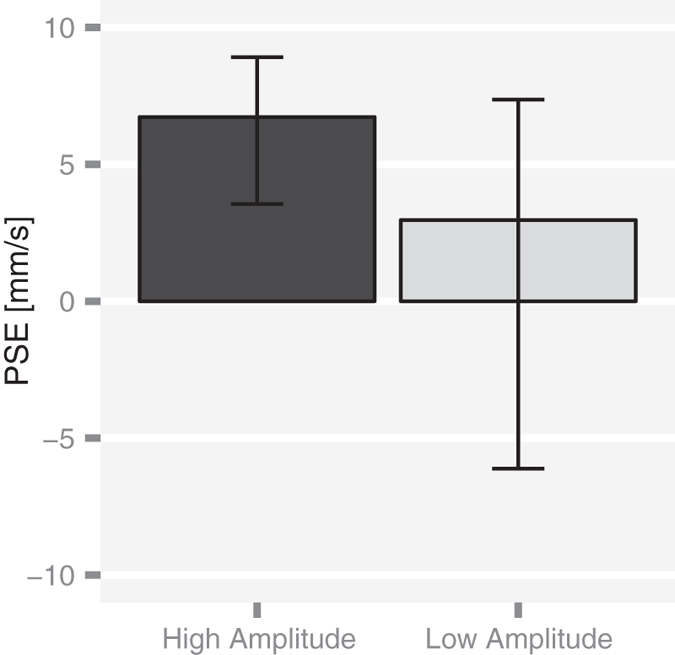
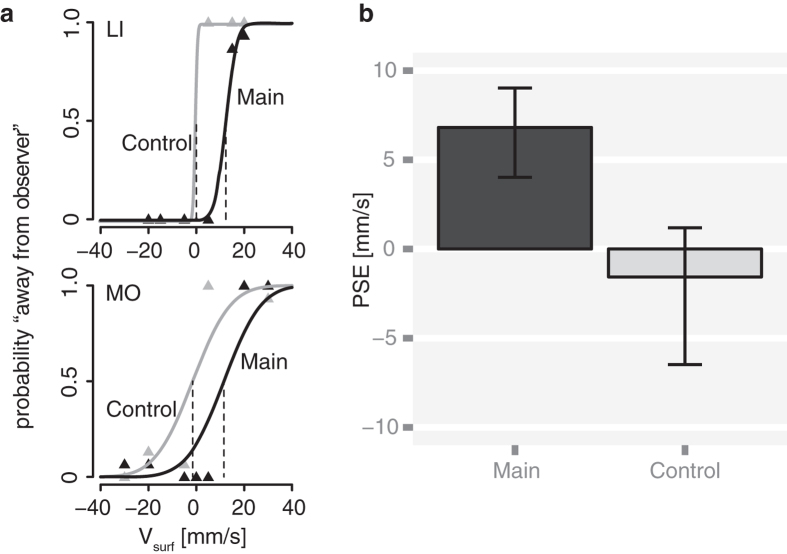
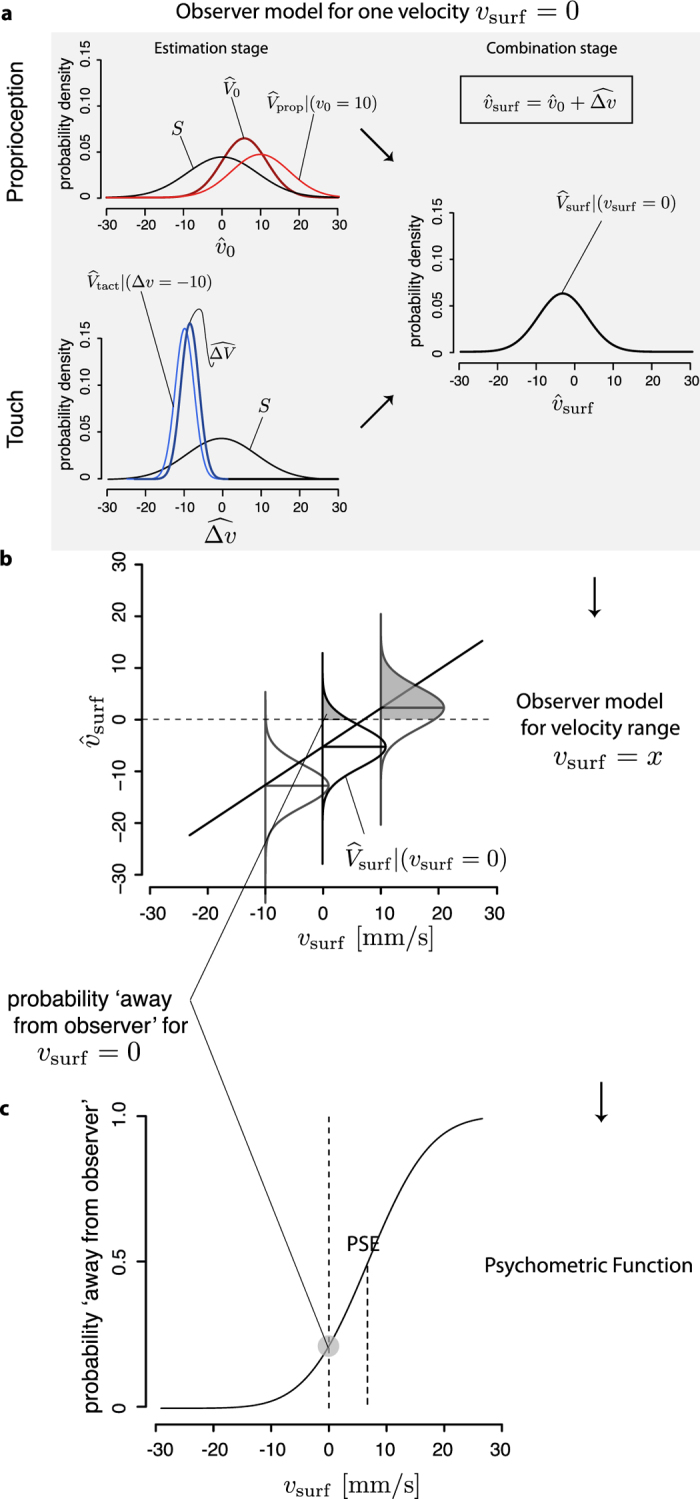
We continually move our body and our eyes when exploring the world, causing our sensory surfaces, the skin and the retina, to move relative to external objects. In order to estimate object motion consistently, an ideal observer would transform estimates of motion acquired from the sensory surface into fixed, world-centered estimates, by taking the motion of the sensor into account. This ability is referred to as spatial constancy. Human vision does not follow this rule strictly and is therefore subject to perceptual illusions during eye movements, where immobile objects can appear to move. Here, we investigated whether one of these, the Filehne illusion, had a counterpart in touch. To this end, observers estimated the movement of a surface from tactile slip, with a moving or with a stationary finger. We found the perceived movement of the surface to be biased if the surface was sensed while moving. This effect exemplifies a failure of spatial constancy that is similar to the Filehne illusion in vision. We quantified this illusion by using a Bayesian model with a prior for stationarity, applied previously in vision. The analogy between vision and touch points to a modality-independent solution to the spatial constancy problem.
在探索世界时,我们会不断移动身体和眼睛,这使得我们的感觉表面(皮肤和视网膜)相对于外部物体发生移动。为了持续估计物体的运动,一个理想的观察者会通过考虑传感器的运动,将从感觉表面获得的运动估计转换为以世界为中心的固定估计。这种能力被称为空间恒常性。人类视觉并不严格遵循这一规则,因此在眼球运动过程中容易受到感知错觉的影响,即静止的物体可能看起来在移动。在此,我们研究了这些错觉之一——费尔内错觉在触觉中是否有对应情况。为此,观察者通过移动或静止的手指从触觉滑动中估计表面的运动。我们发现,如果在表面移动时对其进行感知,表面的感知运动会出现偏差。这种效应体现了空间恒常性的失效,类似于视觉中的费尔内错觉。我们通过使用一个具有平稳性先验的贝叶斯模型对这种错觉进行了量化,该模型先前已应用于视觉研究。视觉和触觉之间的类比指向了一种与模态无关的空间恒常性问题解决方案。