Adjou Moumouni Paul Franck, Aboge Gabriel Oluga, Terkawi Mohamad Alaa, Masatani Tatsunori, Cao Shinuo, Kamyingkird Ketsarin, Jirapattharasate Charoonluk, Zhou Mo, Wang Guanbo, Liu Mingming, Iguchi Aiko, Vudriko Patrick, Ybanez Adrian Patalinghug, Inokuma Hisashi, Shirafuji-Umemiya Rika, Suzuki Hiroshi, Xuan Xuenan
National Research Center for Protozoan Diseases, Obihiro University of Agriculture and Veterinary Medicine, Obihiro, Hokkaido, 080-8555, Japan.
United Graduate School of Veterinary Sciences, Gifu University, Gifu, Gifu, 501-1193, Japan.
Parasit Vectors. 2015 Sep 30;8:496. doi: 10.1186/s13071-015-1106-9.
Infections with Babesia bovis, Babesia bigemina, Theileria species and Anaplasma marginale are endemic in Kenya yet there is a lack of adequate information on their genotypes. This study established the genetic diversities of the above tick-borne hemoparasites infecting cattle in Kenya.
Nested PCR and sequencing were used to determine the prevalence and genetic diversity of the above parasites in 192 cattle blood samples collected from Ngong and Machakos farms. B. bovis spherical body protein 4, B. bigemina rhoptry-associated protein 1a, A. marginale major surface protein 5, Theileria spp. 18S rRNA, T. parva p104 and T. orientalis major piroplasm surface protein were used as the marker genes.
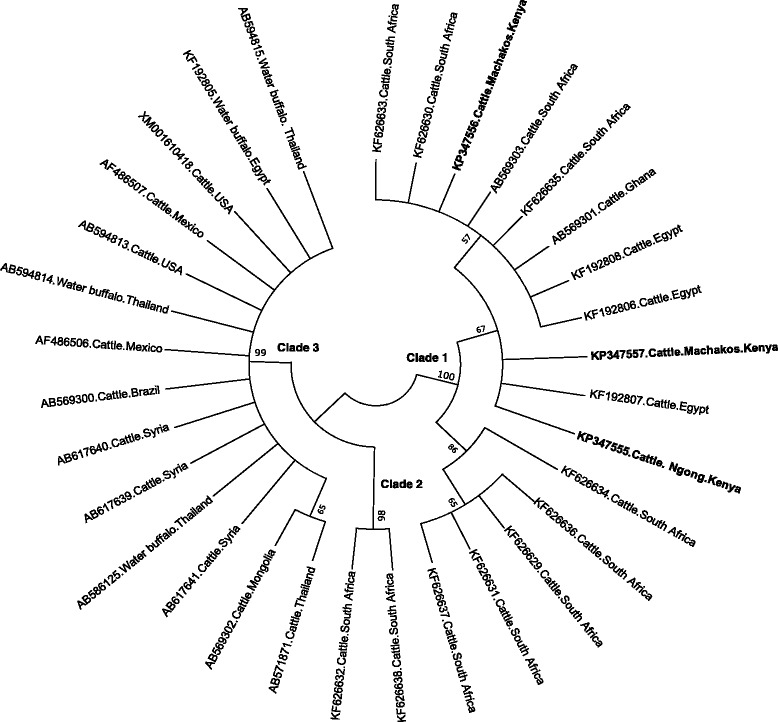
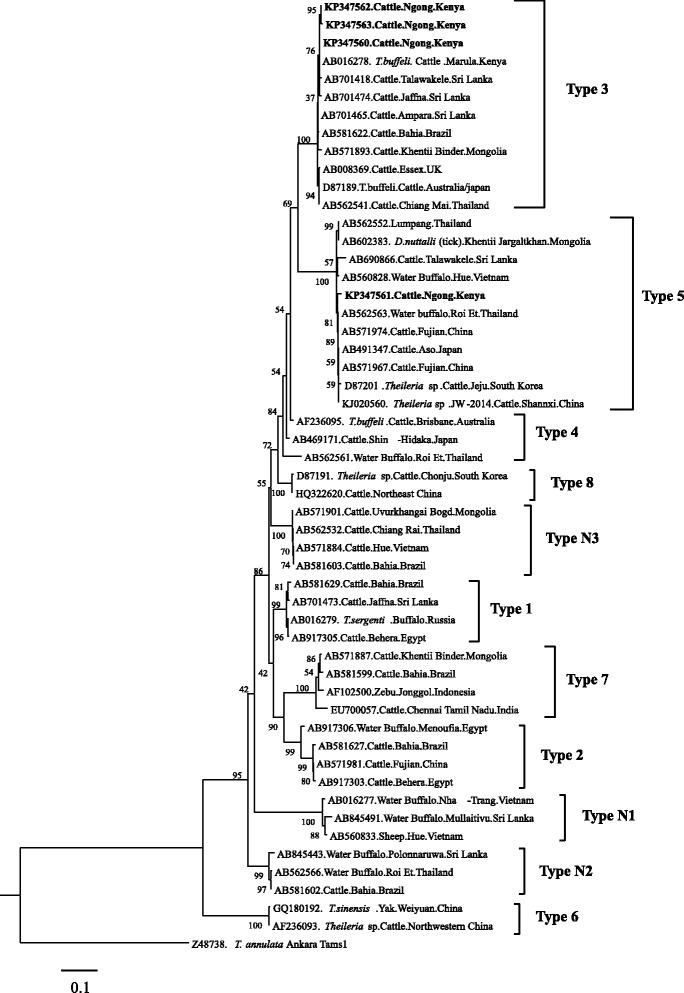
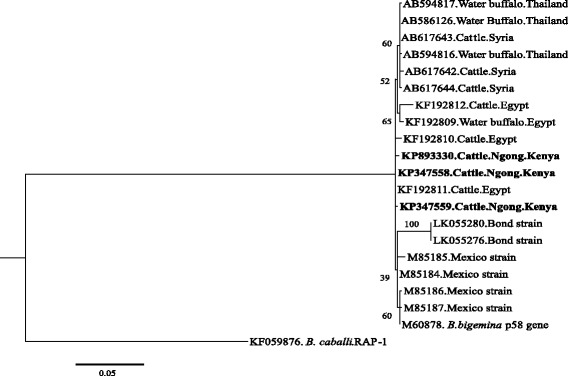
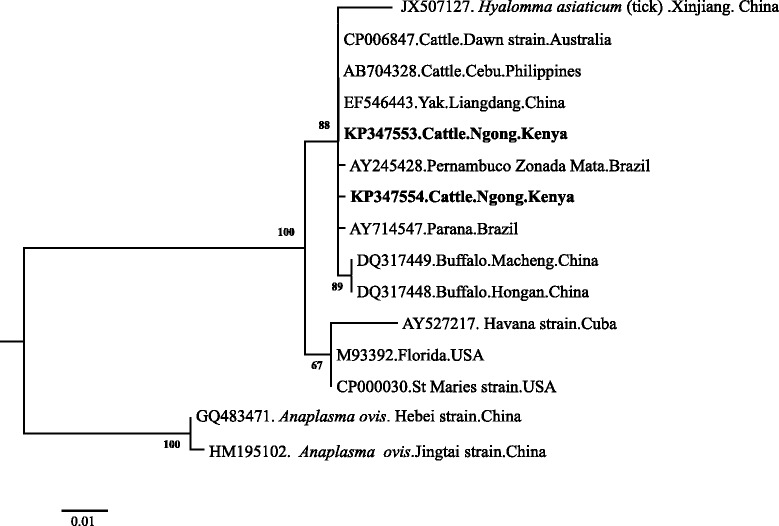
B. bovis, B. bigemina, T. parva, T. velifera, T. taurotragi, T. mutans and A. marginale were prevalent in both farms, whereas T. ovis, Theileria sp. (buffalo) and T. orientalis were found only in Ngong farm. Co-infections were observed in more than 50 % of positive samples in both farms. Babesia parasites and A. marginale sequences were highly conserved while T. parva and T. orientalis were polymorphic. Cattle-derived T. parva was detected in Machakos farm. However, cattle and buffalo-derived Theileria were detected in Ngong farm suggesting interactions between cattle and wild buffaloes. Generally, the pathogens detected in Kenya were genetically related to the other African isolates but different from the isolates in other continents.
The current findings reaffirm the endemicity and co-infection of cattle with tick-borne hemoparasites, and the role of wildlife in pathogens transmission and population genetics in Kenya.
牛巴贝斯虫、双芽巴贝斯虫、泰勒虫属和边缘无形体感染在肯尼亚呈地方流行,但关于它们基因型的信息不足。本研究确定了上述蜱传血液寄生虫在肯尼亚感染牛的遗传多样性。
采用巢式PCR和测序技术,对从恩贡和马查科斯农场采集的192份牛血样中上述寄生虫的流行率和遗传多样性进行测定。使用牛巴贝斯虫球形蛋白4、双芽巴贝斯虫棒状体相关蛋白1a、边缘无形体主要表面蛋白5、泰勒虫属18S rRNA、小泰勒虫p104和东方泰勒虫主要梨形虫表面蛋白作为标记基因。
牛巴贝斯虫、双芽巴贝斯虫、小泰勒虫、韦氏泰勒虫、南非水牛泰勒虫、突变泰勒虫和边缘无形体在两个农场均流行,而绵羊泰勒虫、泰勒虫属(水牛)和东方泰勒虫仅在恩贡农场发现。在两个农场超过50%的阳性样本中观察到混合感染。巴贝斯虫寄生虫和边缘无形体序列高度保守,而小泰勒虫和东方泰勒虫具有多态性。在马查科斯农场检测到源自牛的小泰勒虫。然而,在恩贡农场检测到源自牛和水牛的泰勒虫,表明牛和野生水牛之间存在相互作用。总体而言,在肯尼亚检测到的病原体在基因上与其他非洲分离株相关,但与其他大陆的分离株不同。
目前的研究结果再次证实了蜱传血液寄生虫在牛中的地方流行性和混合感染,以及野生动物在肯尼亚病原体传播和群体遗传学中的作用。