• 文献检索
  • 文档翻译
  • 深度研究
  • 学术资讯
  • Suppr Zotero 插件Zotero 插件
  • 邀请有礼
  • 套餐&价格
  • 历史记录
应用&插件
Suppr Zotero 插件Zotero 插件浏览器插件Mac 客户端Windows 客户端微信小程序
定价
高级版会员购买积分包购买API积分包
服务
文献检索文档翻译深度研究API 文档MCP 服务
关于我们
关于 Suppr公司介绍联系我们用户协议隐私条款
关注我们

Suppr 超能文献

核心技术专利:CN118964589B侵权必究
粤ICP备2023148730 号-1Suppr @ 2026

文献检索

告别复杂PubMed语法,用中文像聊天一样搜索,搜遍4000万医学文献。AI智能推荐,让科研检索更轻松。

立即免费搜索

文件翻译

保留排版,准确专业,支持PDF/Word/PPT等文件格式,支持 12+语言互译。

免费翻译文档

深度研究

AI帮你快速写综述,25分钟生成高质量综述,智能提取关键信息,辅助科研写作。

立即免费体验

低游离型:酯化二十碳五烯酸(EPA)血浆浓度比值与双相情感障碍发作有关,且ω-3血浆浓度会因治疗而改变。

Low unesterified:esterified eicosapentaenoic acid (EPA) plasma concentration ratio is associated with bipolar disorder episodes, and omega-3 plasma concentrations are altered by treatment.

作者信息

Saunders Erika Fh, Reider Aubrey, Singh Gagan, Gelenberg Alan J, Rapoport Stanley I

机构信息

Department of Psychiatry, Penn State College of Medicine, Penn State Milton S. Hershey Medical Center, Hershey, PA, USA.

University of Michigan Department of Psychiatry, Ann Arbor, MI, USA.

出版信息

Bipolar Disord. 2015 Nov;17(7):729-42. doi: 10.1111/bdi.12337. Epub 2015 Oct 1.

DOI:10.1111/bdi.12337
PMID:26424416
原文链接:https://pmc.ncbi.nlm.nih.gov/articles/PMC4623957/
Abstract

OBJECTIVES

Omega (n)-3 and n-6 polyunsaturated fatty acids (PUFAs) are molecular modulators of neurotransmission and inflammation. We hypothesized that plasma concentrations of n-3 PUFAs would be lower and those of n-6 PUFAs higher in subjects with bipolar disorder (BD) compared to healthy controls (HCs), and would correlate with symptom severity in subjects with BD, and that effective treatment would correlate with increased n-3 but lower n-6 PUFA levels. Additionally, we explored clinical correlations and group differences in plasma levels of saturated and monounsaturated fatty acids.

METHODS

This observational, parallel group study compared biomarkers between HCs (n = 31) and symptomatic subjects with BD (n = 27) when ill and after symptomatic recovery (follow-up). Plasma concentrations of five PUFAs [linoleic acid (LA), arachidonic acid (AA), alpha-linolenic acid (ALA), docosahexaenoic acid (DHA), and eicosapentaenoic acid (EPA)], two saturated fatty acids (palmitic acid and stearic acid) and two monounsaturated fatty acids (palmitoleic acid and oleic acid) were measured in esterified (E) and unesterified (UE) forms. Calculated ratios included UE:E for the five PUFAs, ratios of n-3 PUFAs (DHA:ALA, EPA:ALA and EPA:DHA), and the ratio of n-6:n-3 AA:EPA. Comparisons of plasma fatty acid levels and ratios between BD and HC groups were made with Student t-tests, and between the BD group at baseline and follow-up using paired t-tests. Comparison of categorical variables was performed using chi-square tests. Pearson's r was used for bivariate correlations with clinical variables, including depressive and manic symptoms, current panic attacks, and psychosis.

RESULTS

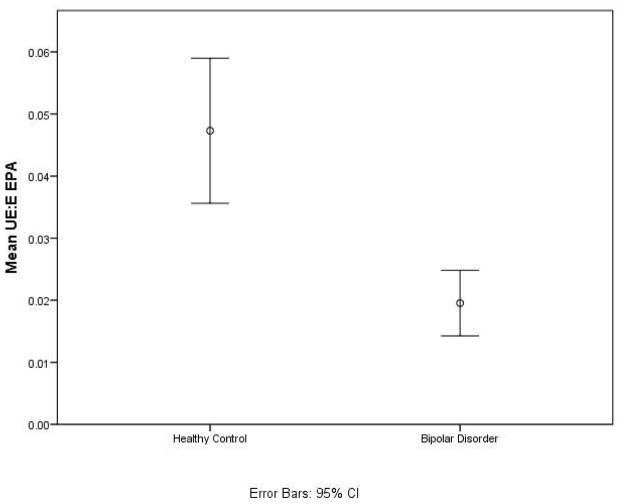
UE EPA was lower in subjects with BD than in HCs, with a large effect size (Cohen's d = 0.86, p < 0.002); however, it was not statistically significant after correction for multiple comparisons. No statistically significant difference was seen in any plasma PUFA concentration between the BD and HC groups after Bonferroni correction for 40 comparisons, at p < 0.001. Neither depressive severity nor mania severity was correlated significantly with any PUFA concentration. Exploratory comparison showed lower UE:E EPA in the BD than the HC group (p < 0.0001). At follow-up in the BD group, UE, E DHA:ALA, and UE EPA:ALA were decreased (p < 0.002). Exploratory correlations of clinical variables revealed that mania severity and suicidality were positively correlated with UE:E EPA ratio, and that several plasma levels and ratios correlated with panic disorder and psychosis. Depressive severity was not correlated with any ratio. No plasma fatty acid level or ratio correlated with self-reported n-3 PUFA intake or use of medication by class.

CONCLUSIONS

A large effect size of reduced UE EPA, and a lower plasma UE:E concentration ratio of EPA in the symptomatic BD state may be important factors in vulnerability to a mood state. Altered n-3 PUFA ratios could indicate changes in PUFA metabolism concurrent with symptom improvement. Our findings are consistent with preclinical and postmortem data and suggest testing interventions that increase n-3 and decrease n-6 dietary PUFA intake.
https://cdn.ncbi.nlm.nih.gov/pmc/blobs/a139/4623957/2c1c85f39579/nihms721487f2.jpg
https://cdn.ncbi.nlm.nih.gov/pmc/blobs/a139/4623957/5c6359a9a9cd/nihms721487f1.jpg
https://cdn.ncbi.nlm.nih.gov/pmc/blobs/a139/4623957/2c1c85f39579/nihms721487f2.jpg
https://cdn.ncbi.nlm.nih.gov/pmc/blobs/a139/4623957/5c6359a9a9cd/nihms721487f1.jpg
https://cdn.ncbi.nlm.nih.gov/pmc/blobs/a139/4623957/2c1c85f39579/nihms721487f2.jpg
摘要

目的

ω-3和ω-6多不饱和脂肪酸(PUFAs)是神经传递和炎症的分子调节剂。我们假设,与健康对照者(HCs)相比,双相情感障碍(BD)患者血浆中ω-3多不饱和脂肪酸的浓度会更低,而ω-6多不饱和脂肪酸的浓度会更高,且这与BD患者的症状严重程度相关,有效治疗会与ω-3多不饱和脂肪酸水平升高但ω-6多不饱和脂肪酸水平降低相关。此外,我们还探讨了饱和脂肪酸和单不饱和脂肪酸血浆水平的临床相关性及组间差异。

方法

这项观察性平行组研究比较了HCs(n = 31)与有症状的BD患者(n = 27)在患病时及症状缓解后(随访)的生物标志物。测定了五种PUFAs[亚油酸(LA)、花生四烯酸(AA)、α-亚麻酸(ALA)、二十二碳六烯酸(DHA)和二十碳五烯酸(EPA)]、两种饱和脂肪酸(棕榈酸和硬脂酸)以及两种单不饱和脂肪酸(棕榈油酸和油酸)的酯化(E)和非酯化(UE)形式的血浆浓度。计算的比值包括五种PUFAs的UE:E、ω-3多不饱和脂肪酸的比值(DHA:ALA、EPA:ALA和EPA:DHA)以及ω-6:ω-3 AA:EPA的比值。使用Student t检验比较BD组和HC组之间的血浆脂肪酸水平及比值,使用配对t检验比较BD组基线和随访时的情况。使用卡方检验进行分类变量的比较。Pearson相关系数r用于与临床变量进行双变量相关分析,包括抑郁和躁狂症状、当前惊恐发作和精神病。

结果

BD患者的非酯化EPA低于HCs,效应量较大(Cohen's d = 0.86,p < 0.002);然而,在进行多重比较校正后,差异无统计学意义。在对40次比较进行Bonferroni校正后,p < 0.001时,BD组和HC组之间的任何血浆PUFA浓度均无统计学显著差异。抑郁严重程度和躁狂严重程度与任何PUFA浓度均无显著相关性。探索性比较显示,BD组的非酯化:酯化EPA低于HC组(p < 0.0001)。在BD组随访时,非酯化、酯化DHA:ALA以及非酯化EPA:ALA均降低(p < 0.002)。临床变量的探索性相关分析显示,躁狂严重程度和自杀倾向与非酯化:酯化EPA比值呈正相关,且几种血浆水平和比值与惊恐障碍和精神病相关。抑郁严重程度与任何比值均无相关性。没有血浆脂肪酸水平或比值与自我报告的ω-3多不饱和脂肪酸摄入量或按类别使用的药物相关。

结论

非酯化EPA降低的效应量较大,且有症状的BD状态下血浆非酯化:酯化EPA浓度比值较低可能是易患情绪状态的重要因素。ω-3多不饱和脂肪酸比值的改变可能表明PUFA代谢的变化与症状改善同时发生。我们的研究结果与临床前和尸检数据一致,并建议测试增加ω-3和减少ω-6膳食PUFA摄入量的干预措施。

相似文献

1
Low unesterified:esterified eicosapentaenoic acid (EPA) plasma concentration ratio is associated with bipolar disorder episodes, and omega-3 plasma concentrations are altered by treatment.低游离型:酯化二十碳五烯酸(EPA)血浆浓度比值与双相情感障碍发作有关,且ω-3血浆浓度会因治疗而改变。
Bipolar Disord. 2015 Nov;17(7):729-42. doi: 10.1111/bdi.12337. Epub 2015 Oct 1.
2
Dietary omega-6 fatty acid lowering increases bioavailability of omega-3 polyunsaturated fatty acids in human plasma lipid pools.饮食中ω-6脂肪酸含量降低会增加人体血浆脂质池中ω-3多不饱和脂肪酸的生物利用度。
Prostaglandins Leukot Essent Fatty Acids. 2014 May;90(5):151-7. doi: 10.1016/j.plefa.2014.02.003. Epub 2014 Feb 24.
3
Omega-3 and Omega-6 Polyunsaturated Fatty Acid Levels and Correlations with Symptoms in Children with Attention Deficit Hyperactivity Disorder, Autistic Spectrum Disorder and Typically Developing Controls.注意力缺陷多动障碍、自闭症谱系障碍及正常发育对照儿童体内的Omega-3和Omega-6多不饱和脂肪酸水平及其与症状的相关性
PLoS One. 2016 May 27;11(5):e0156432. doi: 10.1371/journal.pone.0156432. eCollection 2016.
4
Omega-3 and Omega-6 Polyunsaturated Fatty Acids in Bipolar Disorder: A Review of Biomarker and Treatment Studies.双相情感障碍中的ω-3和ω-6多不饱和脂肪酸:生物标志物与治疗研究综述
J Clin Psychiatry. 2016 Oct;77(10):e1301-e1308. doi: 10.4088/JCP.15r09925.
5
Plasma free polyunsaturated fatty acid levels are associated with symptom severity in acute mania.血浆游离多不饱和脂肪酸水平与急性躁狂症的症状严重程度相关。
Bipolar Disord. 2007 Nov;9(7):759-65. doi: 10.1111/j.1399-5618.2007.00387.x.
6
Meta-analysis of erythrocyte polyunsaturated fatty acid biostatus in bipolar disorder.双相情感障碍中红细胞多不饱和脂肪酸生物状态的荟萃分析。
Bipolar Disord. 2016 May;18(3):300-6. doi: 10.1111/bdi.12386. Epub 2016 Apr 18.
7
Validation of a food frequency questionnaire to assess intake of n-3 polyunsaturated fatty acids in subjects with and without major depressive disorder.用于评估患有和未患有重度抑郁症的受试者中n-3多不饱和脂肪酸摄入量的食物频率问卷的验证。
J Am Diet Assoc. 2011 Jan;111(1):117-123.e1-2. doi: 10.1016/j.jada.2010.10.007.
8
Increased ω-3 polyunsaturated fatty acid/arachidonic acid ratios and upregulation of signaling mediator in individuals with autism spectrum disorders.自闭症谱系障碍个体中ω-3多不饱和脂肪酸/花生四烯酸比例增加及信号介质上调。
Life Sci. 2016 Jan 15;145:205-12. doi: 10.1016/j.lfs.2015.12.039. Epub 2015 Dec 24.
9
Changes in fatty acid levels (saturated, monounsaturated and polyunsaturated) during pregnancy.孕期脂肪酸水平(饱和、单不饱和和多不饱和)的变化。
BMC Pregnancy Childbirth. 2021 Nov 17;21(1):778. doi: 10.1186/s12884-021-04251-0.
10
Adipose tissue n-3/n-6 fatty acids ratios versus n-3 fatty acids fractions as predictors of myocardial infarction.脂肪组织 n-3/n-6 脂肪酸比例与 n-3 脂肪酸分数作为心肌梗死的预测因子。
Am Heart J. 2023 Aug;262:38-48. doi: 10.1016/j.ahj.2023.03.019. Epub 2023 Apr 21.

引用本文的文献

1
Omega-3 Fatty Acids for the Treatment of Bipolar Disorder Symptoms: A Narrative Review of the Current Clinical Evidence.用于治疗双相情感障碍症状的ω-3脂肪酸:当前临床证据的叙述性综述
Mar Drugs. 2025 Feb 15;23(2):84. doi: 10.3390/md23020084.
2
Association of plasma arachidonic acid levels with a bipolar disorder and the effects of a FADS gene variant.血浆花生四烯酸水平与双相情感障碍的关联及 FADS 基因变异的影响。
Transl Psychiatry. 2024 Oct 14;14(1):435. doi: 10.1038/s41398-024-03141-1.
3
Lipids in Psychiatric Disorders: Functional and Potential Diagnostic Role as Blood Biomarkers.

本文引用的文献

1
Association between polymorphisms in phospholipase A2 genes and the plasma triglyceride response to an n-3 PUFA supplementation: a clinical trial.磷脂酶A2基因多态性与血浆甘油三酯对n-3多不饱和脂肪酸补充剂反应之间的关联:一项临床试验。
Lipids Health Dis. 2015 Feb 21;14:12. doi: 10.1186/s12944-015-0009-2.
2
Fasting Induces IL-1 Resistance and Free-Fatty Acid-Mediated Up-Regulation of IL-1R2 and IL-1RA.禁食诱导白细胞介素-1抗性以及游离脂肪酸介导的白细胞介素-1受体2和白细胞介素-1受体拮抗剂的上调。
Front Immunol. 2014 Jul 9;5:315. doi: 10.3389/fimmu.2014.00315. eCollection 2014.
3
Reduced activities of phospholipases A2 in platelets of drug-naïve bipolar disorder patients.
精神疾病中的脂质:作为血液生物标志物的功能及潜在诊断作用
Metabolites. 2024 Jan 23;14(2):80. doi: 10.3390/metabo14020080.
4
Adjunctive dietary intervention for bipolar disorder: a randomized, controlled, parallel-group, modified double-blinded trial of a high n-3 plus low n-6 diet.双相障碍的辅助饮食干预:一种高 n-3 低 n-6 饮食的随机、对照、平行分组、改良双盲试验。
Bipolar Disord. 2022 Mar;24(2):171-184. doi: 10.1111/bdi.13112. Epub 2021 Aug 2.
5
Effects of supplementing docosahexaenoic acid-rich microalgae and antioxidants on beef longissimus lumborum steak color stability and sensory characteristics.富含二十二碳六烯酸的微藻和抗氧化剂对牛肉腰大肌牛排颜色稳定性和感官特性的影响。
Transl Anim Sci. 2020 Jul 18;4(3):txaa135. doi: 10.1093/tas/txaa135. eCollection 2020 Jul.
6
Altered polyunsaturated fatty acid levels in relation to proinflammatory cytokines, fatty acid desaturase genotype, and diet in bipolar disorder.双相障碍与促炎细胞因子、脂肪酸去饱和酶基因型和饮食相关的多不饱和脂肪酸水平改变。
Transl Psychiatry. 2019 Aug 27;9(1):208. doi: 10.1038/s41398-019-0536-0.
7
The emerging role of omega-3 fatty acids as a therapeutic option in neuropsychiatric disorders.ω-3脂肪酸在神经精神疾病治疗中的新兴作用。
Ther Adv Psychopharmacol. 2019 Jun 24;9:2045125319858901. doi: 10.1177/2045125319858901. eCollection 2019.
8
Total sleep time and kynurenine metabolism associated with mood symptom severity in bipolar disorder.总睡眠时间和犬尿氨酸代谢与双相情感障碍情绪症状严重程度相关。
Bipolar Disord. 2018 Feb;20(1):27-34. doi: 10.1111/bdi.12529. Epub 2017 Aug 23.
9
Valnoctamide, which reduces rat brain arachidonic acid turnover, is a potential non-teratogenic valproate substitute to treat bipolar disorder.缬草酰胺可降低大鼠脑内花生四烯酸的周转率,是一种治疗双相情感障碍的潜在非致畸性丙戊酸盐替代物。
Psychiatry Res. 2017 Aug;254:279-283. doi: 10.1016/j.psychres.2017.04.048. Epub 2017 Apr 26.
10
Reconsidering Dietary Polyunsaturated Fatty Acids in Bipolar Disorder: A Translational Picture.重新审视双相情感障碍中的膳食多不饱和脂肪酸:一幅转化医学图景。
J Clin Psychiatry. 2016 Oct;77(10):e1342-e1347. doi: 10.4088/JCP.15com10431.
初治双相情感障碍患者血小板中磷脂酶A2的活性降低。
Bipolar Disord. 2015 Feb;17(1):97-101. doi: 10.1111/bdi.12229. Epub 2014 Jul 8.
4
The saturated fatty acid, palmitic acid, induces anxiety-like behavior in mice.饱和脂肪酸棕榈酸会导致小鼠出现类似焦虑的行为。
Metabolism. 2014 Sep;63(9):1131-40. doi: 10.1016/j.metabol.2014.06.002. Epub 2014 Jun 9.
5
Dietary intake and plasma metabolomic analysis of polyunsaturated fatty acids in bipolar subjects reveal dysregulation of linoleic acid metabolism.双相情感障碍患者多不饱和脂肪酸的饮食摄入与血浆代谢组学分析揭示了亚油酸代谢的失调。
J Psychiatr Res. 2014 Oct;57:58-64. doi: 10.1016/j.jpsychires.2014.06.001. Epub 2014 Jun 12.
6
Gender differences, clinical correlates, and longitudinal outcome of bipolar disorder with comorbid migraine.双相障碍合并偏头痛的性别差异、临床相关性和纵向结局。
J Clin Psychiatry. 2014 May;75(5):512-9. doi: 10.4088/JCP.13m08623.
7
Role of omega-3 fatty acids in the treatment of depressive disorders: a comprehensive meta-analysis of randomized clinical trials.ω-3脂肪酸在抑郁症治疗中的作用:随机临床试验的综合荟萃分析
PLoS One. 2014 May 7;9(5):e96905. doi: 10.1371/journal.pone.0096905. eCollection 2014.
8
Lithium and the other mood stabilizers effective in bipolar disorder target the rat brain arachidonic acid cascade.锂盐及其他对双相情感障碍有效的心境稳定剂作用于大鼠脑花生四烯酸级联反应。
ACS Chem Neurosci. 2014 Jun 18;5(6):459-67. doi: 10.1021/cn500058v. Epub 2014 May 15.
9
Dietary omega-6 fatty acid lowering increases bioavailability of omega-3 polyunsaturated fatty acids in human plasma lipid pools.饮食中ω-6脂肪酸含量降低会增加人体血浆脂质池中ω-3多不饱和脂肪酸的生物利用度。
Prostaglandins Leukot Essent Fatty Acids. 2014 May;90(5):151-7. doi: 10.1016/j.plefa.2014.02.003. Epub 2014 Feb 24.
10
Toward clinically applicable biomarkers in bipolar disorder: focus on BDNF, inflammatory markers, and endothelial function.在双相情感障碍中寻找具有临床应用价值的生物标志物:关注 BDNF、炎症标志物和血管内皮功能。
Curr Psychiatry Rep. 2013 Dec;15(12):425. doi: 10.1007/s11920-013-0425-9.