Dantas Márcia Marília Gomes, Rocha Érika Dantas Medeiros, Brito Naira Josele Neves, Alves Camila Xavier, França Mardone Cavalcante, das Graças Almeida Maria, Brandão-Neto José
Department of Internal Medicine, Postgraduate Program in Health Sciences, Federal University of Rio Grande do Norte, Natal, Brazil.
Department of Statistics, Federal University of Rio Grande do Norte, Natal, Brazil.
Food Nutr Res. 2015 Sep 29;59:28918. doi: 10.3402/fnr.v59.28918. eCollection 2015.
The prevalence of abnormal nutritional status has increased in children and adolescents. Nutritional assessment is important for monitoring the health and nutritional status. Bioelectrical impedance vector analysis (BIVA) combines changes in tissue hydration and structure and body composition that can be assessed.
The objective of this study was to use BIVA to evaluate nutritional status in 60 prepubertal children, aged between 8 and 9 years, supplemented with zinc, to detect possible changes in body composition.
We performed a randomized, controlled, triple-blind study. The children were divided into the control group (CG; sorbitol 10%, n=29) or the experimental group (EG; 10 mg Zn/day, n=31), and the duration of the experiment was 3 months. Anthropometric assessments were performed for all of the children.
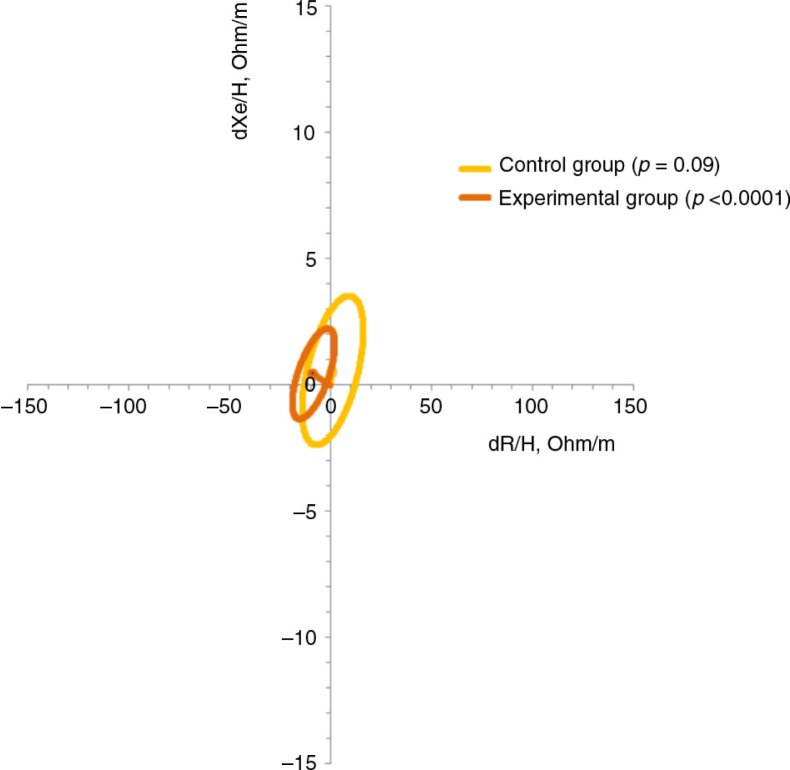
The body mass index-for-age increased after oral zinc supplementation in the EG (p=0.005). BIVA indicated that the CG demonstrated a tendency for dehydration and decreased soft tissue and the EG demonstrated a tendency for increased soft tissue, primarily the fat-free mass. After analyses of BIVA ellipses, we observed that this method could detect improvements in body composition in healthy children supplemented with zinc.
These results suggest that BIVA could be an auxiliary method for studying a small population undergoing zinc intervention.
儿童和青少年中营养状况异常的患病率有所上升。营养评估对于监测健康和营养状况很重要。生物电阻抗矢量分析(BIVA)结合了可评估的组织水合作用、结构和身体成分的变化。
本研究的目的是使用BIVA评估60名8至9岁青春期前补充锌的儿童的营养状况,以检测身体成分的可能变化。
我们进行了一项随机、对照、三盲研究。将儿童分为对照组(CG;山梨醇10%,n = 29)或实验组(EG;每天10毫克锌,n = 31),实验持续时间为3个月。对所有儿童进行了人体测量评估。
实验组口服锌补充剂后年龄别体重指数增加(p = 0.005)。BIVA表明,对照组有脱水倾向且软组织减少,而实验组有软组织增加的倾向,主要是去脂体重。在对BIVA椭圆进行分析后,我们观察到该方法可以检测出补充锌的健康儿童身体成分的改善情况。
这些结果表明,BIVA可能是研究接受锌干预的小群体的一种辅助方法。