Krachler Benno, Völgyi Eszter, Savonen Kai, Tylavsky Frances A, Alén Markku, Cheng Sulin
Department of Health Sciences, University of Jyväskylä, P.O. BOX 35 (L), 40014 Jyväskylä, Finland ; Kuopio Research Institute of Exercise Medicine, Haapaniementie 16, 70100 Kuopio, Finland ; Department of Public Health and Clinical Medicine, Occupational and Environmental Medicine, Umeå University, 901 85 Umeå, Sweden.
Department of Health Sciences, University of Jyväskylä, P.O. BOX 35 (L), 40014 Jyväskylä, Finland ; Department of Preventive Medicine, University of TN Health Science Center, Memphis, Tennessee 38163, USA.
J Obes. 2013;2013:862514. doi: 10.1155/2013/862514. Epub 2013 Dec 24.
To determine whether categories of obesity based on BMI and an anthropometry-based estimate of fat mass percentage (FM% equation) have similar discriminative ability for markers of cardiometabolic risk as measurements of FM% by dual-energy X-ray absorptiometry (DXA) or bioimpedance analysis (BIA).
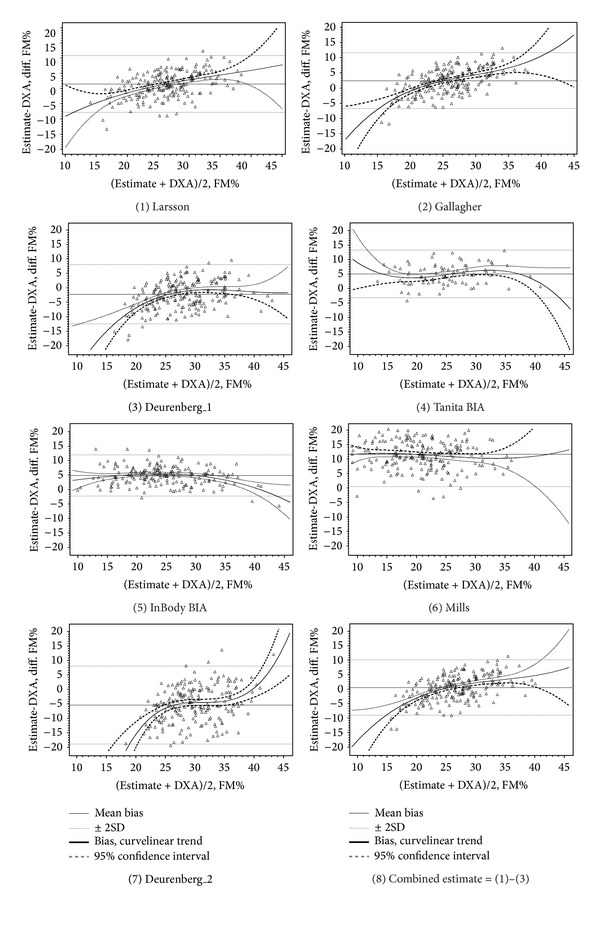
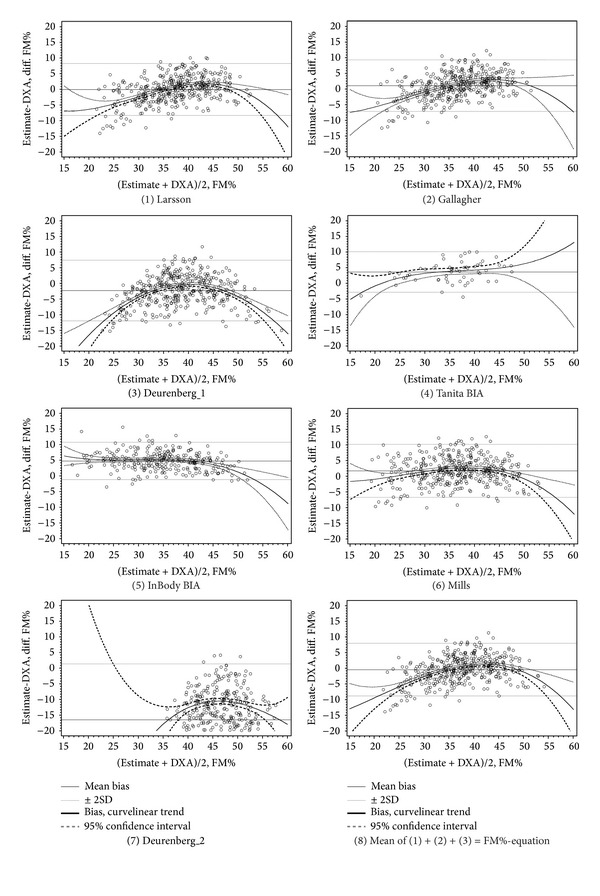
A study of 40-79-year-old male (n = 205) and female (n = 388) Finns. Weight, height, blood pressure, triacylglycerols, HDL cholesterol, and fasting blood glucose were measured. Body composition was assessed by DXA and BIA and a FM%-equation.
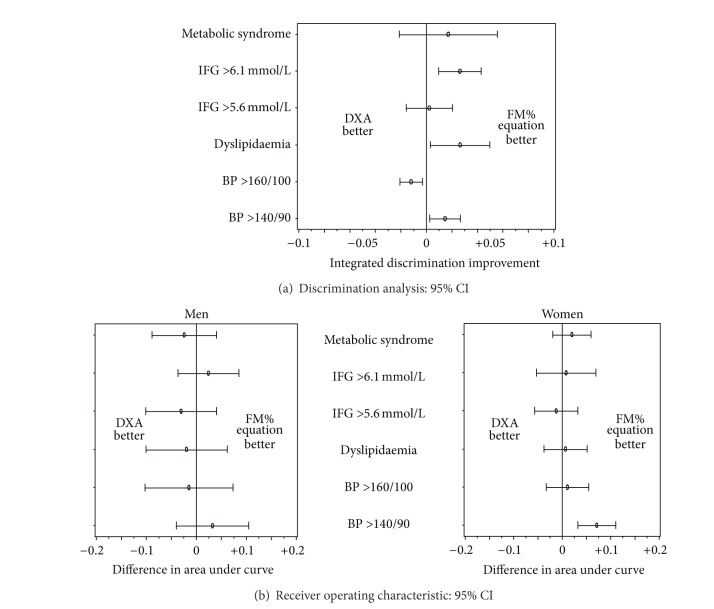
For grade 1 hypertension, dyslipidaemia, and impaired fasting glucose >6.1 mmol/L, the categories of obesity as defined by BMI and the FM% equation had 1.9% to 3.7% (P < 0.01) higher discriminative power compared to DXA. For grade 2 hypertension the FM% equation discriminated 1.2% (P = 0.05) lower than DXA and 2.8% (P < 0.01) lower than BIA. Receiver operation characteristics confirmed BIA as best predictor of grade 2 hypertension and the FM% equation as best predictor of grade 1 hypertension. All other differences in area under curve were small (≤0.04) and 95% confidence intervals included 0.
Both BMI and FM% equations may predict cardiometabolic risk with similar discriminative ability as FM% measured by DXA or BIA.
确定基于体重指数(BMI)和基于人体测量学的体脂百分比估计值(FM%方程)的肥胖类别,对于心脏代谢风险标志物的判别能力,是否与通过双能X线吸收法(DXA)或生物电阻抗分析(BIA)测量的体脂百分比相似。
对40至79岁的芬兰男性(n = 205)和女性(n = 388)进行研究。测量体重、身高、血压、三酰甘油、高密度脂蛋白胆固醇和空腹血糖。通过DXA、BIA和FM%方程评估身体成分。
对于1级高血压、血脂异常和空腹血糖受损>6.1 mmol/L,与DXA相比,由BMI和FM%方程定义的肥胖类别具有高1.9%至3.7%(P < 0.01)的判别能力。对于2级高血压,FM%方程的判别能力比DXA低1.2%(P = 0.05),比BIA低2.8%(P < 0.01)。受试者工作特征曲线证实BIA是2级高血压的最佳预测指标,FM%方程是1级高血压的最佳预测指标。曲线下面积的所有其他差异均较小(≤0.04),95%置信区间包含0。
BMI和FM%方程预测心脏代谢风险的判别能力,可能与通过DXA或BIA测量的FM%相似。