Fan Yu-Chen, Wang Na, Sun Yan-Yan, Xiao Xiao-Yan, Wang Kai
From the Department of Hepatology, Qilu Hospital of Shandong University, Jinan, China (Y-CF, NW, Y-YS, KW); Institute of Hepatology, Shandong University, Jinan, China (Y-CF, KW); and Department of Nephrology, Qilu Hospital of Shandong University, Jinan, China (X-YX).
Medicine (Baltimore). 2015 Sep;94(39):e1638. doi: 10.1097/MD.0000000000001638.
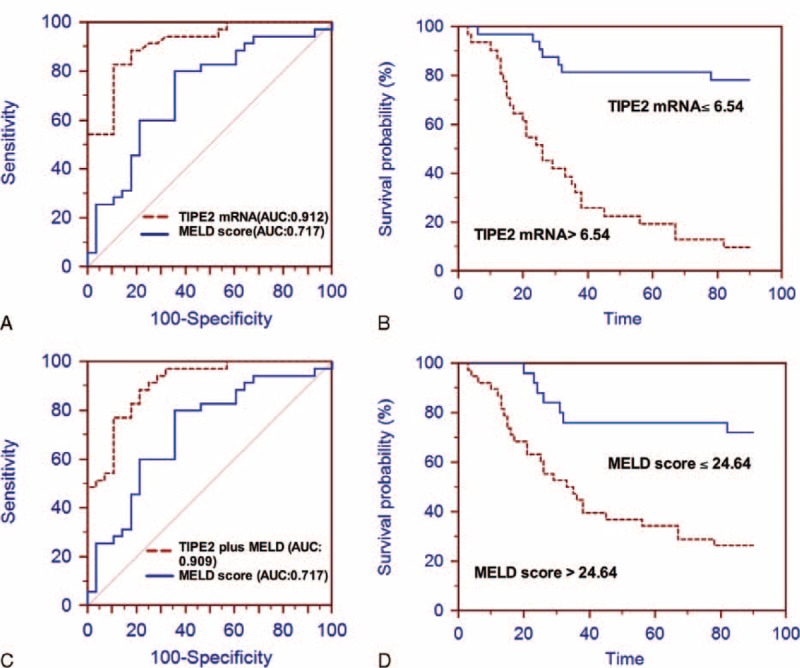
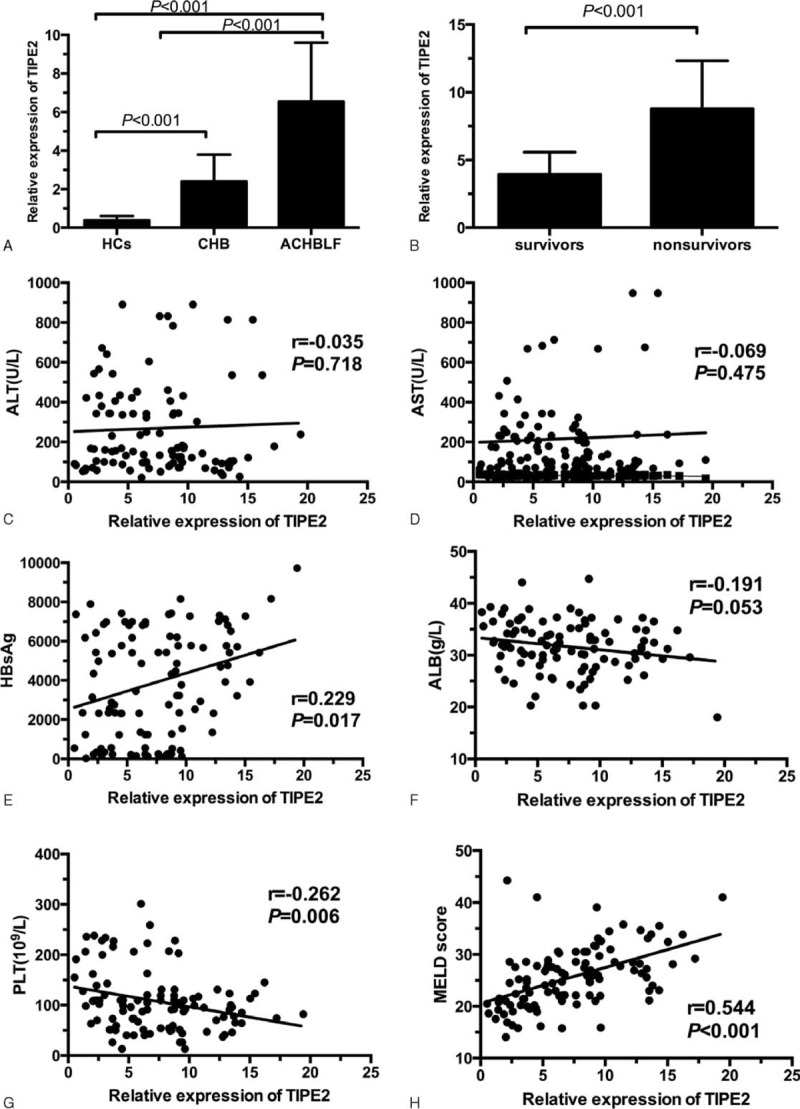
It remains difficult to accurately predicate short-term mortality of acute-on-chronic hepatitis B liver failure (ACHBLF). Tumor necrosis factor-α-induced protein 8-like 2 (TIPE2) is a novel identified negative regulator of immune response and we have previously demonstrated TIPE2 play an essential role in the pathogenesis of ACHBLF. We therefore aimed to evaluate the diagnosis value of TIPE2 mRNA in peripheral blood mononuclear cells (PBMCs) for predicting 3-month mortality of ACHBLF patients. This prospective study consisted of 108 ACHBLF patients from March 2009 to May 2013 as training cohort and 63 ACHBLF patients from June 2013 to December 2014 as validation cohort. Forty-two patients with chronic hepatitis B (CHB) and 22 healthy volunteers were also included as controls. The mRNA level of TIPE2 in PBMCs was determined using quantitative real-time polymerase chain reaction. Univariate analysis and Cox proportional hazard regression analysis were performed to identify independent risk factors to 3-month mortality. Area under the receptor operating characteristic curve (AUROC) was performed to assess diagnostic value of TIPE2 mRNA in training and validation cohort. The level of TIPE2 mRNA was significantly higher in ACHBLF patients (median (interquartile): 6.5 [3.7, 9.6]) compared with CHB (2.3 [1.6, 3.7]) and healthy controls (0.4 [0.3, 0.6]; both P < 0.05). Cox proportional hazards regression analyses showed 5 independent risk factors associated with 3-month mortality of ACHBLF: white blood cells (HR = 1.058, 95% CI: 1.023-1.095), spontaneous bacterial peritonitis (HR = 2.541, 95% CI: 1.378-4.686), hepatic encephalopathy (HR = 1.848, 95% CI: 1.028-3.321), model for end-stage liver diseases (MELD) score (HR = 1.062, 95% CI: 1.009-1.118), and TIPE2 mRNA (HR = 1.081, 95% CI: 1.009-1.159). An optimal cut-off point 6.54 of TIPE2 mRNA showed sensitivity of 74.63%, specificity of 90.24%, positive predictive value of 92.5%, and negative predictive value of 67.3% for predicting 3-month mortality in training cohort. Furthermore, TIPE2 mRNA plus MELD performed better than MELD alone for predicting 3-month mortality in training (AUROC, 0.853 vs 0.722, P < 0.05) and validation cohort (AUROC, 0.909 vs 0.717, P < 0.001). TIPE2 mRNA level might be a novel biomarker in predicting 3-month mortality of ACHBLF. Combination of TIPE2 mRNA and MELD would improve the diagnostic value of MELD alone in predicting 3-month mortality of patients with ACHBLF.
准确预测慢性乙型肝炎急性肝衰竭(ACHBLF)的短期死亡率仍然困难。肿瘤坏死因子-α诱导蛋白8样2(TIPE2)是新发现的免疫反应负调节因子,我们之前已证明TIPE2在ACHBLF发病机制中起重要作用。因此,我们旨在评估外周血单个核细胞(PBMC)中TIPE2 mRNA对预测ACHBLF患者3个月死亡率的诊断价值。这项前瞻性研究包括2009年3月至2013年5月的108例ACHBLF患者作为训练队列,以及2013年6月至2014年12月的63例ACHBLF患者作为验证队列。还纳入了42例慢性乙型肝炎(CHB)患者和22名健康志愿者作为对照。使用定量实时聚合酶链反应测定PBMC中TIPE2的mRNA水平。进行单因素分析和Cox比例风险回归分析以确定3个月死亡率的独立危险因素。绘制受试者工作特征曲线下面积(AUROC)以评估训练和验证队列中TIPE2 mRNA的诊断价值。与CHB患者(2.3 [1.6, 3.7])和健康对照(0.4 [0.3, 0.6];均P < 0.05)相比,ACHBLF患者的TIPE2 mRNA水平显著更高(中位数(四分位数间距):6.5 [3.7, 9.6])。Cox比例风险回归分析显示与ACHBLF患者3个月死亡率相关的5个独立危险因素:白细胞(HR = 1.058,95% CI:1.023 - 1.095)、自发性细菌性腹膜炎(HR = 2.541,95% CI:1.378 - 4.686)、肝性脑病(HR = 1.848,95% CI:1.028 - 3.321)、终末期肝病模型(MELD)评分(HR = 1.062,95% CI:1.009 - 1.118)和TIPE2 mRNA(HR = 1.081,95% CI:1.009 - 1.159)。TIPE2 mRNA的最佳截断值6.54对训练队列中预测3个月死亡率的敏感性为74.63%,特异性为90.24%,阳性预测值为92.5%,阴性预测值为67.3%。此外,在训练队列(AUROC,0.853对0.722,P < 0.05)和验证队列(AUROC,0.909对0.717,P < 0.001)中,TIPE2 mRNA加MELD在预测3个月死亡率方面比单独使用MELD表现更好。TIPE2 mRNA水平可能是预测ACHBLF患者3个月死亡率的新型生物标志物。TIPE2 mRNA与MELD联合使用将提高单独使用MELD预测ACHBLF患者3个月死亡率的诊断价值。