Lenz Heinz-Josef, Stintzing Sebastian, Loupakis Fotios
USC Norris Comprehensive Cancer Center, University of Southern California, 1441 Eastlake Avenue, NOR 3456, Los Angeles, CA 90089-9173, United States.
Department of Hematology and Oncology, University Hospital Grosshadern, University of Munich (LMU), Marchioninistrasse 15, 81377 Munich, Germany.
Cancer Treat Rev. 2015 Nov;41(9):777-83. doi: 10.1016/j.ctrv.2015.06.001. Epub 2015 Jun 6.
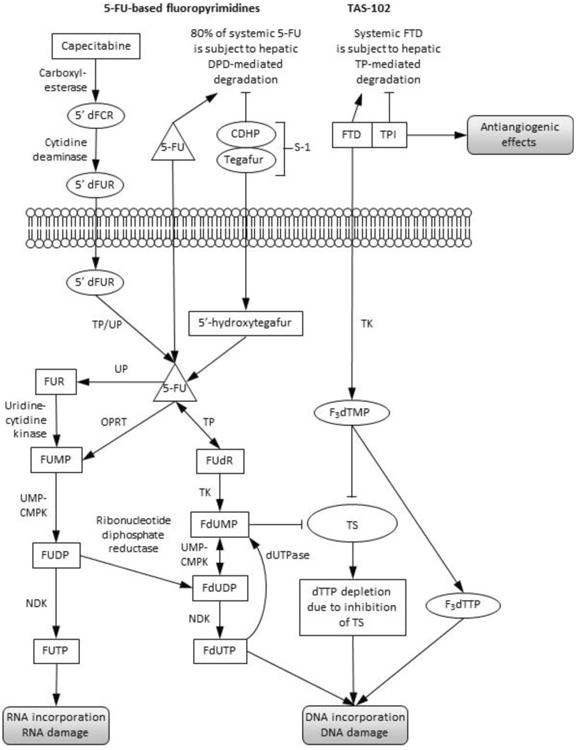
Inhibition of nucleoside metabolism is an important principle in cancer therapy as evidenced by the role of fluoropyrimidines, such as 5-fluorouracil (5-FU), and antifolates in the treatment of many cancers. TAS-102 is an oral combination therapy consisting of trifluridine (FTD), a thymidine-based nucleoside analog, plus tipiracil hydrochloride (TPI), a novel thymidine phosphorylase inhibitor that improves the bioavailability of FTD. TAS-102 has demonstrated efficacy in 5-FU-refractory patients based on a different mechanism of action and has been approved for the treatment of metastatic colorectal cancer in Japan. This review describes the mechanism of action of TAS-102, highlighting key differences between TAS-102 and 5-FU-based therapies. While both FTD and 5-FU inhibit thymidylate synthase (TS), a central enzyme in DNA synthesis, sufficient TS inhibition by FTD requires continuous infusion; therefore, it is not considered a clinically relevant mechanism with oral dosing. Instead, the primary cytotoxic mechanism with twice-daily oral dosing, the schedule used in TAS-102 clinical development, is DNA incorporation. FTD incorporation into DNA induces DNA dysfunction, including DNA strand breaks. Uracil-based analogs such as 5-FU may also be incorporated into DNA; however, they are immediately cleaved off by uracil-DNA glycosylases, reducing their ability to damage DNA. Moreover, the TPI component may enhance the durability of response to FTD. With its distinct mechanism of action and metabolism, TAS-102 is a promising treatment option for patients resistant to or intolerant of 5-FU-based fluoropyrimidines.
核苷代谢抑制是癌症治疗中的一项重要原则,氟嘧啶(如5-氟尿嘧啶(5-FU))和抗叶酸药物在多种癌症治疗中的作用就证明了这一点。TAS-102是一种口服联合疗法,由基于胸苷的核苷类似物三氟尿苷(FTD)加新型胸苷磷酸化酶抑制剂盐酸替匹嘧啶(TPI)组成,TPI可提高FTD的生物利用度。基于不同的作用机制,TAS-102已在对5-FU耐药的患者中显示出疗效,并已在日本获批用于治疗转移性结直肠癌。本综述描述了TAS-102的作用机制,强调了TAS-102与基于5-FU的疗法之间的关键差异。虽然FTD和5-FU都抑制胸苷酸合成酶(TS),这是DNA合成中的一种关键酶,但FTD要充分抑制TS需要持续输注;因此,口服给药时它不被认为是一种具有临床相关性的机制。相反,TAS-102临床研发中使用的每日两次口服给药方案的主要细胞毒性机制是DNA掺入。FTD掺入DNA会导致DNA功能障碍,包括DNA链断裂。基于尿嘧啶的类似物如5-FU也可能掺入DNA;然而,它们会立即被尿嘧啶-DNA糖基化酶切割掉,从而降低其损伤DNA的能力。此外,TPI成分可能会增强对FTD反应的持久性。由于其独特的作用机制和代谢方式,TAS-102对于对基于5-FU的氟嘧啶耐药或不耐受的患者来说是一种有前景的治疗选择。