Biehl Michelle, Kashyap Rahul, Ahmed Adil H, Reriani Martin K, Ofoma Uchenna R, Wilson Gregory A, Li Guangxi, Malinchoc Michael, Sloan Jeff A, Gajic Ognjen
Multidisciplinary Epidemiology and Translational Research in Intensive Care (METRIC) Group, Mayo Clinic, Rochester, MN, USA.
Department of Internal Medicine, Division of Pulmonary and Critical Care Medicine, Mayo Clinic, Rochester, MN, USA.
Crit Care. 2015 Oct 2;19:356. doi: 10.1186/s13054-015-1062-y.
The long-term attributable burden related to acute respiratory distress syndrome (ARDS) is not fully investigated. The aim of this study is to evaluate the quality of life (QOL) and functional status at 6 months after hospitalization in patients at risk for ARDS who did and did not develop the syndrome.
This is a population-based prospective cohort study of adult patients from Olmsted County, Minnesota, with or at risk for ARDS hospitalized from October 2008 to July 2011. The primary outcomes were changes in QOL and functional status, measured through 12-Item Short Form Survey (SF-12) and Barthel Index (BI) respectively, from baseline to 6 months, compared between survivors who did and did not develop ARDS.
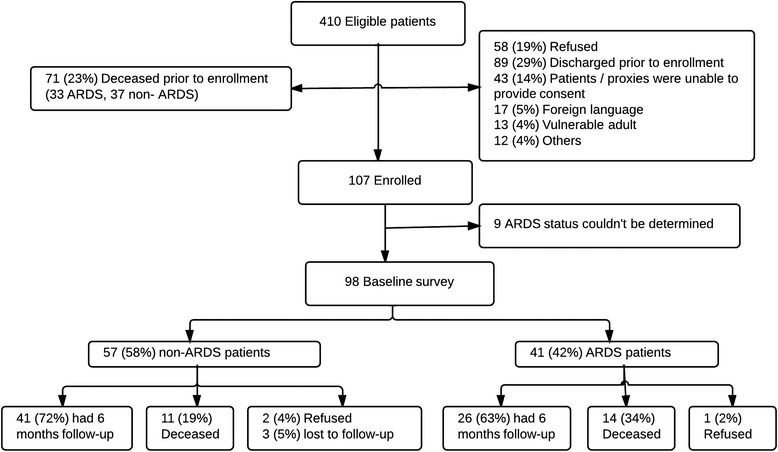
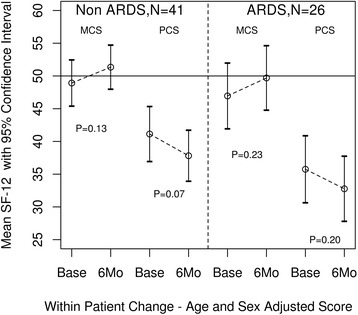
Of 410 patients with or at risk for ARDS, 98 had baseline surveys collected and 67 responded to a 6-month survey (26 ARDS, 41 non-ARDS). Both ARDS and non-ARDS groups had lower physical component of SF-12 at baseline compared to general population (P < 0.001 for both). ARDS patients had poorer baseline functional status compared to non-ARDS (mean BI 80 ± 25 vs. 88 ± 22, P = 0.03). No significant differences were observed for the change between 6 months and baseline BI (delta 2.3 for ARDS vs. 2.0 for non-ARDS, P = 0.5), or mental (delta 2.7 vs. 2.4, P = 0.9) or physical (delta -3 vs. -3.3, P = 0.9) component of SF-12 between survivors with and without ARDS.
In this population-based study, decreased QOL and functional status 6 months after hospitalization were largely explained by baseline condition, with similar recovery in survivors who did and did not develop ARDS.
与急性呼吸窘迫综合征(ARDS)相关的长期归因负担尚未得到充分研究。本研究的目的是评估发生和未发生ARDS综合征的ARDS风险患者在住院6个月后的生活质量(QOL)和功能状态。
这是一项基于人群的前瞻性队列研究,研究对象为2008年10月至2011年7月在明尼苏达州奥尔姆斯特德县住院的患有或有ARDS风险的成年患者。主要结局是通过12项简短形式调查(SF-12)和Barthel指数(BI)分别测量的从基线到6个月的QOL和功能状态变化,在发生和未发生ARDS的幸存者之间进行比较。
在410例患有或有ARDS风险的患者中,98例进行了基线调查,67例对6个月的调查做出了回应(26例ARDS,41例非ARDS)。与一般人群相比,ARDS组和非ARDS组在基线时SF-12的身体成分均较低(两组P均<0.001)。与非ARDS患者相比,ARDS患者的基线功能状态较差(平均BI 80±25 vs. 88±22,P = 0.03)。在发生和未发生ARDS的幸存者之间,6个月与基线BI的变化(ARDS组为2.3,非ARDS组为2.0,P = 0.5)、SF-12的心理成分变化(2.7 vs. 2.4,P = 0.9)或身体成分变化(-3 vs. -3.3,P = 0.9)均未观察到显著差异。
在这项基于人群的研究中,住院6个月后QOL和功能状态的下降在很大程度上由基线状况所解释,发生和未发生ARDS的幸存者恢复情况相似。