Bulut Mustafa, Deniz Acar Rezzan, Ergün Sunay, Geçmen Çetin, Akçakoyun Mustafa
Department of Cardiology, Kartal Kosuyolu Education and Research Hospital, Istanbul, Turkey.
Department of Physical Therapy and Rehabilitation, Kartal Kosuyolu Education and Research Hospital, Istanbul, Turkey.
J Cardiovasc Thorac Res. 2015;7(3):96-100. doi: 10.15171/jcvtr.2015.21.
We aimed to evaluate the effect of exercise-based cardiac rehabilitation (CR) on the fragmented QRS (fQRS) in patients with ST elevation myocardial infarction (STEMI).
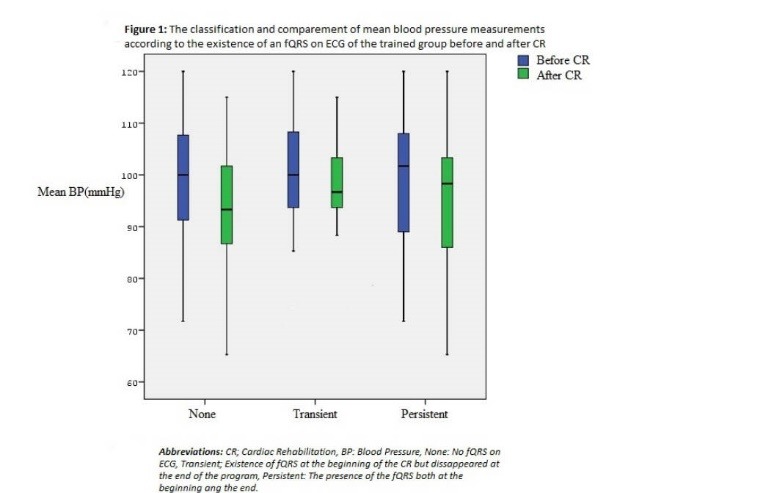
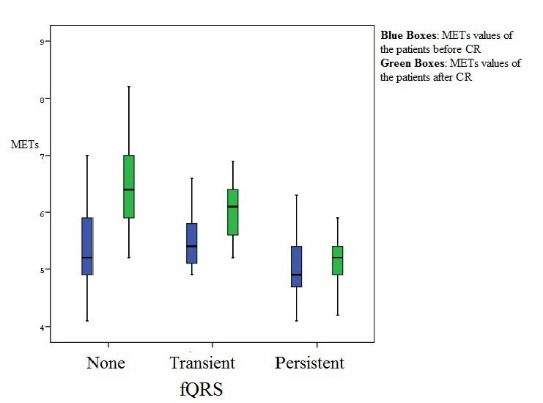
Ninety-seven patients with STEMI participated CR and 81 patients as a control group were included to the study. The trained patients were grouped according to the presence and persistence of QRS fragmentation on the electrocardiogram (ECG) before and after CR. If the fragmentation was present on the ECG at the beginning of the CR but not on the ECG at the end of CR; the transient group, if the fQRS persists after CR; the persistent fQRS group. ECGs obtained from the control group were grouped according to the presence of a fQRS on ECG.
Among the trained patients, 45 (46%) did not have a fQRS before CR, whereas 52 (54%) presented a fQRS before CR, which was persistent in 35 patients (the persistent fQRS group) and transient in 17 patients (the transient fQRS group). Among 81 patients included in the control group, fQRS was persistent in 41 patients. Presence of fQRS on the ECG was significantly decreased with CR and it is better in trained group than the control group (P = .034). There were not significant correlations with other characteristics, except hypertension.
The existence of the fQRS decreases after CR in patients with STEMI especially in hypertensive individuals, which may be related to improved electrical stability in the myocardium as a predictor of increase in survival and decrease in major cardiac events.
我们旨在评估运动心脏康复(CR)对ST段抬高型心肌梗死(STEMI)患者碎裂QRS波(fQRS)的影响。
97例STEMI患者参与心脏康复,81例患者作为对照组纳入研究。根据心脏康复前后心电图(ECG)上QRS波碎裂的存在情况和持续情况对接受训练的患者进行分组。如果在心脏康复开始时心电图上存在碎裂,但在心脏康复结束时心电图上不存在;则为短暂组,如果心脏康复后fQRS持续存在;则为持续性fQRS组。根据心电图上是否存在fQRS对从对照组获得的心电图进行分组。
在接受训练的患者中,45例(46%)在心脏康复前没有fQRS,而52例(54%)在心脏康复前出现fQRS,其中35例持续存在(持续性fQRS组),17例短暂存在(短暂性fQRS组)。在纳入对照组的81例患者中,41例fQRS持续存在。心脏康复后,心电图上fQRS的出现明显减少,训练组比对照组更好(P = 0.034)。除高血压外,与其他特征无显著相关性。
STEMI患者尤其是高血压患者在心脏康复后fQRS的存在减少,这可能与心肌电稳定性改善有关,可作为生存率增加和主要心脏事件减少的预测指标。