Anderson A, McMullan R
Department of Life Sciences; Imperial College London; South Kensington Campus ; London, UK.
Worm. 2014 Oct 30;3(3):e959425. doi: 10.4161/21624046.2014.959425. eCollection 2014 Jul-Sep.
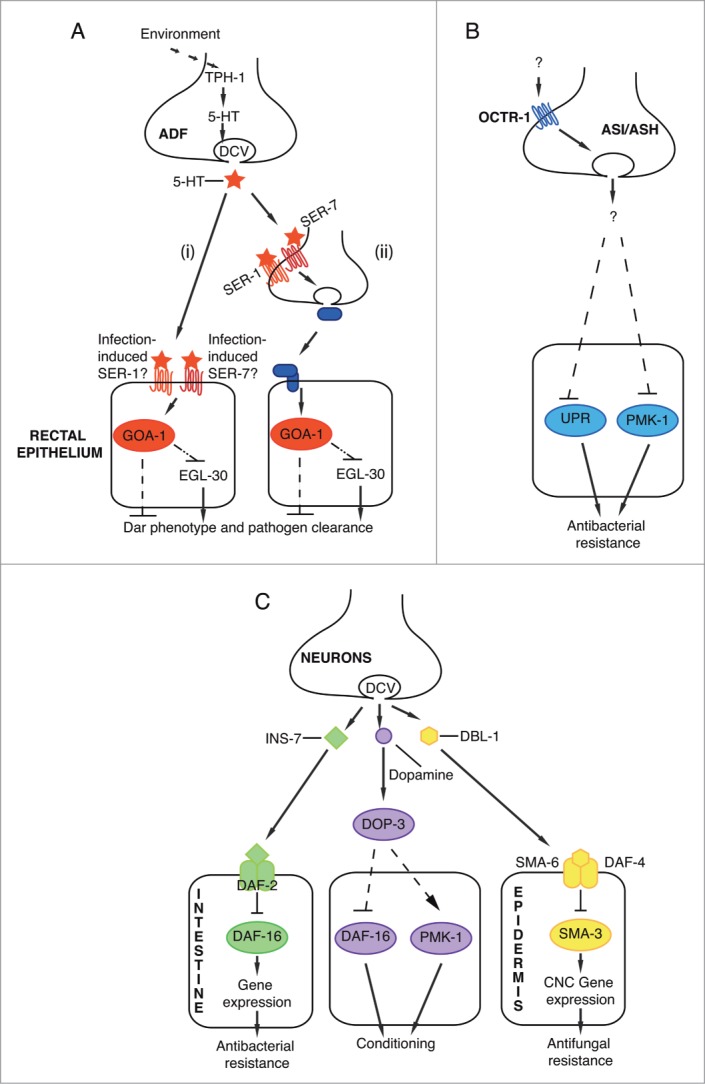
Animals need to be able to rapidly and effectively respond to changes in their external and internal environment. To achieve this the nervous and immune systems need to coordinate their responses, integrating multiple cues including presence of potential pathogens, and availability of food. In our recent study (1) we demonstrate that signaling by sensory neurons in the head using the classical neurotransmitter serotonin can negatively regulate the rectal epithelial immune response upon infection of C. elegans with the naturally occurring bacterial pathogen Microbacterium nematophilum (M. nematophilum). The complicated nature of the mammalian brain and immune system has made it difficult to identify the molecular mechanisms mediating these interactions. With its simple, well described, nervous system and a rapidly growing understanding of its immune system, C. elegans has emerged as an excellent model to study the mechanisms by which animals recognize pathogens and coordinate behavioral and cellular immune responses to infection.
动物需要能够快速且有效地应对其外部和内部环境的变化。为实现这一点,神经系统和免疫系统需要协调它们的反应,整合多种线索,包括潜在病原体的存在以及食物的可获得性。在我们最近的研究中(1),我们证明,秀丽隐杆线虫被天然存在的细菌病原体嗜线虫微杆菌(M. nematophilum)感染后,头部感觉神经元利用经典神经递质血清素发出的信号可对直肠上皮免疫反应产生负调控作用。哺乳动物大脑和免疫系统的复杂性使得确定介导这些相互作用的分子机制变得困难。秀丽隐杆线虫具有简单且描述详尽的神经系统,并且对其免疫系统的了解也在迅速增加,它已成为研究动物识别病原体以及协调对感染的行为和细胞免疫反应机制的优秀模型。