Hou Nicole S, Taubert Stefan
Centre for Molecular Medicine and Therapeutics and Child & Family Research Institute ; Vancouver, BC, Canada.
Centre for Molecular Medicine and Therapeutics and Child & Family Research Institute ; Vancouver, BC, Canada ; Department of Medical Genetics; University of British Columbia ; Vancouver, BC, Canada.
Worm. 2014 Oct 30;3(3):e962405. doi: 10.4161/21624046.2014.962405. eCollection 2014 Jul-Sep.
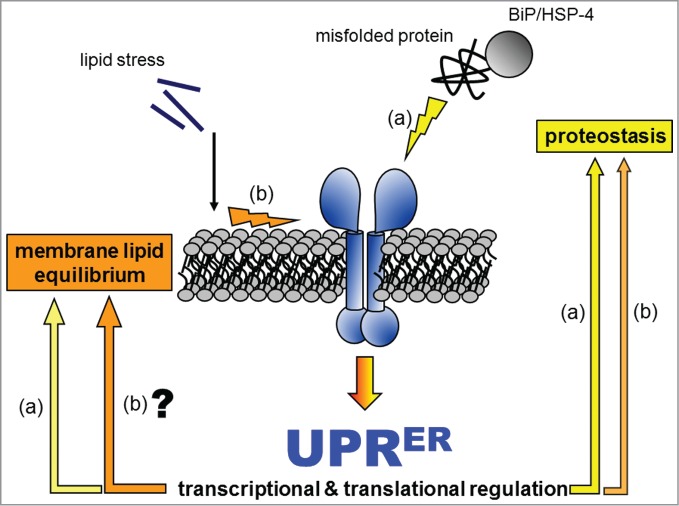
The unfolded protein response of the endoplasmic reticulum (UPR(ER)) is a conserved signaling circuit that ensures ER protein homeostasis (proteostasis). In the UPR(ER) of higher eukaryotes, multiple sensors cooperatively perceive proteostatic disturbances in the ER lumen and induce downstream adaptive changes. Besides direct proteotoxic insults, altered lipid profiles can also lead to UPR(ER) activation, evidently because abnormal lipid composition impairs protein folding. However, 2 recent studies propose an alternative mechanism of UPR(ER) sensor activation. In one report, UPR(ER) activation occurred in cells expressing UPR(ER) sensors lacking the very domains that sense unfolded proteins; the other study found that Caenorhabditis elegans worms displayed UPR(ER) activation without apparent proteostatic imbalance in the ER lumen. Collectively, these studies suggest that lipid disequilibrium-activated UPR(ER) is not strictly accompanied by compromised ER proteostasis and hint at a lipid membrane-monitoring role of the UPR(ER). These discoveries raise several important questions: does the UPR(ER) monitor and maintain homeostasis of the ER membrane and/or its lipids? In turn, does the UPR(ER) initiate downstream regulatory events that specifically alleviate lipid or proteostatic imbalance? And what is the physiological significance of proteostasis-independent UPR(ER) activation? In this commentary, we will discuss these issues and highlight the utility of C. elegans as an in vivo model to study lipid disequilibrium-induced UPR(ER) and related pathways.
内质网的未折叠蛋白反应(UPR(ER))是一种保守的信号传导通路,可确保内质网蛋白质稳态(蛋白稳态)。在高等真核生物的UPR(ER)中,多种传感器协同感知内质网腔中的蛋白稳态紊乱,并诱导下游适应性变化。除了直接的蛋白毒性损伤外,脂质谱的改变也可导致UPR(ER)激活,显然是因为异常的脂质组成会损害蛋白质折叠。然而,最近的两项研究提出了UPR(ER)传感器激活的另一种机制。在一份报告中,UPR(ER)激活发生在表达缺乏感知未折叠蛋白结构域的UPR(ER)传感器的细胞中;另一项研究发现,秀丽隐杆线虫在没有明显内质网腔蛋白稳态失衡的情况下表现出UPR(ER)激活。总体而言,这些研究表明,脂质失衡激活的UPR(ER)并不严格伴随着内质网蛋白稳态受损,并暗示了UPR(ER)对脂质膜的监测作用。这些发现提出了几个重要问题:UPR(ER)是否监测并维持内质网膜及其脂质的稳态?反过来,UPR(ER)是否启动了专门缓解脂质或蛋白稳态失衡的下游调节事件?以及不依赖蛋白稳态的UPR(ER)激活的生理意义是什么?在这篇评论中,我们将讨论这些问题,并强调秀丽隐杆线虫作为研究脂质失衡诱导的UPR(ER)及相关通路的体内模型的实用性。