Pintus Eliana, Ros-Santaella José Luis, Garde José Julián
Department of Veterinary Clinics and Pathology, Faculty of Veterinary Medicine, University of Sassari, Sassari, Italy; Department of Veterinary Sciences, Faculty of Agrobiology, Food and Natural Resources, Czech University of Life Sciences, Prague, Czech Republic.
Department of Animal Science and Food Processing, Faculty of Tropical AgriSciences, Czech University of Life Sciences, Prague, Czech Republic.
PLoS One. 2015 Oct 2;10(10):e0139240. doi: 10.1371/journal.pone.0139240. eCollection 2015.
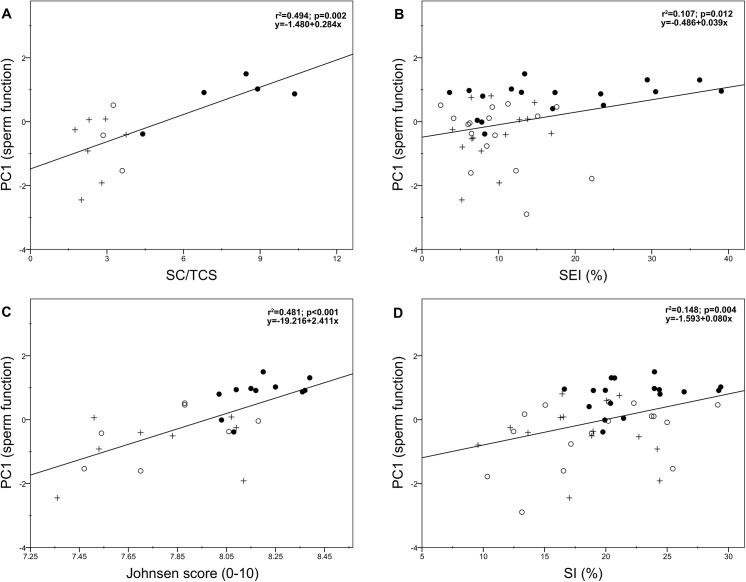
Spermatogenesis is a costly process that is expected to be under selection to maximise sperm quantity and quality. Testis size is often regarded as a proxy measure of sperm investment, implicitly overlooking the quantitative assessment of spermatogenesis. An enhanced understanding of testicular function, beyond testis size, may reveal further sexual traits involved in sperm quantity and quality. Here, we first estimated the inter-male variation in testicular function and sperm traits in red deer across the breeding and non-breeding seasons. Then, we analysed the relationships between the testis mass, eight parameters of spermatogenic function, and seven parameters of sperm quality. Our findings revealed that the Sertoli cell number and function parameters vary greatly between red deer males, and that spermatogenic activity co-varies with testis mass and sperm quality across the breeding and non-breeding seasons. For the first time in a seasonal breeder, we found that not only is the Sertoli cell number important in determining testis mass (r = 0.619, p = 0.007 and r = 0.248, p = 0.047 for the Sertoli cell number assessed by histology and cytology, respectively), but also sperm function (r = 0.703, p = 0.002 and r = 0.328, p = 0.012 for the Sertoli cell number assessed by histology and cytology, respectively). Testicular histology also revealed that a high Sertoli cell number per tubular cross-section is associated with high sperm production (r = 0.600, p = 0.009). Sperm production and function were also positively correlated (r = 0.384, p = 0.004), suggesting that these traits co-vary to maximise sperm fertilisation ability in red deer. In conclusion, our findings contribute to the understanding of the dynamics of spermatogenesis, and reveal new insights into the role of testicular function and the Sertoli cell number on testis size and sperm quality in red deer.
精子发生是一个消耗巨大的过程,有望通过选择来实现精子数量和质量的最大化。睾丸大小常被视为精子投入的替代指标,这在一定程度上忽略了对精子发生的定量评估。对睾丸功能的深入理解,而非仅仅局限于睾丸大小,可能会揭示出更多与精子数量和质量相关的性特征。在此,我们首先估算了马鹿在繁殖季节和非繁殖季节雄性个体之间睾丸功能和精子特征的差异。然后,我们分析了睾丸质量、精子发生功能的八个参数以及精子质量的七个参数之间的关系。我们的研究结果表明,马鹿雄性个体之间支持细胞数量和功能参数差异很大,并且在繁殖季节和非繁殖季节,精子发生活动与睾丸质量和精子质量共同变化。在季节性繁殖动物中,我们首次发现,支持细胞数量不仅对确定睾丸质量很重要(通过组织学和细胞学评估的支持细胞数量,其相关系数分别为r = 0.619,p = 0.007和r = 0.248,p = 0.047),而且对精子功能也很重要(通过组织学和细胞学评估的支持细胞数量,其相关系数分别为r = 0.703,p = 0.002和r = 0.328,p = 0.012)。睾丸组织学还显示,每个管状横截面上较高的支持细胞数量与较高的精子产量相关(r = 0.600,p = 0.009)。精子产量和功能也呈正相关(r = 0.384,p = 0.004),这表明这些特征共同变化以最大化马鹿精子的受精能力。总之,我们的研究结果有助于理解精子发生的动态过程,并揭示了睾丸功能和支持细胞数量在马鹿睾丸大小和精子质量方面作用的新见解。