López Dioxelis, Cherigo Lilia, Spadafora Carmenza, Loza-Mejía Marco A, Martínez-Luis Sergio
Center for Drug Discovery and Biodiversity, Institute for Scientific Research and Technology Services (INDICASAT), Clayton, P.O. Box 0843-01103, Panama City, Republic of Panama ; Department of Biotechnology, Acharya Nagarjuna University, Nagarjuna Nagar, Guntur, 522510 India.
Department of Organic Chemistry, Chemistry School, Faculty of Natural Sciences, Exact and Technology, University of Panama, P.O. Box 3366, Panama City, Republic of Panama.
Chem Cent J. 2015 Sep 28;9(1):53. doi: 10.1186/s13065-015-0130-3. eCollection 2015 Dec.
Panama has an extensive mangrove area and it is one of the countries with the highest biodiversity in America. Mangroves are widely used in traditional medicine, nevertheless, there are very few studies that validates their medicinal properties in America. Given the urgent need for therapeutic options to treat several diseases of public health importance, mangrove ecosystem could be an interesting source of new bioactive molecules. This study was designed to evaluate the potential of as a source of bioactive compounds.
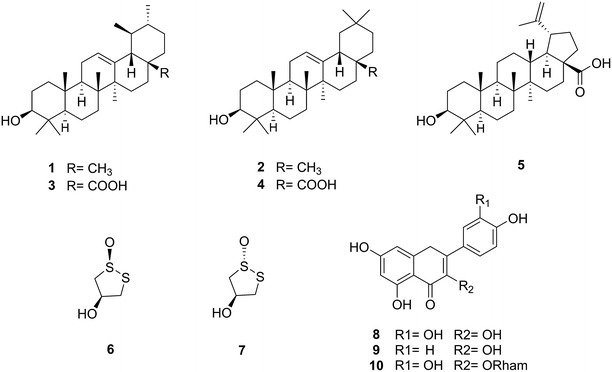
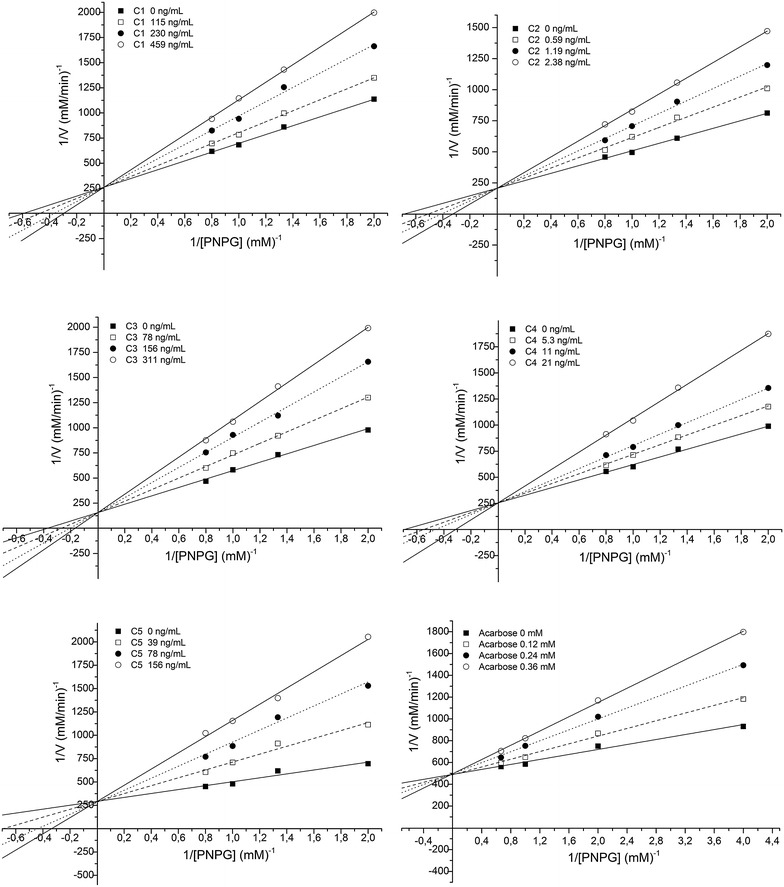
The present investigation was undertaken to explore the possible antiparasitic potential and α-glucosidase inhibition by compounds derived from the Panamanian mangrove . Bioassay-guided fractionation of the crude extract led to the isolation of ten chemical compounds: α-amyrine (), β-amyrine (), ursolic acid (), oleanolic acid (), betulinic acid (), brugierol () iso-brugierol (), kaempferol (), quercetin (), and quercetrin (). The structures of these compounds were established by spectroscopic analyses including APCI-HR-MS and NMR. Compounds (IC = 5.3 µM), (IC = 22.9 µM) and (IC = 3.4 µM) showed selective antiparasitic activity against , while compounds (IC = 19.0 µM) and (IC = 18.0 µM) exhibited selectivity against and , respectively. Moreover, compounds - inhibited α-glucosidase enzyme in a concentration-dependent manner with IC values of 1.45, 0.02, 1.08, 0.98 and 2.37 µM, respectively. Their inhibitory activity was higher than that of antidiabetic drug acarbose (IC 217.7 µM), used as a positive control. Kinetic analysis established that the five compounds acted as competitive inhibitors. Docking analysis predicted that all triterpenes bind at the same site that acarbose in the human intestinal α-glucosidase (PDB: 3TOP).
Three groups of compounds were isolated in this study (triterpenes, flavonols and dithiolanes). Triterpenes and flavones showed activity in at least one bioassay (antiparasitic or α-glucosidase). In addition, only the pentacyclic triterpenes exhibited a competitive type of inhibition against α-glucosidase.
巴拿马拥有广阔的红树林区域,是美洲生物多样性最高的国家之一。红树林在传统医学中被广泛应用,然而,在美国,验证其药用特性的研究却非常少。鉴于迫切需要治疗具有公共卫生重要性的多种疾病的治疗选择,红树林生态系统可能是新生物活性分子的一个有趣来源。本研究旨在评估[具体红树林名称]作为生物活性化合物来源的潜力。
本研究旨在探索巴拿马红树林衍生化合物的可能抗寄生虫潜力和α - 葡萄糖苷酶抑制作用。对粗提物进行生物测定导向的分离,得到了十种化合物:α - 香树脂醇()、β - 香树脂醇()、熊果酸()、齐墩果酸()、桦木酸()、布鲁吉醇()、异布鲁吉醇()、山柰酚()、槲皮素()和槲皮苷()。通过包括APCI - HR - MS和NMR在内的光谱分析确定了这些化合物的结构。化合物[具体化合物编号1](IC₅₀ = 5.3 μM)、[具体化合物编号2](IC₅₀ = 22.9 μM)和[具体化合物编号3](IC₅₀ = 3.4 μM)对[寄生虫名称1]表现出选择性抗寄生虫活性,而化合物[具体化合物编号4](IC₅₀ = 19.0 μM)和[具体化合物编号5](IC₅₀ = 18.0 μM)分别对[寄生虫名称2]和[寄生虫名称3]表现出选择性。此外,化合物[具体化合物编号6 - 10]以浓度依赖方式抑制α - 葡萄糖苷酶,IC₅₀值分别为1.45、0.02、1.08、0.98和2.37 μM。它们的抑制活性高于用作阳性对照的抗糖尿病药物阿卡波糖(IC₅₀ 217.7 μM)。动力学分析确定这五种化合物为竞争性抑制剂。对接分析预测所有三萜类化合物与人肠道α - 葡萄糖苷酶(PDB:3TOP)中阿卡波糖结合的位点相同。
本研究分离出了三组化合物(三萜类、黄酮醇类和二硫杂环戊烷类)。三萜类和黄酮类在至少一种生物测定(抗寄生虫或α - 葡萄糖苷酶)中表现出活性。此外,只有五环三萜类对α - 葡萄糖苷酶表现出竞争性抑制类型。