Eisenberg Ian W, Wallace Gregory L, Kenworthy Lauren, Gotts Stephen J, Martin Alex
Laboratory of Brain and Cognition, National Institute of Mental Health, Bethesda, MD USA.
Laboratory of Brain and Cognition, National Institute of Mental Health, Bethesda, MD USA ; Department of Speech and Hearing Sciences, The George Washington University, Washington, DC USA.
Mol Autism. 2015 Oct 1;6:54. doi: 10.1186/s13229-015-0047-7. eCollection 2015.
Autism spectrum disorder (ASD) is characterized by atypical development of cortical and subcortical gray matter volume. Subcortical structural changes have been associated with restricted and repetitive behavior (RRB), a core component of ASD. Behavioral studies have identified insistence on sameness (IS) as a separable RRB dimension prominent in high-functioning ASD, though no simple brain-behavior relationship has emerged. Structural covariance, a measure of morphological coupling among brain regions using magnetic resonance imaging (MRI), has proven an informative measure of anatomical relationships in typical development and neurodevelopmental disorders. In this study, we use this measure to characterize the relationship between brain structure and IS.
We quantified the structural covariance of cortical and subcortical gray matter volume in 55 individuals with high-functioning ASD using 3T MRI. We then related these structural metrics to individual IS scores, as assessed by the Repetitive Behavior Scale-Revised (RBS-R).
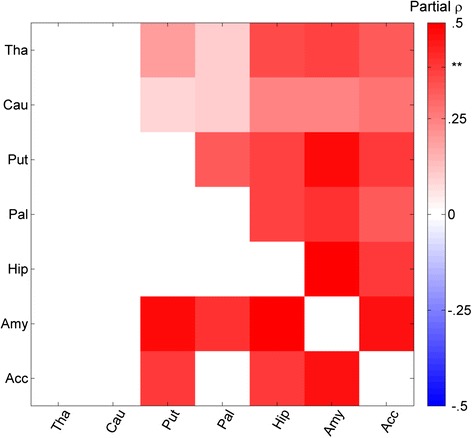
We found that increased coupling among subcortical regions and between subcortical and cortical regions related to greater IS symptom severity. Most pronounced, the striatum and amygdala participated in a plurality of identified relationships, indicating a central role for these structures in IS symptomatology. These structural associations were specific to IS and did not relate to any of the other RRB subcomponents measured by the RBS-R.
This study indicates that behavioral dimensions in ASD can relate to the coordination of development across multiple brain regions, which might be otherwise obscured using typical brain-behavior correlations. It also expands the structures traditionally related to RRB in ASD and provides neuroanatomical evidence supportive of IS as a separate RRB dimension.
ClinicalTrials.gov NCT01031407.
自闭症谱系障碍(ASD)的特征是皮质和皮质下灰质体积的非典型发育。皮质下结构变化与ASD的核心组成部分——受限的重复行为(RRB)有关。行为学研究已将坚持一致性(IS)确定为高功能ASD中突出的一个可分离的RRB维度,不过尚未出现简单的脑-行为关系。结构协方差是一种利用磁共振成像(MRI)测量脑区之间形态耦合的方法,已被证明是一种了解典型发育和神经发育障碍中解剖学关系的有效手段。在本研究中,我们使用这种方法来描述脑结构与IS之间的关系。
我们使用3T MRI对55名高功能ASD个体的皮质和皮质下灰质体积的结构协方差进行了量化。然后,我们将这些结构指标与通过重复行为量表修订版(RBS-R)评估的个体IS得分相关联。
我们发现皮质下区域之间以及皮质下与皮质区域之间耦合增加与更严重的IS症状相关。最显著的是,纹状体和杏仁核参与了多个已确定的关系,表明这些结构在IS症状学中起核心作用。这些结构关联特定于IS,与RBS-R测量的任何其他RRB子成分均无关。
本研究表明,ASD中的行为维度可能与多个脑区发育的协调性有关,而使用典型的脑-行为相关性可能会掩盖这种关系。它还扩展了传统上与ASD中RRB相关的结构,并提供了支持将IS作为一个单独的RRB维度的神经解剖学证据。
ClinicalTrials.gov NCT01031407。