Pal Uttam, Pramanik Sumit Kumar, Bhattacharya Baisali, Banerji Biswadip, Maiti Nakul Chandra
Structural Biology and Bioinformatics Division, Council of Scientific and Industrial Research (CSIR)-Indian Institute of Chemical Biology (IICB), Kolkata, West Bengal India.
Chemistry Division, Council of Scientific and Industrial Research (CSIR)-Indian Institute of Chemical Biology (IICB), Kolkata, West Bengal India.
Springerplus. 2015 Sep 24;4:548. doi: 10.1186/s40064-015-1333-8. eCollection 2015.
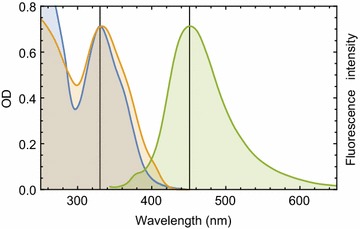
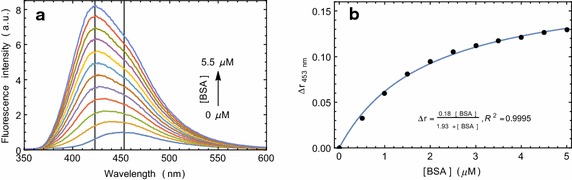
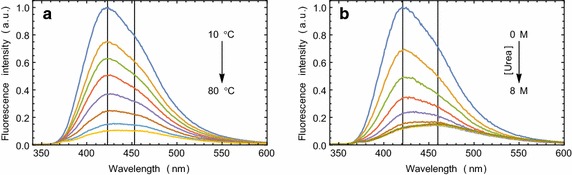
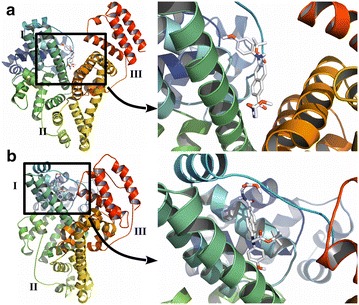
Fluorescence emission and anisotropy are widely used to measure the binding parameters and kinetic behavior of reactions that cause a change in the rotational time of a fluorescent molecule. We report here fluorescence emission and anisotropy behavior of a newly synthesized novel naphthalene base fluorophore (methyl 3-[(6-{[2-(tert-butoxy)-2-oxoethyl] (4-methoxyphenyl)amino}naphthalen-2-yl)formamido]propanoate) in several solution conditions including its binding to human and bovine serum albumin proteins both in their native and denatured states. The fluorescence yield of the compound substantially increased inside hydrophobic protein surface and ~30 nm decrease in Stokes' shift, compared to aqueous solution, was observed. Shift in fluorescence excitation peak position from the absorption peak of the molecule was ~8 nm in protein solution. This indicated possible alteration of excited state geometry of the compound by the globular fold of albumins. In addition, we measured the steady state fluorescence anisotropy of the molecule to evaluate several thermodynamic parameters and the results suggested the binding was energetically favorable. The measured ΔG° was ~-30 kJ mol(-1) and the derived dissociation constant was ~10(-6) M. The molecular docking analysis further highlighted the nonspecific association of the compound with the proteins and hydrophobic forces may have a significant role in the binding processes. Under the denatured condition of the protein, the compound lost its binding efficacy and reduction in fluorescence intensity was observed. Thus, the molecule appears as a new fluorescence probe to report the nature of its binding site in terms of increased fluorescence quantum yield and decreased Stokes' shift. It can also report the changes in the binding site due to global change in protein structure such as unfolding/misfolding often linked to several human disorder. Further it could be useful to detect and study the drug binding site of specific protein of interest.
荧光发射和各向异性被广泛用于测量导致荧光分子旋转时间发生变化的反应的结合参数和动力学行为。我们在此报告一种新合成的新型萘基荧光团(3 - [(6 - {[2 - (叔丁氧基)-2 - 氧代乙基](4 - 甲氧基苯基)氨基}萘 - 2 - 基)甲酰胺基]丙酸甲酯)在几种溶液条件下的荧光发射和各向异性行为,包括其与天然和变性状态下的人血清白蛋白和牛血清白蛋白的结合。与水溶液相比,该化合物在疏水蛋白质表面内的荧光产率大幅增加,并且观察到斯托克斯位移降低了约30 nm。在蛋白质溶液中,荧光激发峰位置相对于分子吸收峰的位移约为8 nm。这表明白蛋白的球状折叠可能改变了该化合物的激发态几何结构。此外,我们测量了该分子的稳态荧光各向异性以评估几个热力学参数,结果表明这种结合在能量上是有利的。测得的ΔG°约为 - 30 kJ·mol⁻¹,推导得到的解离常数约为10⁻⁶ M。分子对接分析进一步突出了该化合物与蛋白质的非特异性结合,疏水作用力可能在结合过程中起重要作用。在蛋白质的变性条件下,该化合物失去其结合效力,并观察到荧光强度降低。因此,该分子似乎是一种新的荧光探针,可根据荧光量子产率增加和斯托克斯位移减小来报告其结合位点的性质。它还可以报告由于蛋白质结构的整体变化(如通常与几种人类疾病相关的展开/错误折叠)导致的结合位点变化。此外,它可能有助于检测和研究感兴趣的特定蛋白质的药物结合位点。