• 文献检索
  • 文档翻译
  • 深度研究
  • 学术资讯
  • Suppr Zotero 插件Zotero 插件
  • 邀请有礼
  • 套餐&价格
  • 历史记录
应用&插件
Suppr Zotero 插件Zotero 插件浏览器插件Mac 客户端Windows 客户端微信小程序
定价
高级版会员购买积分包购买API积分包
服务
文献检索文档翻译深度研究API 文档MCP 服务
关于我们
关于 Suppr公司介绍联系我们用户协议隐私条款
关注我们

Suppr 超能文献

核心技术专利:CN118964589B侵权必究
粤ICP备2023148730 号-1Suppr @ 2026

文献检索

告别复杂PubMed语法,用中文像聊天一样搜索,搜遍4000万医学文献。AI智能推荐,让科研检索更轻松。

立即免费搜索

文件翻译

保留排版,准确专业,支持PDF/Word/PPT等文件格式,支持 12+语言互译。

免费翻译文档

深度研究

AI帮你快速写综述,25分钟生成高质量综述,智能提取关键信息,辅助科研写作。

立即免费体验

从南非急诊科就诊患者身上采集的血培养样本是一种重要的抗生素管理工具,它直接影响患者的治疗。

Blood cultures taken from patients attending emergency departments in South Africa are an important antibiotic stewardship tool, which directly influences patient management.

作者信息

Boyles Tom H, Davis Kelly, Crede Thomas, Malan Jacques, Mendelson Marc, Lesosky Maia

机构信息

Division of Infectious Diseases and HIV Medicine, Department of Medicine, Groote Schuur Hospital, University of Cape Town, Observatory, 7925, Cape Town, South Africa.

University of Texas Southwestern Medical Center, Dallas, TX, USA.

出版信息

BMC Infect Dis. 2015 Oct 6;15:410. doi: 10.1186/s12879-015-1127-1.

DOI:10.1186/s12879-015-1127-1
PMID:26437651
原文链接:https://pmc.ncbi.nlm.nih.gov/articles/PMC4594638/
Abstract

BACKGROUND

Febrile illness with suspected blood stream infection (BSI) is a common reason for admission to hospital in Africa and blood cultures are therefore an important investigation. Data on the prevalence and causes of community acquired BSI in Africa are scarce and there are no studies from South Africa. There are no validated clinical prediction rules for use of blood cultures in Africa.

METHODS

A prospective observational cohort study of patients attending 2 urban emergency departments in Cape Town, South Africa. The decision to take a blood culture was made by the attending clinician and information available at the time of blood draw was collected. Bottles were weighed to measure volume of blood inoculated.

RESULTS

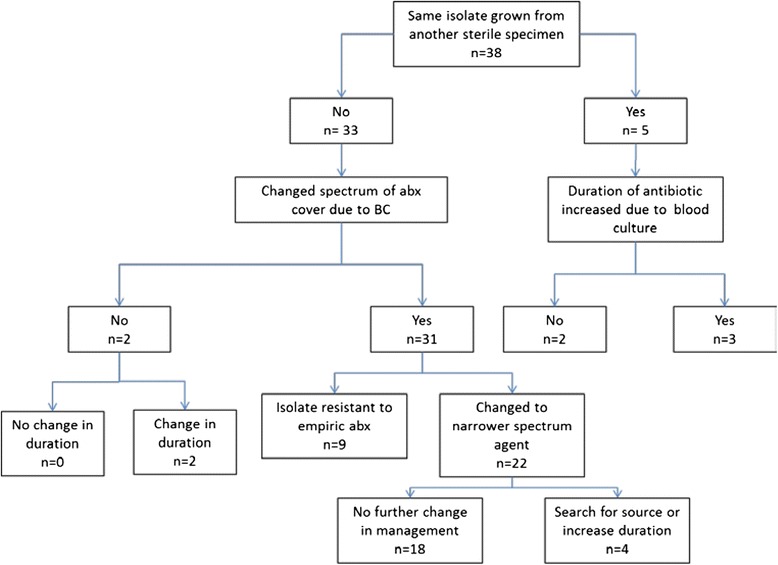
500 blood culture sets were obtained from 489 patients. 39 (7.8 %) were positive for pathogens and 13 (2.6 %) for contaminants. Significant independent predictors of positive cultures were diastolic blood pressure <60 mmHg, pulse >120 bpm, diabetes and a suspected biliary source of infection, but not HIV infection. Positive results influenced patient management in 36 of 38 (95 %) cases with the organism being resistant to the chosen empiric antibiotic in 9 of 38 (24 %). Taking <8 ml of blood was predictive of a negative culture. The best clinical prediction rule had a negative predictive value (NPV) of 92 % which is unlikely to be high enough to be clinically useful.

DISCUSSION

Blood cultures taken from patients attending emergency departments in a high HIV prevalent city in South Africa are frequently positive and almost always influence patient management. At least 8 ml of blood should be inoculated into each bottle.

CONCLUSION

Blood cultures should be taken from all patients attending EDs in South Africa suspected of having BSI particularly if diabetic, with hypotension, tachycardia or if biliary sepsis is suspected.

摘要

背景

疑似血流感染(BSI)的发热性疾病是非洲患者住院的常见原因,因此血培养是一项重要的检查。非洲社区获得性BSI的患病率和病因数据稀缺,南非尚无相关研究。在非洲,尚无经过验证的用于指导血培养的临床预测规则。

方法

对南非开普敦两家城市急诊科的患者进行前瞻性观察队列研究。血培养的决定由主治医生做出,并收集采血时可获得的信息。对血培养瓶称重以测量接种的血量。

结果

从489名患者中获取了500套血培养标本。39份(7.8%)病原体培养阳性,13份(2.6%)污染菌培养阳性。培养阳性的显著独立预测因素为舒张压<60 mmHg、脉搏>120次/分、糖尿病和疑似胆源性感染源,但不包括HIV感染。38例中有36例(95%)的阳性结果影响了患者的治疗,其中38例中有9例(约24%)的病原体对选用的经验性抗生素耐药。采血<8 ml提示培养结果为阴性。最佳临床预测规则的阴性预测值(NPV)为92%,可能不足以在临床上发挥作用。

讨论

在南非一个HIV高流行城市的急诊科患者中进行的血培养结果常常呈阳性,且几乎总是会影响患者的治疗。每个血培养瓶应接种至少8 ml血液。

结论

南非所有疑似患有BSI的急诊科患者均应进行血培养,尤其是糖尿病患者、伴有低血压或心动过速者或疑似胆源性败血症患者。
https://cdn.ncbi.nlm.nih.gov/pmc/blobs/0dfc/4594638/ad34ba5f569d/12879_2015_1127_Fig1_HTML.jpg

相似文献

1
Blood cultures taken from patients attending emergency departments in South Africa are an important antibiotic stewardship tool, which directly influences patient management.从南非急诊科就诊患者身上采集的血培养样本是一种重要的抗生素管理工具,它直接影响患者的治疗。
BMC Infect Dis. 2015 Oct 6;15:410. doi: 10.1186/s12879-015-1127-1.
2
Community- versus healthcare-acquired bloodstream infections at Groote Schuur Hospital, Cape Town, South Africa.南非开普敦古特·舒尔医院社区获得性与医疗保健相关性血流感染情况
S Afr Med J. 2015 Apr 6;105(5):363-9. doi: 10.7196/samj.8183.
3
Bloodstream infections at a tertiary level paediatric hospital in South Africa.南非一家三级儿科医院的血流感染情况。
BMC Infect Dis. 2017 Dec 6;17(1):750. doi: 10.1186/s12879-017-2862-2.
4
Does HIV status affect the aetiology, bacterial resistance patterns and recommended empiric antibiotic treatment in adult patients with bloodstream infection in Cambodia?在柬埔寨,艾滋病毒状况是否会影响成人血流感染患者的病因、细菌耐药模式和推荐的经验性抗生素治疗?
Trop Med Int Health. 2013 Apr;18(4):485-94. doi: 10.1111/tmi.12060. Epub 2013 Jan 7.
5
Trends in antimicrobial resistance and empiric antibiotic therapy of bloodstream infections at a general hospital in Mid-Norway: a prospective observational study.挪威中部一家综合医院血流感染的抗菌药物耐药性及经验性抗生素治疗趋势:一项前瞻性观察研究。
BMC Infect Dis. 2017 Feb 2;17(1):116. doi: 10.1186/s12879-017-2210-6.
6
Bloodstream infections and antimicrobial resistance patterns in a South African neonatal intensive care unit.南非新生儿重症监护病房的血流感染及抗菌药物耐药模式
Paediatr Int Child Health. 2014 May;34(2):108-14. doi: 10.1179/2046905513Y.0000000082. Epub 2013 Dec 6.
7
Best Clinical Practice: Blood Culture Utility in the Emergency Department.最佳临床实践:急诊科血培养的应用
J Emerg Med. 2016 Nov;51(5):529-539. doi: 10.1016/j.jemermed.2016.07.003. Epub 2016 Sep 14.
8
Meticillin-resistant Staphylococcus aureus blood-stream infection among patients attending the emergency department of an urban tertiary-referral hospital.一所城市三级转诊医院急诊科患者中耐甲氧西林金黄色葡萄球菌血流感染情况
Ir Med J. 2007 Apr;100(4):433-5.
9
Occult bloodstream infections in adults: a "benign" entity.
Am J Emerg Med. 2014 Sep;32(9):966-71. doi: 10.1016/j.ajem.2014.05.007. Epub 2014 May 14.
10
Isolated pathogens and clinical outcomes of adult bacteremia in the emergency department: a retrospective study in a tertiary Referral Center.急诊科成人菌血症的分离病原体和临床结局:三级转诊中心的回顾性研究。
J Microbiol Immunol Infect. 2011 Jun;44(3):215-21. doi: 10.1016/j.jmii.2011.01.023. Epub 2011 Jan 18.

引用本文的文献

1
Do all Emergency Room Patients With Influenza-like Symptoms Need Blood Cultures? A Retrospective Cohort Study of 2 Annual Influenza Seasons.所有出现流感样症状的急诊室患者都需要进行血培养吗?对两个年度流感季节的回顾性队列研究。
Open Forum Infect Dis. 2024 Apr 30;11(5):ofae242. doi: 10.1093/ofid/ofae242. eCollection 2024 May.
2
Antibiotic prescribing patterns in Emergency Department at Regional Hospital in South Africa.南非地区医院急诊科的抗生素处方模式。
Afr Health Sci. 2021 Dec;21(4):1651-1661. doi: 10.4314/ahs.v21i4.19.
3
Prevalence and characterization of antimicrobial resistance among gram-negative bacteria isolated from febrile hospitalized patients in central Ethiopia.

本文引用的文献

1
Global, regional, and national age-sex specific all-cause and cause-specific mortality for 240 causes of death, 1990-2013: a systematic analysis for the Global Burden of Disease Study 2013.全球、地区和国家按年龄、性别划分的 240 种死因的全死因和特定死因死亡率,1990-2013 年:2013 年全球疾病负担研究的系统分析。
Lancet. 2015 Jan 10;385(9963):117-71. doi: 10.1016/S0140-6736(14)61682-2. Epub 2014 Dec 18.
2
A reduction in adult blood stream infection and case fatality at a large African hospital following antiretroviral therapy roll-out.抗逆转录病毒疗法推出后,一家大型非洲医院成人血流感染和病死率降低。
PLoS One. 2014 Mar 18;9(3):e92226. doi: 10.1371/journal.pone.0092226. eCollection 2014.
3
埃塞俄比亚中部发热住院患者分离的革兰氏阴性菌的抗菌药物耐药性的流行情况及特征。
Antimicrob Resist Infect Control. 2022 Jan 15;11(1):8. doi: 10.1186/s13756-022-01053-7.
4
Clinical factors associated with bloodstream infection at the emergency department.急诊科与血流感染相关的临床因素。
BMC Emerg Med. 2021 Mar 12;21(1):30. doi: 10.1186/s12873-021-00426-2.
5
Multi-drug resistant bacteria predict mortality in bloodstream infection in a tertiary setting in Tanzania.多药耐药菌可预测坦桑尼亚三级医疗机构血流感染患者的死亡率。
PLoS One. 2020 Mar 4;15(3):e0220424. doi: 10.1371/journal.pone.0220424. eCollection 2020.
6
Antimicrobial resistance of bacteraemia in the emergency department of a German university hospital (2013-2018): potential carbapenem-sparing empiric treatment options in light of the new EUCAST recommendations.德国大学医院急诊科的菌血症的抗菌药物耐药性(2013-2018 年):根据新的欧盟药敏试验委员会推荐意见,潜在的可减少碳青霉烯类药物使用的经验性治疗选择。
BMC Infect Dis. 2019 Dec 30;19(1):1091. doi: 10.1186/s12879-019-4721-9.
7
Strategies for increasing diagnostic yield of community-onset bacteraemia within the emergency department: A retrospective study.提高急诊科社区获得性菌血症诊断率的策略:一项回顾性研究。
PLoS One. 2019 Sep 12;14(9):e0222545. doi: 10.1371/journal.pone.0222545. eCollection 2019.
8
Childhood pneumococcal disease in Africa - A systematic review and meta-analysis of incidence, serotype distribution, and antimicrobial susceptibility.非洲儿童肺炎球菌疾病——发病率、血清型分布及抗菌药物敏感性的系统评价与Meta分析
Vaccine. 2017 Apr 4;35(15):1817-1827. doi: 10.1016/j.vaccine.2017.02.045. Epub 2017 Mar 9.
Does this adult patient with suspected bacteremia require blood cultures?
这位疑似菌血症的成年患者需要进行血培养吗?
JAMA. 2012 Aug 1;308(5):502-11. doi: 10.1001/jama.2012.8262.
4
Predictors of bacteremia in emergency department patients with suspected infection.急诊科疑似感染患者发生菌血症的预测因素。
Am J Emerg Med. 2012 Nov;30(9):1691-7. doi: 10.1016/j.ajem.2012.01.018. Epub 2012 May 23.
5
Invasive non-typhoidal salmonella disease: an emerging and neglected tropical disease in Africa.侵袭性非伤寒沙门氏菌病:非洲一种新出现的被忽视热带病。
Lancet. 2012 Jun 30;379(9835):2489-2499. doi: 10.1016/S0140-6736(11)61752-2. Epub 2012 May 14.
6
Predictive model for bacteremia in adult patients with blood cultures performed at the emergency department: a preliminary report.急诊科血培养成人患者菌血症预测模型:初步报告。
J Microbiol Immunol Infect. 2011 Dec;44(6):449-55. doi: 10.1016/j.jmii.2011.04.006. Epub 2011 Jun 17.
7
Community-acquired bloodstream infections in Africa: a systematic review and meta-analysis.非洲获得性血流感染:系统评价和荟萃分析。
Lancet Infect Dis. 2010 Jun;10(6):417-32. doi: 10.1016/S1473-3099(10)70072-4.
8
Effects of volume and site of blood draw on blood culture results.采血部位和采血量对血培养结果的影响。
J Clin Microbiol. 2009 Nov;47(11):3482-5. doi: 10.1128/JCM.02107-08. Epub 2009 Sep 30.
9
Who needs a blood culture? A prospectively derived and validated prediction rule.谁需要进行血培养?一项前瞻性得出并经验证的预测规则。
J Emerg Med. 2008 Oct;35(3):255-64. doi: 10.1016/j.jemermed.2008.04.001. Epub 2008 May 16.
10
Do peripheral blood cultures taken in the emergency department influence clinical management?在急诊科采集的外周血培养物会影响临床管理吗?
Emerg Med J. 2007 Mar;24(3):213-4. doi: 10.1136/emj.2006.039875.