Department of Neurology, Jeju National University, Jeju, Korea.
Clinical Research Center, Asan Medical Center, Seoul, Korea.
J Stroke. 2015 Sep;17(3):327-35. doi: 10.5853/jos.2015.17.3.327. Epub 2015 Sep 30.
In a recent pooled analysis of randomized clinical trials (RCTs), intravenous tissue plasminogen activator (TPA) improves the outcome in patients aged ≥80 years. However, it is uncertain whether the findings are applicable to clinical practice in Asian populations.
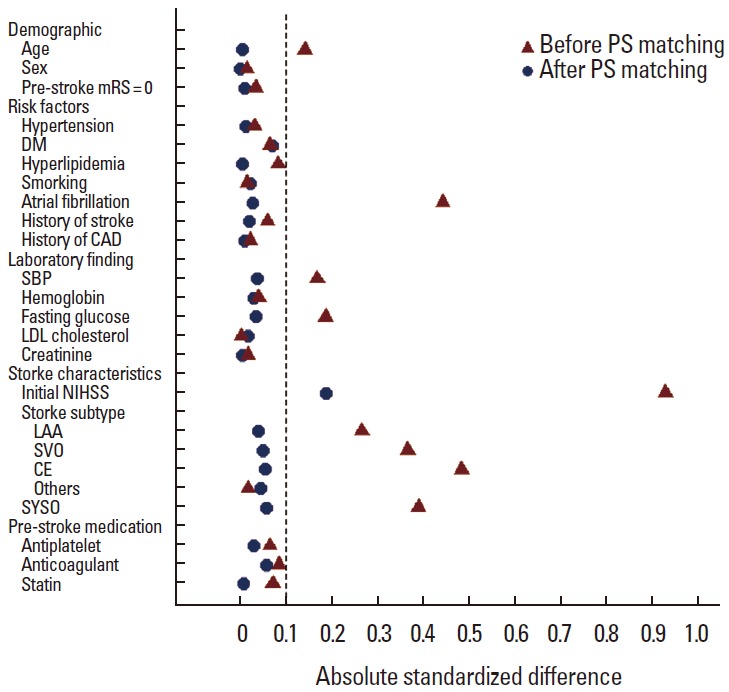
From a multicenter stroke registry database of Korea, we identified patients with acute ischemic stroke who were aged ≥ 80 years. Using multivariable analysis and propensity score (PS)-matched analyses, we assessed the effectiveness and safety of intravenous TPA within 4.5 hours.
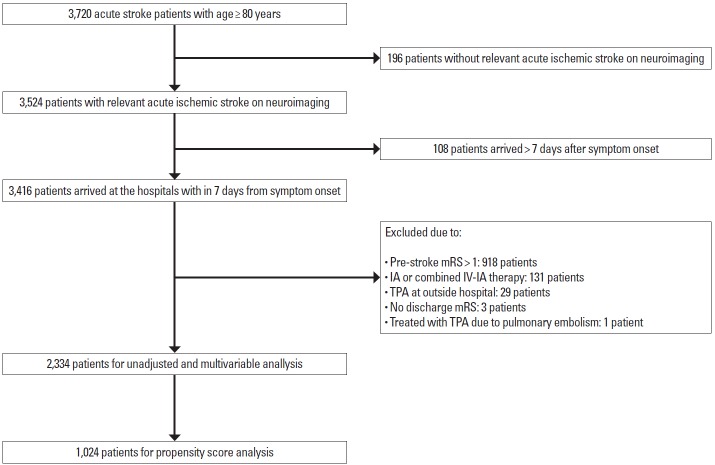
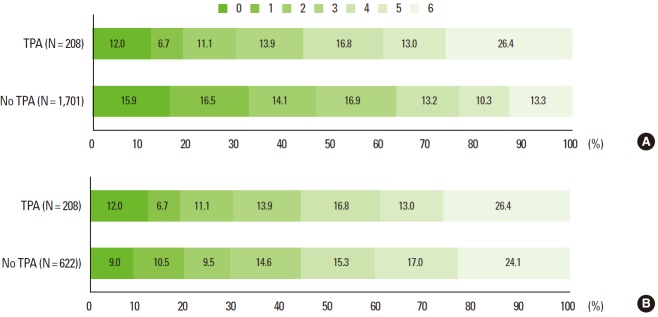
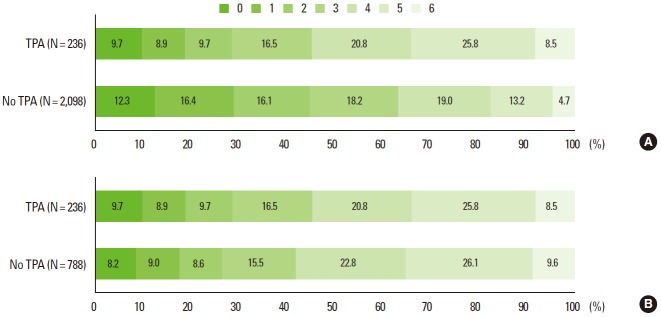
Among 2,334 patients who met the eligible criteria, 236 were treated with intravenous TPA (mean age, 83±5; median NIHSS, 13 [IQR, 8-17]). At discharge, the TPA group compared to the no-TPA group had a favorable shift on the modified Rankin Scale (mRS) score (multivariable analysis, OR [95% CI], 1.51 [1.17-1.96], P=0.002; PS-matched analysis, 1.54 [1.17-2.04], P=0.002) and was more likely to achieve mRS 0-1 outcome (multivariable analysis, 2.00 [1.32-3.03], P=0.001; PS-matched analysis, 1.59 [1.04-2.42], P=0.032). TPA treatment was associated with an increased risk of symptomatic intracranial hemorrhage (multivariable analysis, 5.45 [2.80-10.59], P<0.001; PS-matched analysis, 4.52 [2.24-9.13], P<0.001), but did not increase the in-hospital mortality (multivariable analysis, 0.86 [0.50-1.48], P=0.58; PS-matched analysis, 0.88 [0.52-1.47], P=0.61).
In the setting of clinical practice, intravenous TPA within 4.5 hours improved the functional outcome despite an increased risk of symptomatic intracranial hemorrhage in very elderly Korean patients. The findings, consistent with those from pooled analysis of RCTs, strongly support the use of TPA for this population.
在最近一项对随机临床试验(RCT)的汇总分析中,静脉内组织型纤溶酶原激活物(tissue plasminogen activator,TPA)改善了≥80 岁患者的结局。然而,尚不确定这些发现是否适用于亚洲人群的临床实践。
我们从韩国的一个多中心卒中登记数据库中确定了符合条件的急性缺血性卒中患者,年龄≥80 岁。我们使用多变量分析和倾向评分(propensity score,PS)匹配分析,评估了 4.5 小时内静脉内 TPA 的有效性和安全性。
在符合条件的 2334 名患者中,有 236 名接受了静脉内 TPA 治疗(平均年龄 83±5 岁;中位数 NIHSS 为 13[IQR,8-17])。出院时,TPA 组与未接受 TPA 组相比,改良 Rankin 量表(modified Rankin Scale,mRS)评分的改善更明显(多变量分析,OR[95%CI],1.51[1.17-1.96],P=0.002;PS 匹配分析,1.54[1.17-2.04],P=0.002),更有可能获得 mRS 0-1 结局(多变量分析,2.00[1.32-3.03],P=0.001;PS 匹配分析,1.59[1.04-2.42],P=0.032)。TPA 治疗与症状性颅内出血的风险增加相关(多变量分析,5.45[2.80-10.59],P<0.001;PS 匹配分析,4.52[2.24-9.13],P<0.001),但不会增加住院死亡率(多变量分析,0.86[0.50-1.48],P=0.58;PS 匹配分析,0.88[0.52-1.47],P=0.61)。
在临床实践中,尽管症状性颅内出血的风险增加,但在 4.5 小时内给予静脉内 TPA 可改善功能结局。这些发现与 RCT 汇总分析一致,强烈支持对这一人群使用 TPA。