Adorno A, Alafaci C, Sanfilippo F, Cafarella D, Scordino M, Granata F, Grasso G, Salpietro F M
Department of Neurosurgery - AOOR Papardo-Piemonte, Contrada Papardo, 98158, Messina, Italy.
Department of Neurosurgery - AOU Policlinico "G.Martino", Via Consolare Valeria, 98125, Messina, Italy.
J Med Case Rep. 2015 Oct 4;9:229. doi: 10.1186/s13256-015-0700-y.
Klippel-Feil syndrome is characterized by a congenital fusion of cervical vertebrae. Intracranial teratomas are nongerminomatous germ cell tumors and they account for 0.3 to 0.9% of all intracranial tumors. Teratomas with malignant transformation refer to lesions which give rise to malignant cancer of somatic type. The association between tumors of dermoid origin and Klippel-Feil malformation is extremely rare. Only 23 other cases have so far been reported, and only one case of dermoid tumor with areas of dedifferentiation on squamous cell carcinoma has been described.
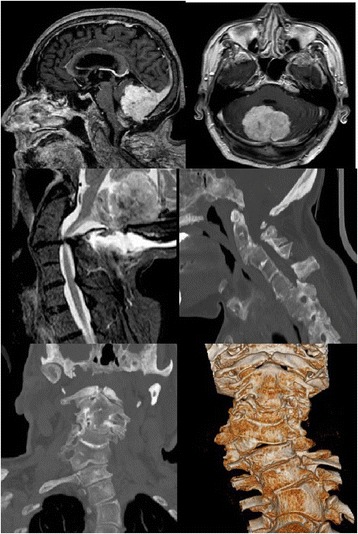
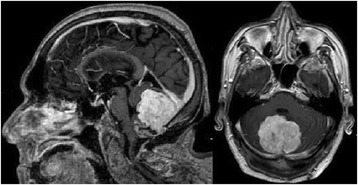
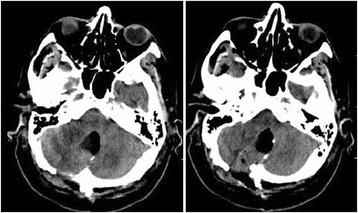
We report the case of a 72-year-old white man with a 2-year history of gait and balance disturbances. A brain magnetic resonance imaging revealed a fourth ventricle neoplastic process with infiltrative features. He was operated through a suboccipital craniectomy with a C1 laminotomy and bilateral vertebral artery transposition. At 6-months follow-up, magnetic resonance imaging showed an early regrowth of the fourth ventricle tumor, with the same radiological features.
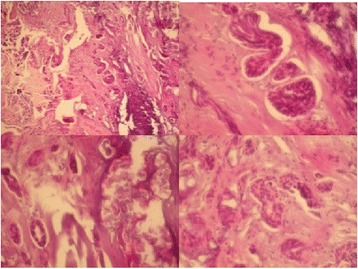
Patients with Klippel-Feil malformation could develop posterior fossa dermoid tumors. The malignant potential of such tumors must be considered and surgery is recommended. Particular attention must be focused on the histopathological analysis in order to identify possible foci of malignant transformation.
Klippel-Feil综合征的特征是颈椎先天性融合。颅内畸胎瘤是非生殖细胞性生殖细胞肿瘤,占所有颅内肿瘤的0.3%至0.9%。发生恶性转化的畸胎瘤是指引发体细胞型恶性肿瘤的病变。皮样起源的肿瘤与Klippel-Feil畸形之间的关联极为罕见。迄今为止,仅报道了另外23例病例,且仅描述了1例具有鳞状细胞癌去分化区域的皮样肿瘤。
我们报告了1例72岁白人男性,有2年步态和平衡障碍病史。脑部磁共振成像显示第四脑室有具有浸润性特征的肿瘤病变。他接受了枕下颅骨切除术、C1椎板切开术和双侧椎动脉移位术。在6个月的随访中,磁共振成像显示第四脑室肿瘤早期复发,具有相同的影像学特征。
Klippel-Feil畸形患者可能发生后颅窝皮样肿瘤。必须考虑此类肿瘤的恶性潜能,并建议进行手术。必须特别关注组织病理学分析,以识别可能的恶性转化病灶。