Zulliger Rahel, Conley Shannon M, Naash Muna I
Department of Biomedical Engineering, University of Houston, Houston, TX 77204-5060, United States.
Department of Cell Biology, University of Oklahoma Health Sciences Center, Oklahoma City, OK 73104, United States.
J Control Release. 2015 Dec 10;219:471-487. doi: 10.1016/j.jconrel.2015.10.007. Epub 2015 Oct 9.
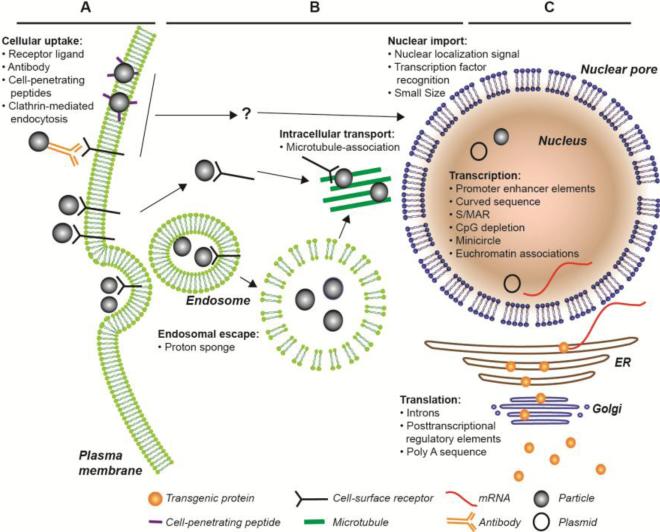
Currently there are no viable treatment options for patients with debilitating inherited retinal degeneration. The vast variability in disease-inducing mutations and resulting phenotypes has hampered the development of therapeutic interventions. Gene therapy is a logical approach, and recent work has focused on ways to optimize vector design and packaging to promote optimized expression and phenotypic rescue after intraocular delivery. In this review, we discuss ongoing ocular clinical trials, which currently use viral gene delivery, but focus primarily on new advancements in optimizing the efficacy of non-viral gene delivery for ocular diseases. Non-viral delivery systems are highly customizable, allowing functionalization to improve cellular and nuclear uptake, bypassing cellular degradative machinery, and improving gene expression in the nucleus. Non-viral vectors often yield transgene expression levels lower than viral counterparts, however their favorable safety/immune profiles and large DNA capacity (critical for the delivery of large ocular disease genes) make their further development a research priority. Recent work on particle coating and vector engineering presents exciting ways to overcome limitations of transient/low gene expression levels, but also highlights the fact that further refinements are needed before use in the clinic.
目前,对于患有使人衰弱的遗传性视网膜变性的患者,尚无可行的治疗方案。致病突变和由此产生的表型的巨大变异性阻碍了治疗干预措施的开发。基因治疗是一种合理的方法,最近的工作集中在优化载体设计和包装的方法上,以促进眼内给药后优化表达和表型挽救。在这篇综述中,我们讨论了正在进行的眼部临床试验,这些试验目前使用病毒基因递送,但主要关注优化非病毒基因递送治疗眼部疾病疗效的新进展。非病毒递送系统具有高度可定制性,允许进行功能化以改善细胞和核摄取,绕过细胞降解机制,并提高细胞核中的基因表达。非病毒载体产生的转基因表达水平通常低于病毒载体,然而它们良好的安全性/免疫特性以及大的DNA容量(对于递送大型眼部疾病基因至关重要)使其进一步开发成为研究重点。最近关于颗粒包被和载体工程的工作提出了克服瞬时/低基因表达水平限制的令人兴奋的方法,但也凸显了在临床应用前还需要进一步改进的事实。