Welch James, Kanter Benjamin, Skora Brooke, McCombie Scott, Henry Isaac, McCombie Devin, Kennedy Rosemary, Soller Babs
Sotera Wireless Inc., 10020 Huennekens St., San Diego, CA, 92121, USA.
J Clin Monit Comput. 2016 Dec;30(6):895-900. doi: 10.1007/s10877-015-9790-8. Epub 2015 Oct 6.
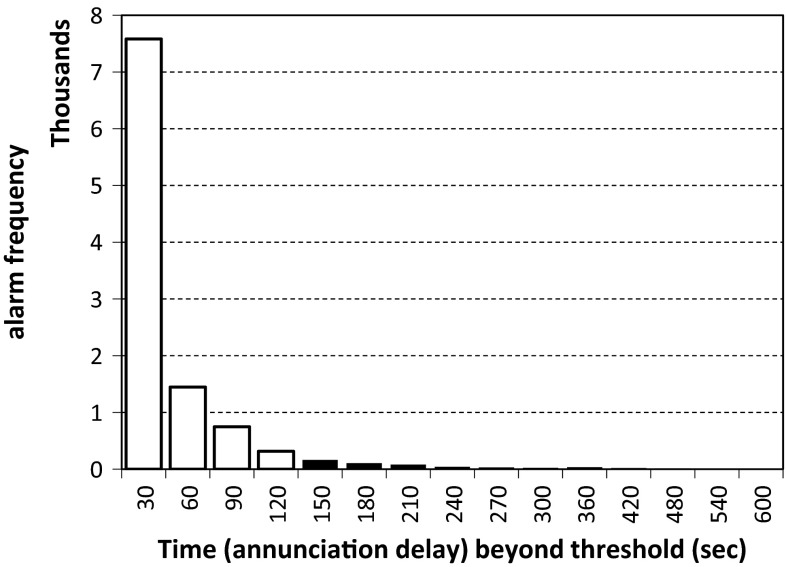
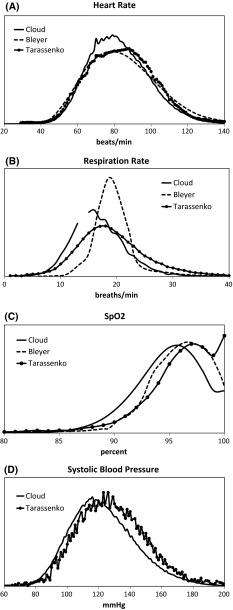
Continual vital sign assessment on the general care, medical-surgical floor is expected to provide early indication of patient deterioration and increase the effectiveness of rapid response teams. However, there is concern that continual, multi-parameter vital sign monitoring will produce alarm fatigue. The objective of this study was the development of a methodology to help care teams optimize alarm settings. An on-body wireless monitoring system was used to continually assess heart rate, respiratory rate, SpO and noninvasive blood pressure in the general ward of ten hospitals between April 1, 2014 and January 19, 2015. These data, 94,575 h for 3430 patients are contained in a large database, accessible with cloud computing tools. Simulation scenarios assessed the total alarm rate as a function of threshold and annunciation delay (s). The total alarm rate of ten alarms/patient/day predicted from the cloud-hosted database was the same as the total alarm rate for a 10 day evaluation (1550 h for 36 patients) in an independent hospital. Plots of vital sign distributions in the cloud-hosted database were similar to other large databases published by different authors. The cloud-hosted database can be used to run simulations for various alarm thresholds and annunciation delays to predict the total alarm burden experienced by nursing staff. This methodology might, in the future, be used to help reduce alarm fatigue without sacrificing the ability to continually monitor all vital signs.
在普通护理、内科-外科病房持续进行生命体征评估,有望为患者病情恶化提供早期迹象,并提高快速反应团队的工作效率。然而,有人担心持续的多参数生命体征监测会导致警报疲劳。本研究的目的是开发一种方法,以帮助护理团队优化警报设置。2014年4月1日至2015年1月19日期间,在十家医院的普通病房使用了一种可穿戴无线监测系统,持续评估心率、呼吸频率、血氧饱和度(SpO)和无创血压。这些数据(3430名患者的94575小时)包含在一个大型数据库中,可通过云计算工具访问。模拟场景评估了作为阈值和报警延迟(秒)函数的总警报率。从云托管数据库预测的每位患者每天十次警报的总警报率,与一家独立医院进行的为期10天评估(36名患者的1550小时)的总警报率相同。云托管数据库中的生命体征分布图与不同作者发表的其他大型数据库相似。云托管数据库可用于针对各种警报阈值和报警延迟运行模拟,以预测护理人员承受的总警报负担。这种方法未来可能用于帮助减少警报疲劳,同时又不影响持续监测所有生命体征的能力。