von Berg A, Filipiak-Pittroff B, Schulz H, Hoffmann U, Link E, Sußmann M, Schnappinger M, Brüske I, Standl M, Krämer U, Hoffmann B, Heinrich J, Bauer C-P, Koletzko S, Berdel D
Department of Pediatrics, Marien-Hospital Wesel, Research Institute, Wesel, Germany.
Institute of Epidemiology I, Helmholtz Zentrum Munich, German Research Center for Environmental Health (GmbH), Neuherberg, Germany.
Allergy. 2016 Feb;71(2):210-9. doi: 10.1111/all.12790. Epub 2015 Nov 23.
Data on the long-term impact of hydrolyzed formulas on allergies are scarce.
To assess the association between early intervention with hydrolyzed formulas in high-risk children and allergic outcomes in adolescence.
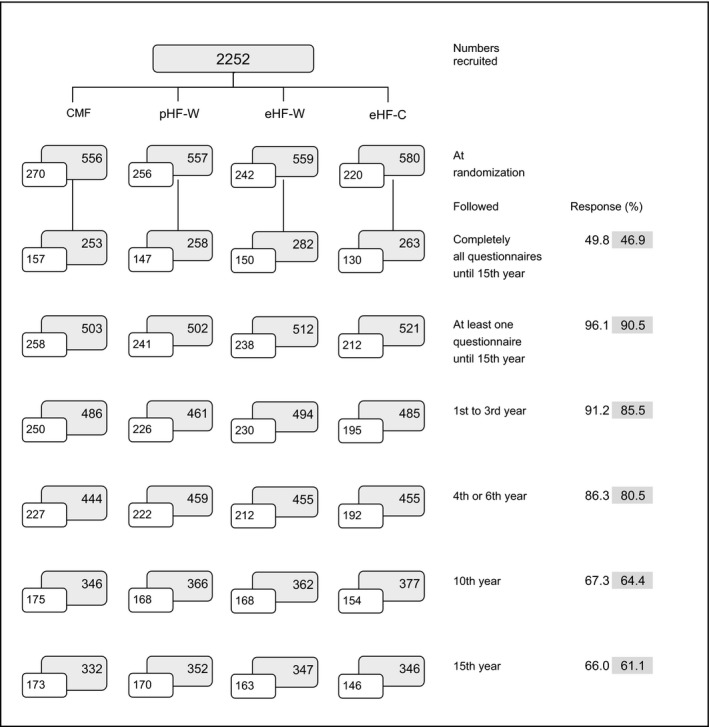
GINI trial participants (n = 2252) received one of four formulas in the first four months of life as breastmilk substitute if necessary: partial or extensive whey hydrolyzate (pHF-W, eHF-W), extensive casein hydrolyzate (eHF-C) or standard cow's milk formula (CMF) as reference. Associations between these formulas and the cumulative incidence and prevalence of parent-reported physician-diagnosed asthma, allergic rhinitis (AR) and eczema, as well as spirometric indices and sensitization, were examined using generalized linear models.
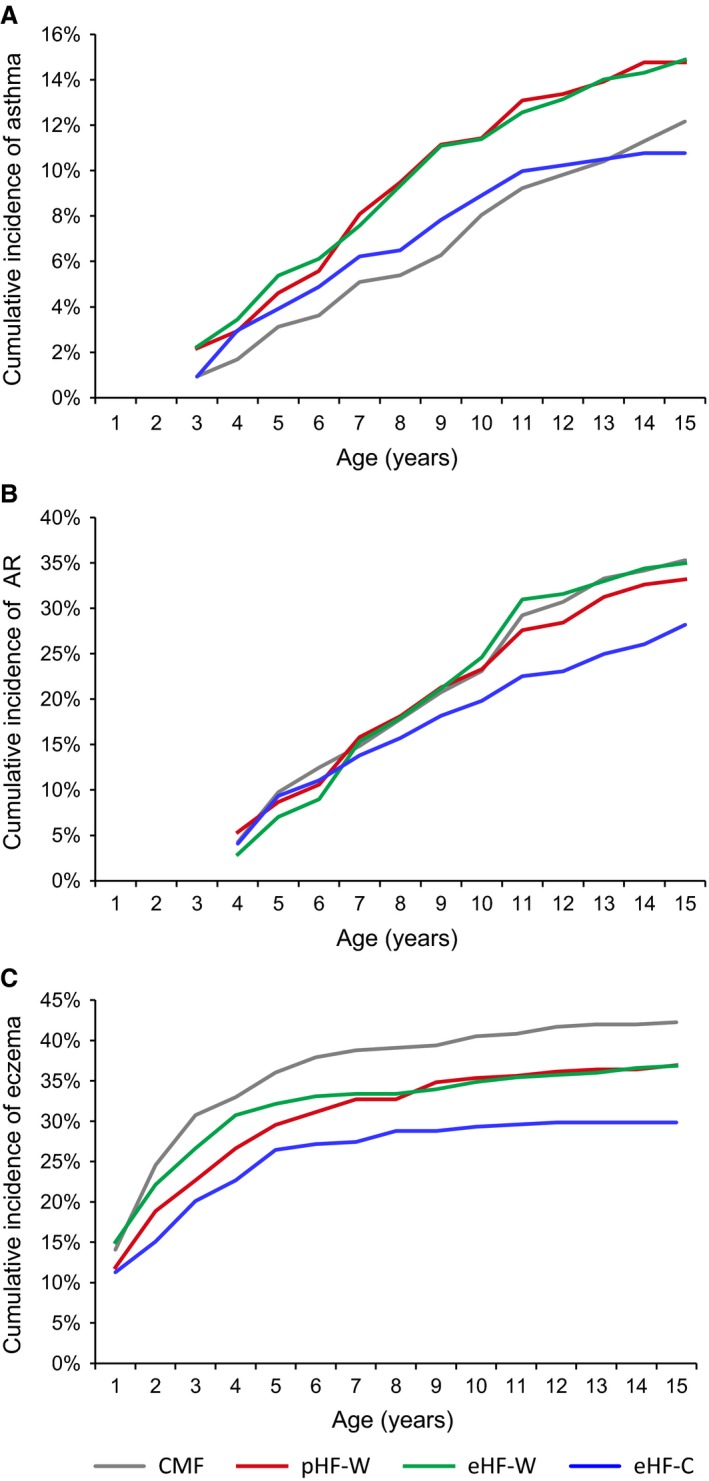
Between 11 and 15 years, the prevalence of asthma was reduced in the eHF-C group compared to CMF (odds ratio (OR) 0.49, 95% confidence interval (CI) 0.26-0.89), which is consistent with the spirometric results. The cumulative incidence of AR was lower in eHF-C (risk ratio (RR) 0.77, 95% CI 0.59-0.99]) and the AR prevalence in pHF-W (OR 0.67, 95% CI 0.47-0.95) and eHF-C (OR 0.59, 95% CI 0.41-0.84). The cumulative incidence of eczema was reduced in pHF-W (RR 0.75, 95% CI 0.59-0.96) and eHF-C (RR 0.60, 95% CI 0.46-0.77), as was the eczema prevalence between 11 and 15 years in eHF-C (OR 0.42, 95% CI 0.23-0.79). No significant effects were found in the eHF-W group on any manifestation,nor was there an effect on sensitization with any formula.
In high-risk children, early intervention using different hydrolyzed formulas has variable preventative effects on asthma, allergic rhinitis and eczema up to adolescence.
关于水解配方奶粉对过敏长期影响的数据稀缺。
评估高危儿童早期使用水解配方奶粉干预与青少年期过敏结局之间的关联。
GINI试验参与者(n = 2252)在出生后的前四个月根据需要接受四种配方奶粉之一作为母乳替代品:部分或深度乳清水解配方奶粉(pHF-W,eHF-W)、深度酪蛋白水解配方奶粉(eHF-C)或标准牛奶配方奶粉(CMF)作为对照。使用广义线性模型研究这些配方奶粉与家长报告的医生诊断哮喘、过敏性鼻炎(AR)和湿疹的累积发病率及患病率,以及肺功能指标和致敏之间的关联。
在11至15岁之间,与CMF组相比,eHF-C组哮喘患病率降低(优势比(OR)0.49,95%置信区间(CI)0.26 - 0.89),这与肺功能检查结果一致。eHF-C组AR的累积发病率较低(风险比(RR)0.77,95% CI 0.59 - 0.99),pHF-W组(OR 0.67,95% CI 0.47 - 0.95)和eHF-C组(OR 0.59,95% CI 0.41 - 0.84)的AR患病率也较低。pHF-W组(RR 0.75,95% CI 0.59 - 0.96)和eHF-C组(RR 0.60,95% CI 0.46 - 0.77)湿疹的累积发病率降低,eHF-C组在11至15岁之间的湿疹患病率也降低(OR 0.42,95% CI 0.23 - 0.79)。eHF-W组在任何表现方面均未发现显著影响,任何配方奶粉对致敏也无影响。
在高危儿童中,早期使用不同的水解配方奶粉干预对青少年期哮喘、过敏性鼻炎和湿疹具有不同的预防效果。