Schmidt Linnea, Gørtz Sanne, Wohlfahrt Jan, Melbye Mads, Munch Tina Noergaard
Department of Epidemiology Research, Statens Serum Institut, Copenhagen, Denmark.
Department of Epidemiology Research, Statens Serum Institut, Copenhagen, Denmark; Department of Neurosurgery, Copenhagen University Hospital, Denmark.
PLoS One. 2015 Oct 14;10(10):e0140450. doi: 10.1371/journal.pone.0140450. eCollection 2015.
To estimate the risks of and identify predictors for recurrent subdural haematoma in surgically and conservatively treated patients.
The cohort comprised all individuals diagnosed with a first-time subdural hematoma in Denmark 1996-2011. Information on potential predictors was retrieved from the Danish health registers. Cumulative recurrence risks were estimated using the Aalen-Johansen estimator. Rate ratios (RR) were estimated using Poisson regression.
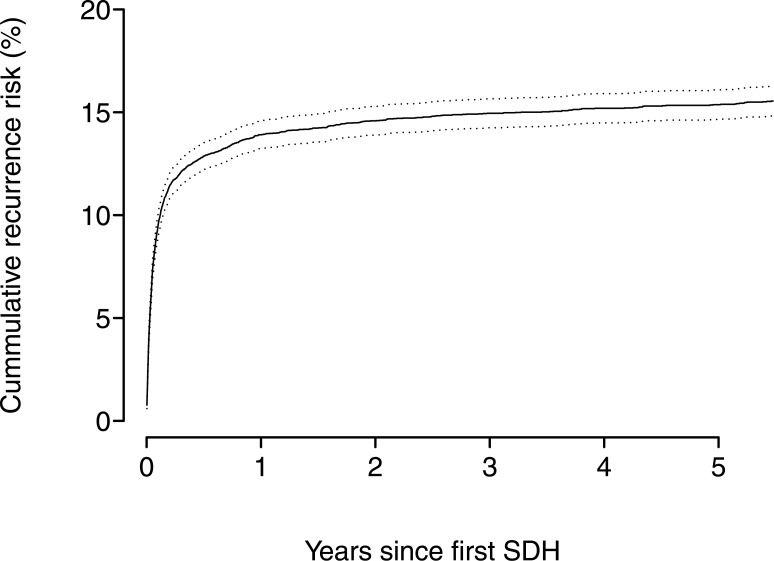
Among 10,158 individuals with a subdural hematoma, 1,555 had a recurrent event. The cumulative risk of recurrent subdural hematoma was 9% at 4 weeks after the primary bleeding, increasing to and stabilising at 14% after one year. Predictors associated with recurrence were: Male sex (RR 1.60, 95% CI:1.43-1.80), older age (>70 years compared to 20-49 years; RR 1.41, 95% CI: 1.21-1.65), alcohol addiction (RR 1.20, 95% CI:1.04-1.37), surgical treatment (RR 1.76, 95% CI:1.58-1.96), trauma diagnoses (RR 1.14, 95% CI:1.03-1.27), and diabetes mellitus (RR 1.40, 95% CI:1.11-1.74). Out of a selected combination of risk factors, the highest cumulative 1-year recurrence risks for subdural hematoma of 25% (compared to 14% for all patients) was found in surgically treated males with diabetes mellitus.
The recurrence risk of subdural hematoma is largely limited to the first year. Patient characteristics including co-morbidities greatly influence the recurrence risk of SDH, suggesting that individualized prognostic guidance and follow-up is needed.
评估手术治疗和保守治疗的患者复发性硬膜下血肿的风险,并确定其预测因素。
该队列包括1996年至2011年在丹麦首次诊断为硬膜下血肿的所有个体。潜在预测因素的信息从丹麦健康登记处获取。使用Aalen-Johansen估计量估计累积复发风险。使用泊松回归估计率比(RR)。
在10158例硬膜下血肿患者中,1555例出现复发事件。原发性出血后4周,复发性硬膜下血肿的累积风险为9%,一年后增至14%并稳定。与复发相关的预测因素包括:男性(RR 1.60,95% CI:1.43 - 1.80)、老年(70岁以上与20 - 49岁相比;RR 1.41,95% CI:1.21 - 1.65)、酒精成瘾(RR 1.20,95% CI:1.04 - 1.37)、手术治疗(RR 1.76,95% CI:1.58 - 1.96)、创伤诊断(RR 1.14,95% CI:1.03 - 1.27)以及糖尿病(RR 1.40,95% CI:1.11 - 1.74)。在选定的风险因素组合中,手术治疗的糖尿病男性患者硬膜下血肿的1年累积复发风险最高,为25%(所有患者为14%)。
硬膜下血肿的复发风险主要限于第一年。包括合并症在内的患者特征极大地影响了硬膜下血肿的复发风险,提示需要个体化的预后指导和随访。