Fountoulakis Konstantinos N, McIntyre Roger S, Carvalho André F
6, Odysseos str (1st Parodos Ampelonon str.), 55535 Pylaia Thessaloniki, Greece.
Curr Neuropharmacol. 2015;13(5):605-15. doi: 10.2174/1570159x13666150630174343.
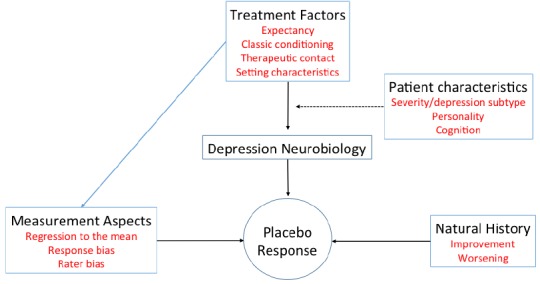
During the last decade, several meta-analytic studies employing different methodological approaches have had inconsistent conclusions regarding antidepressant efficacy. Herein, we aim to comment on methodological aspects that may have contributed to disparate findings. We initially discuss methodological inconsistencies and limitations related to the conduct of individual antidepressant randomized controlled trials (RCTs), including differences in allocated samples, limitations of psychometric scales, possible explanations for the heightened placebo response rates in antidepressant RCTs across the past two decades as well as the reporting of conflicts of interest. In the second part of this article, we briefly describe the various meta-analyses techniques (e.g., simple random effects meta-analysis and network meta-analysis) and the application of these methods to synthesize evidence related to antidepressant efficacy. Recently published antidepressant metaanalyses often provide discrepant results and similar results often lead to different interpretations. Finally, we propose strategies to improve methodology considering real-world clinical scenarios.
在过去十年中,几项采用不同方法的荟萃分析研究在抗抑郁药疗效方面得出了不一致的结论。在此,我们旨在评论可能导致不同研究结果的方法学方面。我们首先讨论与个别抗抑郁药随机对照试验(RCT)实施相关的方法学不一致和局限性,包括分配样本的差异、心理测量量表的局限性、过去二十年抗抑郁药RCT中安慰剂反应率升高的可能解释以及利益冲突的报告。在本文的第二部分,我们简要描述了各种荟萃分析技术(例如,简单随机效应荟萃分析和网状荟萃分析)以及这些方法在综合抗抑郁药疗效相关证据方面的应用。最近发表的抗抑郁药荟萃分析常常提供相互矛盾的结果,而相似的结果也常常导致不同的解释。最后,我们提出考虑现实世界临床场景来改进方法学的策略。