Sullivan Sarah, Joinson Carol, Heron Jon
*School of Social and Community Medicine, University of Bristol, Bristol, United Kingdom; †Epidemiology and Health Services Research, CLAHRC West, Lewins Mead, Bristol, United Kingdom.
J Dev Behav Pediatr. 2015 Nov-Dec;36(9):724-33. doi: 10.1097/DBP.0000000000000229.
To derive latent classes (longitudinal "phenotypes") of frequency of bedwetting from 4 to 9 years and to examine their association with developmental delay, parental history of bedwetting, length of gestation and birth weight.
The authors used data from 8,769 children from the U.K. Avon Longitudinal Study of Parents and Children cohort. Mothers provided repeated reports on their child's frequency of bedwetting from 4 to 9 years. The authors used longitudinal latent class analysis to derive latent classes of bedwetting and examined their association with sex, developmental level at 18 months, parental history of wetting, birth weight, and gestational length.
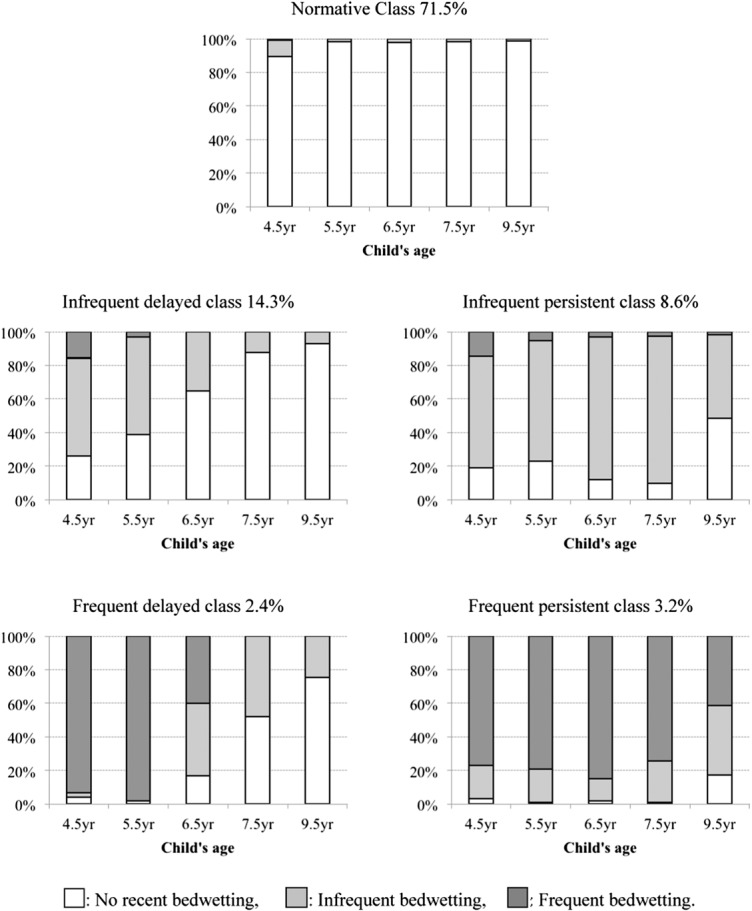
The authors identified 5 latent classes: (1) "normative"-low probability of bedwetting; (2) "infrequent delayed"-delayed attainment of nighttime bladder control with bedwetting <twice a week; (3) "frequent delayed"-delayed attainment of nighttime bladder control with bedwetting ≥ twice a week; (4) "infrequent persistent"-persistent bedwetting < twice a week; and (5) "frequent persistent"-persistent bedwetting ≥ twice a week. Male gender (odds ratio = 3.20 [95% confidence interval = 2.36-4.34]), developmental delay, for example, delayed social skills (1.33 [1.11-1.58]), and maternal history of wetting (3.91 [2.60-5.88]) were associated with an increase in the odds of bedwetting at 4 to 9 years. There was little evidence that low birth weight and shorter gestation period were associated with bedwetting.
The authors described patterns of development of nighttime bladder control and found evidence for factors that predict continuation of bedwetting at school age. Increased knowledge of risk factors for bedwetting is needed to identify children at risk of future problems attaining and maintaining continence.
推导4至9岁尿床频率的潜在类别(纵向“表型”),并研究它们与发育迟缓、父母尿床史、妊娠时长和出生体重之间的关联。
作者使用了来自英国埃文亲子纵向研究队列中8769名儿童的数据。母亲们多次报告了孩子4至9岁时的尿床频率。作者采用纵向潜在类别分析来推导尿床的潜在类别,并研究它们与性别、18个月时的发育水平、父母尿床史、出生体重和妊娠时长之间的关联。
作者识别出5个潜在类别:(1)“正常型”——尿床可能性低;(2)“偶发性延迟型”——夜间膀胱控制能力延迟获得,尿床频率<每周两次;(3)“频繁性延迟型”——夜间膀胱控制能力延迟获得,尿床频率≥每周两次;(4)“偶发性持续性型”——持续性尿床,频率<每周两次;(5)“频繁性持续性型”——持续性尿床,频率≥每周两次。男性(优势比=3.20[95%置信区间=2.36-4.34])、发育迟缓,例如社交技能延迟(1.33[1.11-1.58])以及母亲尿床史(3.91[2.60-5.88])与4至9岁尿床几率增加相关。几乎没有证据表明低出生体重和较短妊娠期与尿床有关。
作者描述了夜间膀胱控制的发育模式,并发现了预测学龄期尿床持续情况的因素的证据。需要增加对尿床风险因素的了解,以识别有未来尿床及维持控尿问题风险的儿童。