Guglielmelli Paola, Bisognin Andrea, Saccoman Claudia, Mannarelli Carmela, Coppe Alessandro, Vannucchi Alessandro M, Bortoluzzi Stefania
Department of Experimental and Clinical Medicine, University of Florence, Florence, Italy.
Department of Molecular Medicine, University of Padova, Padova, Italy.
PLoS One. 2015 Oct 15;10(10):e0140445. doi: 10.1371/journal.pone.0140445. eCollection 2015.
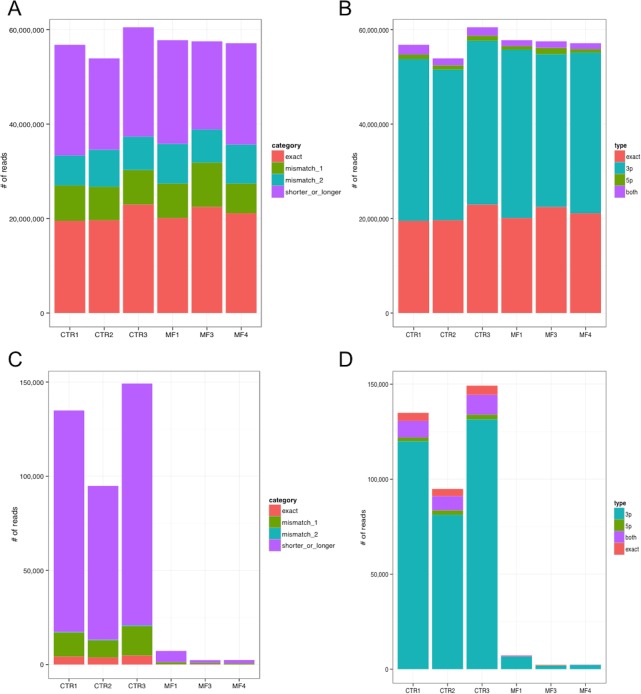
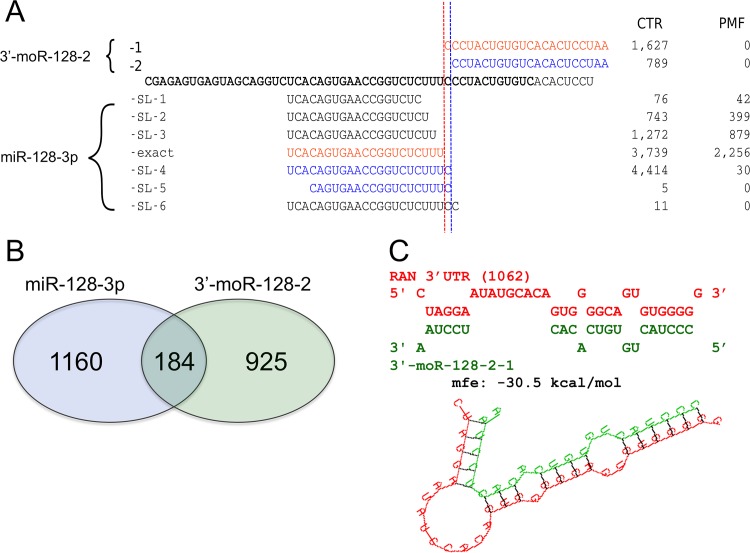
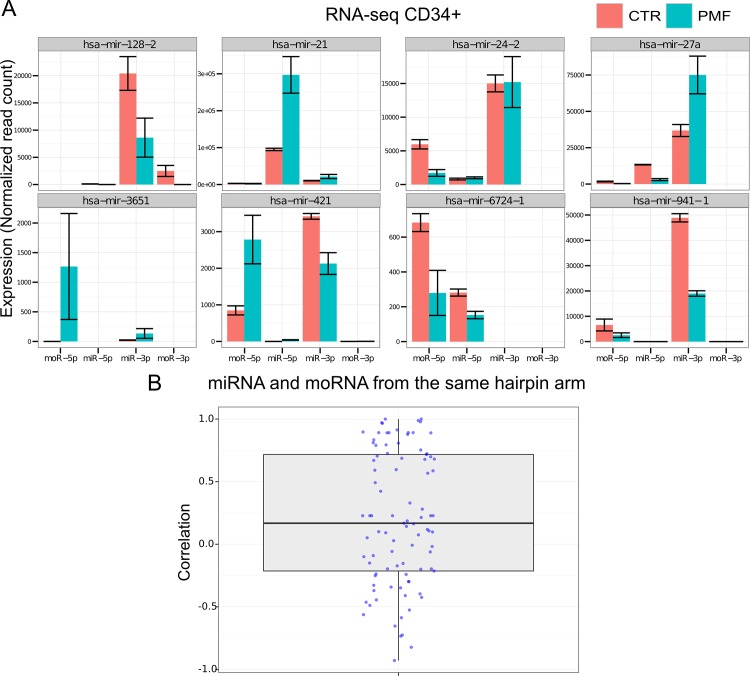
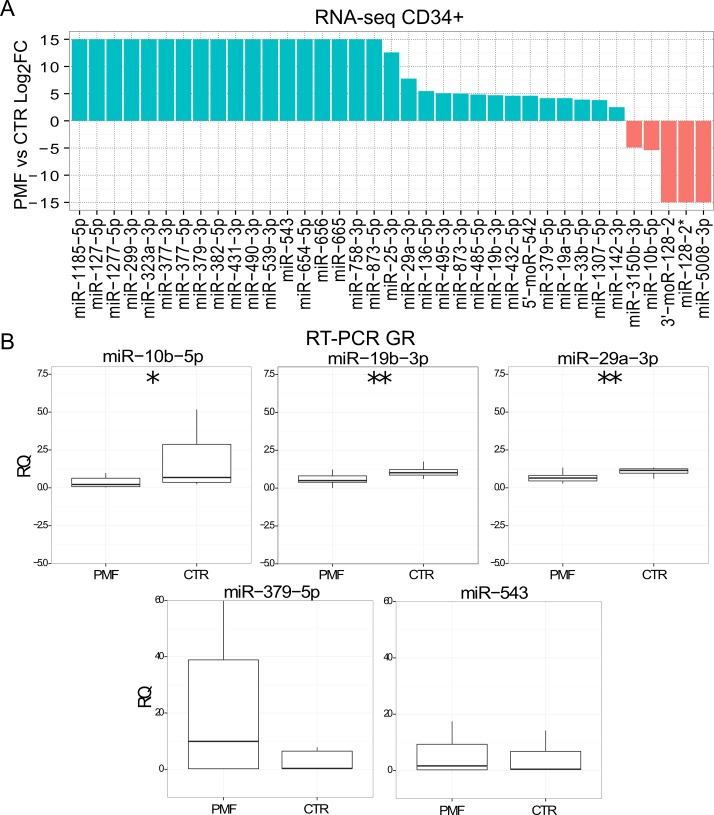
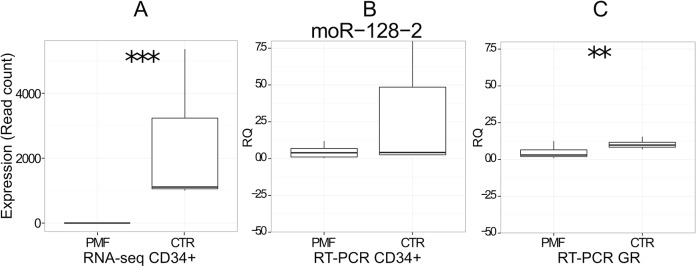
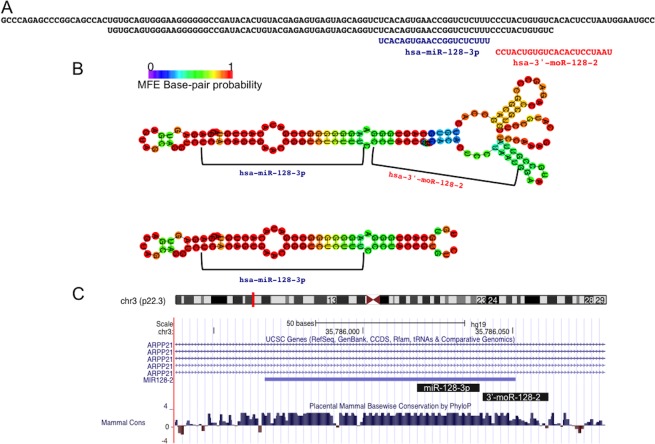
Myeloproliferative neoplasms (MPN) are chronic myeloid cancers thought to arise at the level of CD34+ hematopoietic stem/progenitor cells. They include essential thrombocythemia (ET), polycythemia vera (PV) and primary myelofibrosis (PMF). All can progress to acute leukemia, but PMF carries the worst prognosis. Increasing evidences indicate that deregulation of microRNAs (miRNAs) might plays an important role in hematologic malignancies, including MPN. To attain deeper knowledge of short RNAs (sRNAs) expression pattern in CD34+ cells and of their possible role in mediating post-transcriptional regulation in PMF, we sequenced with Illumina HiSeq2000 technology CD34+ cells from healthy subjects and PMF patients. We detected the expression of 784 known miRNAs, with a prevalence of miRNA up-regulation in PMF samples, and discovered 34 new miRNAs and 99 new miRNA-offset RNAs (moRNAs), in CD34+ cells. Thirty-seven small RNAs were differentially expressed in PMF patients compared with healthy subjects, according to microRNA sequencing data. Five miRNAs (miR-10b-5p, miR-19b-3p, miR-29a-3p, miR-379-5p, and miR-543) were deregulated also in PMF granulocytes. Moreover, 3'-moR-128-2 resulted consistently downregulated in PMF according to RNA-seq and qRT-PCR data both in CD34+ cells and granulocytes. Target predictions of these validated small RNAs de-regulated in PMF and functional enrichment analyses highlighted many interesting pathways involved in tumor development and progression, such as signaling by FGFR and DAP12 and Oncogene Induced Senescence. As a whole, data obtained in this study deepened the knowledge of miRNAs and moRNAs altered expression in PMF CD34+ cells and allowed to identify and validate a specific small RNA profile that distinguishes PMF granulocytes from those of normal subjects. We thus provided new information regarding the possible role of miRNAs and, specifically, of new moRNAs in this disease.
骨髓增殖性肿瘤(MPN)是一类慢性髓系癌症,被认为起源于CD34+造血干/祖细胞水平。它们包括原发性血小板增多症(ET)、真性红细胞增多症(PV)和原发性骨髓纤维化(PMF)。所有这些疾病都可能进展为急性白血病,但PMF的预后最差。越来越多的证据表明,微小RNA(miRNA)失调可能在血液系统恶性肿瘤(包括MPN)中起重要作用。为了更深入了解CD34+细胞中短链RNA(sRNA)的表达模式及其在PMF转录后调控中的可能作用,我们使用Illumina HiSeq2000技术对健康受试者和PMF患者的CD34+细胞进行了测序。我们检测到784种已知miRNA的表达,在PMF样本中miRNA上调更为普遍,并在CD34+细胞中发现了34种新的miRNA和99种新的miRNA-offset RNA(moRNA)。根据微小RNA测序数据,与健康受试者相比,37种小RNA在PMF患者中差异表达。5种miRNA(miR-10b-5p、miR-19b-3p、miR-29a-3p、miR-379-5p和miR-543)在PMF粒细胞中也失调。此外,根据RNA测序和qRT-PCR数据,3'-moR-128-2在CD34+细胞和粒细胞中的PMF中均持续下调。对这些在PMF中失调的经过验证的小RNA进行靶标预测和功能富集分析,突出了许多参与肿瘤发生和进展的有趣途径,如FGFR和DAP12信号传导以及癌基因诱导的衰老。总体而言,本研究获得的数据加深了对PMF CD34+细胞中miRNA和moRNA表达改变的认识,并有助于识别和验证区分PMF粒细胞与正常受试者粒细胞的特定小RNA谱。因此,我们提供了关于miRNA,特别是新的moRNA在这种疾病中可能作用的新信息。