Paterson M A, Smart C E M, Lopez P E, McElduff P, Attia J, Morbey C, King B R
Hunter Medical Research Institute, School of Medicine and Public Health, University of Newcastle, Rankin Park, NSW, Australia.
Faculty of Health, School of Medicine, University of Newcastle, NSW, Australia.
Diabet Med. 2016 May;33(5):592-8. doi: 10.1111/dme.13011. Epub 2015 Dec 6.
To determine the effects of protein alone (independent of fat and carbohydrate) on postprandial glycaemia in individuals with Type 1 diabetes mellitus using intensive insulin therapy.
Participants with Type 1 diabetes mellitus aged 7-40 years consumed six 150 ml whey isolate protein drinks [0 g (control), 12.5, 25, 50, 75 and 100] and two 150 ml glucose drinks (10 and 20 g) without insulin, in randomized order over 8 days, 4 h after the evening meal. Continuous glucose monitoring was used to assess postprandial glycaemia.
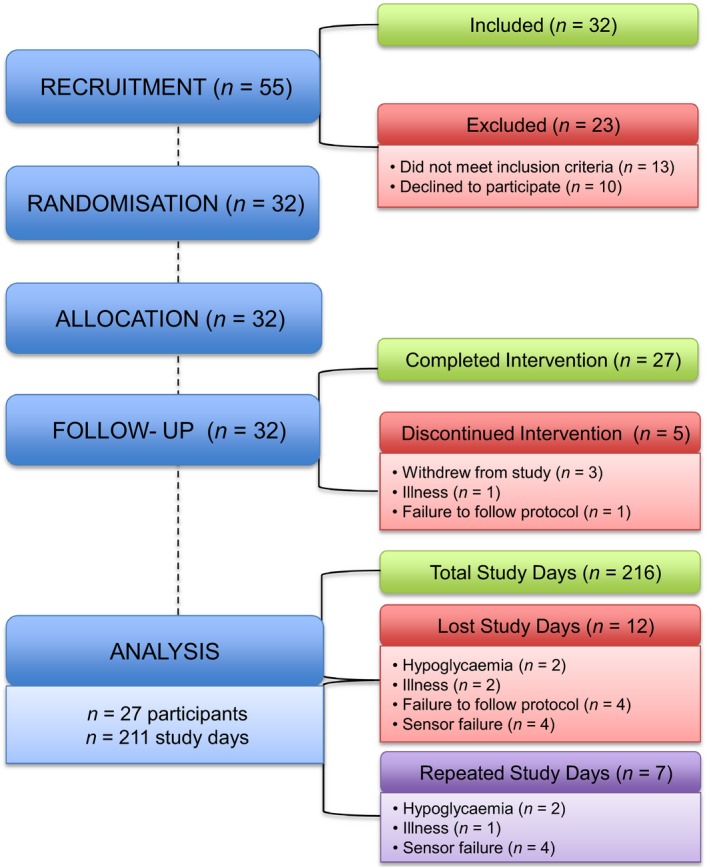
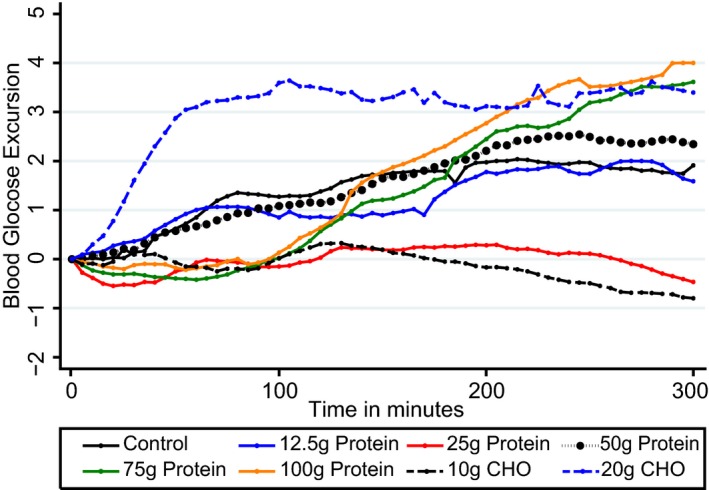
Data were collected from 27 participants. Protein loads of 12.5 and 50 g did not result in significant postprandial glycaemic excursions compared with control (water) throughout the 300 min study period (P > 0.05). Protein loads of 75 and 100 g resulted in lower glycaemic excursions than control in the 60-120 min postprandial interval, but higher excursions in the 180-300 min interval. In comparison with 20 g glucose, the large protein loads resulted in significantly delayed and sustained glucose excursions, commencing at 180 min and continuing to 5 h.
Seventy-five grams or more of protein alone significantly increases postprandial glycaemia from 3 to 5 h in people with Type 1 diabetes mellitus using intensive insulin therapy. The glycaemic profiles resulting from high protein loads differ significantly from the excursion from glucose in terms of time to peak glucose and duration of the glycaemic excursion. This research supports recommendations for insulin dosing for large amounts of protein.
使用强化胰岛素治疗,确定单纯蛋白质(独立于脂肪和碳水化合物)对1型糖尿病患者餐后血糖的影响。
7至40岁的1型糖尿病参与者在晚餐后4小时,于8天内以随机顺序饮用六种150毫升的乳清分离蛋白饮料[0克(对照)、12.5克、25克、50克、75克和100克]以及两种150毫升的葡萄糖饮料(10克和20克),且不使用胰岛素。采用连续血糖监测来评估餐后血糖。
收集了27名参与者的数据。在整个300分钟的研究期间,与对照(水)相比,12.5克和50克的蛋白质负荷未导致显著的餐后血糖波动(P>0.05)。75克和100克的蛋白质负荷在餐后60 - 120分钟内导致的血糖波动低于对照,但在180 - 300分钟内波动更高。与20克葡萄糖相比,大量蛋白质负荷导致血糖波动显著延迟且持续,从180分钟开始并持续至5小时。
对于使用强化胰岛素治疗的1型糖尿病患者,单独摄入75克或更多蛋白质会在3至5小时内显著增加餐后血糖。高蛋白负荷导致的血糖曲线在血糖峰值时间和血糖波动持续时间方面与葡萄糖引起的波动有显著差异。本研究支持针对大量蛋白质摄入时胰岛素剂量的建议。