Brooks Justin M, Carrillo Gabriela L, Su Jianmin, Lindsay David S, Fox Michael A, Blader Ira J
Department of Microbiology and Immunology, SUNY at Buffalo School of Medicine, Buffalo, New York, USA.
Virginia Tech Carilion Research Institute, Roanoke, Virginia, USA.
mBio. 2015 Oct 27;6(6):e01428-15. doi: 10.1128/mBio.01428-15.
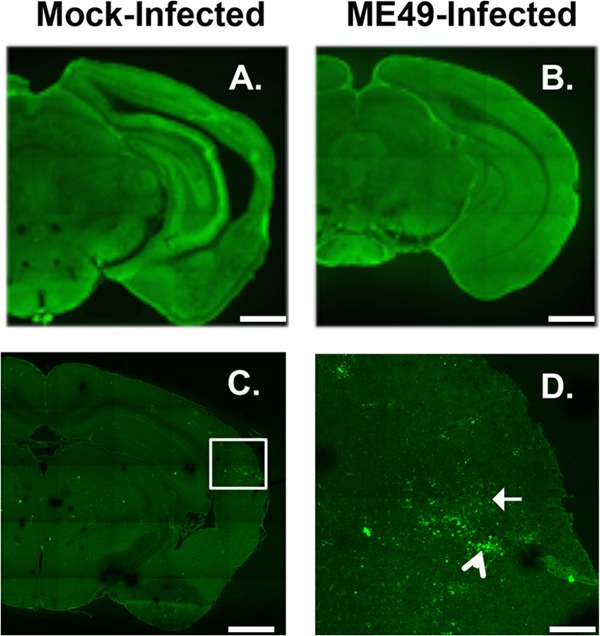
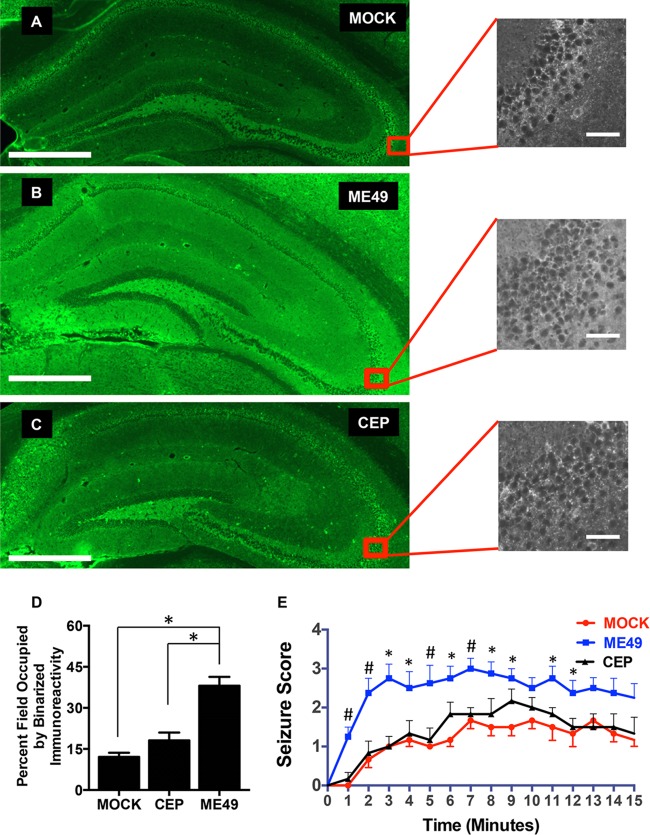
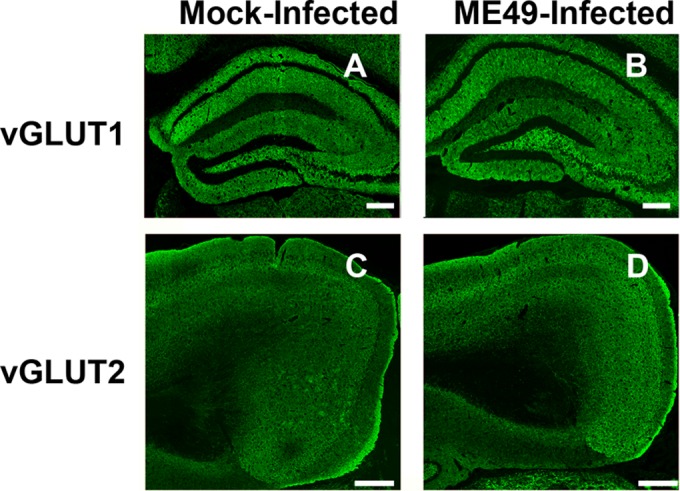
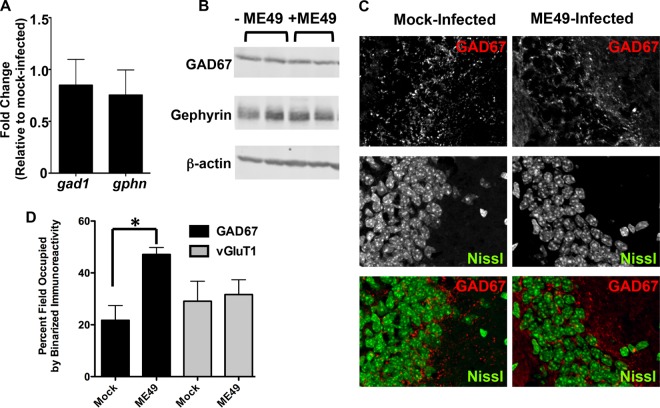
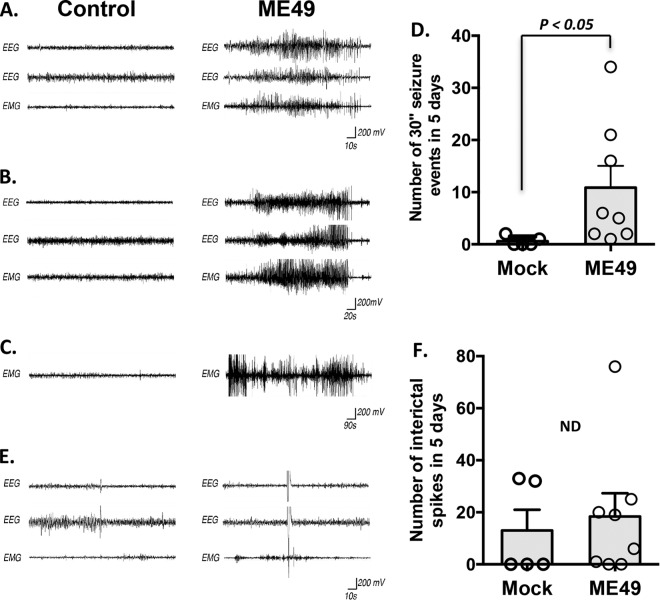
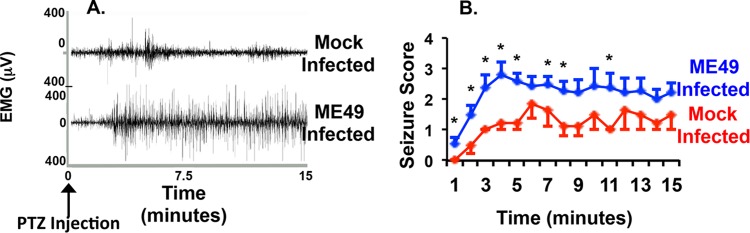
During infections with the protozoan parasite Toxoplasma gondii, gamma-aminobutyric acid (GABA) is utilized as a carbon source for parasite metabolism and also to facilitate parasite dissemination by stimulating dendritic-cell motility. The best-recognized function for GABA, however, is its role in the nervous system as an inhibitory neurotransmitter that regulates the flow and timing of excitatory neurotransmission. When this pathway is altered, seizures develop. Human toxoplasmosis patients suffer from seizures, suggesting that Toxoplasma interferes with GABA signaling in the brain. Here, we show that while excitatory glutamatergic presynaptic proteins appeared normal, infection with type II ME49 Toxoplasma tissue cysts led to global changes in the distribution of glutamic acid decarboxylase 67 (GAD67), a key enzyme that catalyzes GABA synthesis in the brain. Alterations in GAD67 staining were not due to decreased expression but rather to a change from GAD67 clustering at presynaptic termini to a more diffuse localization throughout the neuropil. Consistent with a loss of GAD67 from the synaptic terminals, Toxoplasma-infected mice develop spontaneous seizures and are more susceptible to drugs that induce seizures by antagonizing GABA receptors. Interestingly, GABAergic protein mislocalization and the response to seizure-inducing drugs were observed in mice infected with type II ME49 but not type III CEP strain parasites, indicating a role for a polymorphic parasite factor(s) in regulating GABAergic synapses. Taken together, these data support a model in which seizures and other neurological complications seen in Toxoplasma-infected individuals are due, at least in part, to changes in GABAergic signaling.
Infections of the central nervous system can cause seizures. While inflammation in the brain has been proposed to initiate the onset of the seizures, relatively little is known about how inflammation impacts the structure and function of the neurons. Here we used a parasite called Toxoplasma gondii that infects the brain and showed that seizures arise due to a defect in signaling of GABA, which is the neurotransmitter primarily responsible for preventing the onset of seizures.
在原生动物寄生虫刚地弓形虫感染期间,γ-氨基丁酸(GABA)被用作寄生虫代谢的碳源,还通过刺激树突状细胞运动促进寄生虫传播。然而,GABA最广为人知的功能是其在神经系统中作为抑制性神经递质的作用,调节兴奋性神经传递的流量和时机。当这条通路改变时,就会发生癫痫发作。人类弓形虫病患者会出现癫痫发作,这表明弓形虫会干扰大脑中的GABA信号传导。在这里,我们表明,虽然兴奋性谷氨酸能突触前蛋白看起来正常,但II型ME49弓形虫组织囊肿感染导致谷氨酸脱羧酶67(GAD67)分布发生全局性变化,GAD67是催化大脑中GABA合成的关键酶。GAD67染色的改变不是由于表达减少,而是由于从突触前末端的GAD67聚集转变为在整个神经毡中更弥散的定位。与突触末端GAD67的缺失一致,感染弓形虫的小鼠会出现自发性癫痫发作,并且更容易受到通过拮抗GABA受体诱导癫痫发作的药物的影响。有趣的是,在感染II型ME49但未感染III型CEP株寄生虫的小鼠中观察到GABA能蛋白定位错误和对诱导癫痫发作药物的反应,表明多态性寄生虫因子在调节GABA能突触中起作用。综上所述,这些数据支持了一个模型,即弓形虫感染个体中出现的癫痫发作和其他神经并发症至少部分是由于GABA能信号传导的变化。
中枢神经系统感染可导致癫痫发作。虽然有人提出大脑中的炎症会引发癫痫发作的开始,但关于炎症如何影响神经元的结构和功能知之甚少。在这里,我们使用一种感染大脑的寄生虫刚地弓形虫,表明癫痫发作是由于GABA信号传导缺陷引起的,GABA是主要负责预防癫痫发作开始的神经递质。