Shukla Alpesh Khushalchand, Ramasse Quentin M, Ophus Colin, Duncan Hugues, Hage Fredrik, Chen Guoying
Energy Storage and Distributed Resources Division, Lawrence Berkeley National Laboratory, Berkeley, California 94720, USA.
SuperSTEM Laboratory, SciTech Daresbury Campus, Daresbury WA4 4AD, UK.
Nat Commun. 2015 Oct 29;6:8711. doi: 10.1038/ncomms9711.
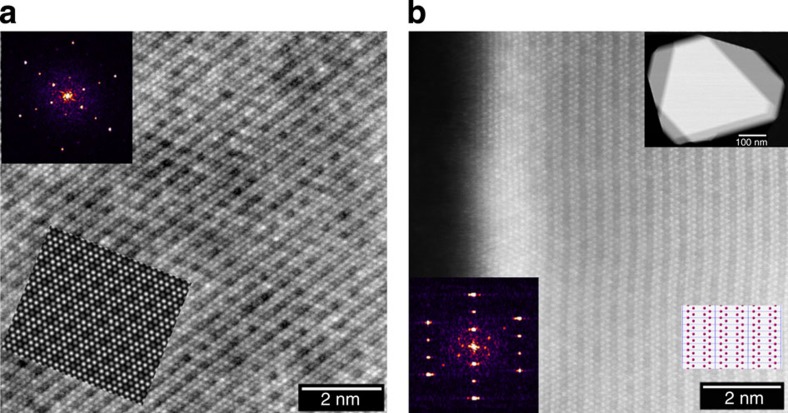
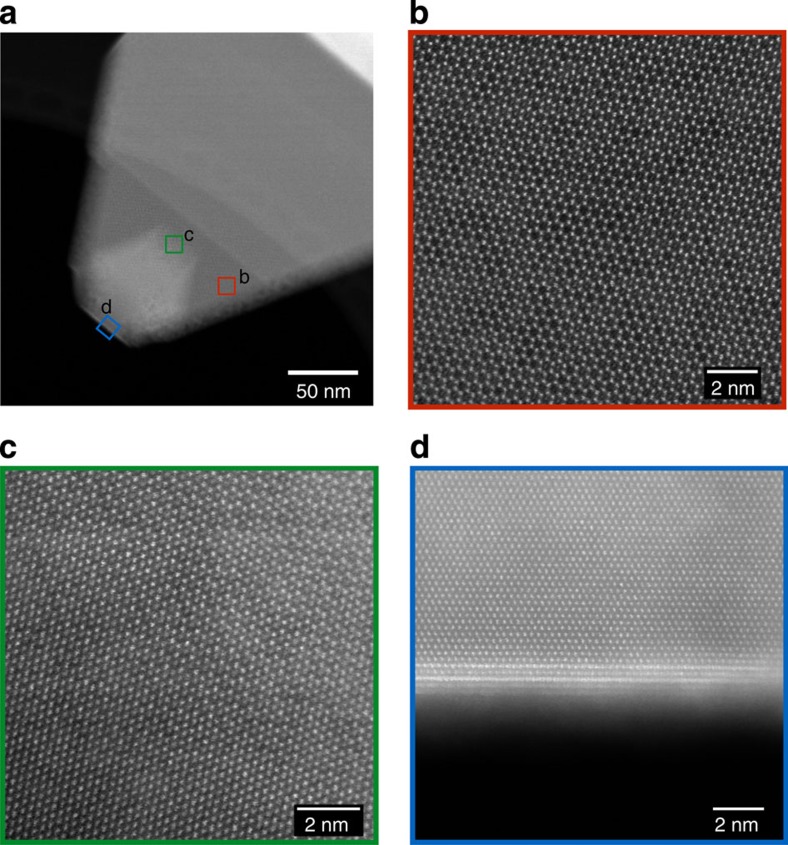
Although Li- and Mn-rich transition metal oxides have been extensively studied as high-capacity cathode materials for Li-ion batteries, the crystal structure of these materials in their pristine state is not yet fully understood. Here we apply complementary electron microscopy and spectroscopy techniques at multi-length scale on well-formed Li1.2(Ni0.13Mn0.54Co0.13)O2 crystals with two different morphologies as well as two commercially available materials with similar compositions, and unambiguously describe the structural make-up of these samples. Systematically observing the entire primary particles along multiple zone axes reveals that they are consistently made up of a single phase, save for rare localized defects and a thin surface layer on certain crystallographic facets. More specifically, we show the bulk of the oxides can be described as an aperiodic crystal consisting of randomly stacked domains that correspond to three variants of monoclinic structure, while the surface is composed of a Co- and/or Ni-rich spinel with antisite defects.
尽管富锂和富锰过渡金属氧化物作为锂离子电池的高容量正极材料已得到广泛研究,但这些材料原始状态下的晶体结构尚未完全明晰。在此,我们在多长度尺度上对具有两种不同形貌的规整Li1.2(Ni0.13Mn0.54Co0.13)O2晶体以及两种成分相似的市售材料应用了互补的电子显微镜和光谱技术,明确描述了这些样品的结构组成。沿着多个晶带轴系统地观察整个一次颗粒发现,除了罕见的局部缺陷和某些晶面的薄表面层外,它们始终由单相组成。更具体地说,我们表明氧化物的主体可描述为由对应于单斜结构三种变体的随机堆叠畴组成的非周期性晶体,而表面由具有反位缺陷的富钴和/或富镍尖晶石组成。