Ham Daniel J, Gleeson Benjamin G, Chee Annabel, Baum Dale M, Caldow Marissa K, Lynch Gordon S, Koopman René
Basic and Clinical Myology Laboratory, Department of Physiology, The University of Melbourne, Parkville, Victoria, Australia.
PLoS One. 2015 Oct 29;10(10):e0141572. doi: 10.1371/journal.pone.0141572. eCollection 2015.
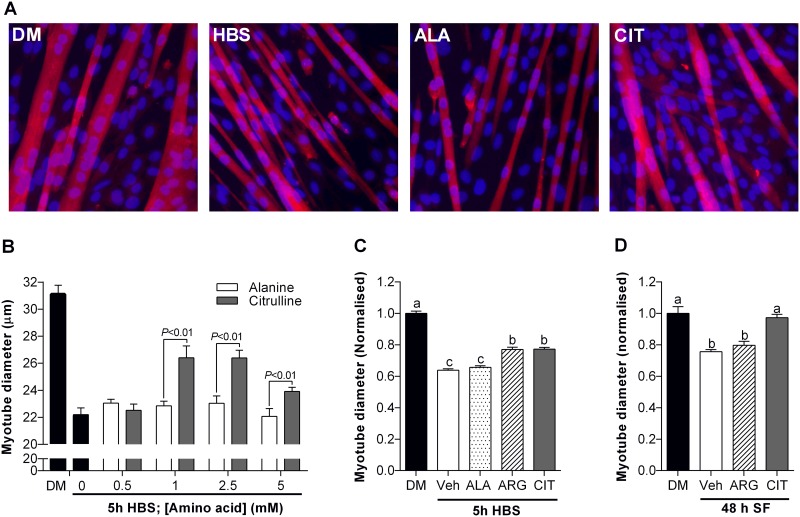
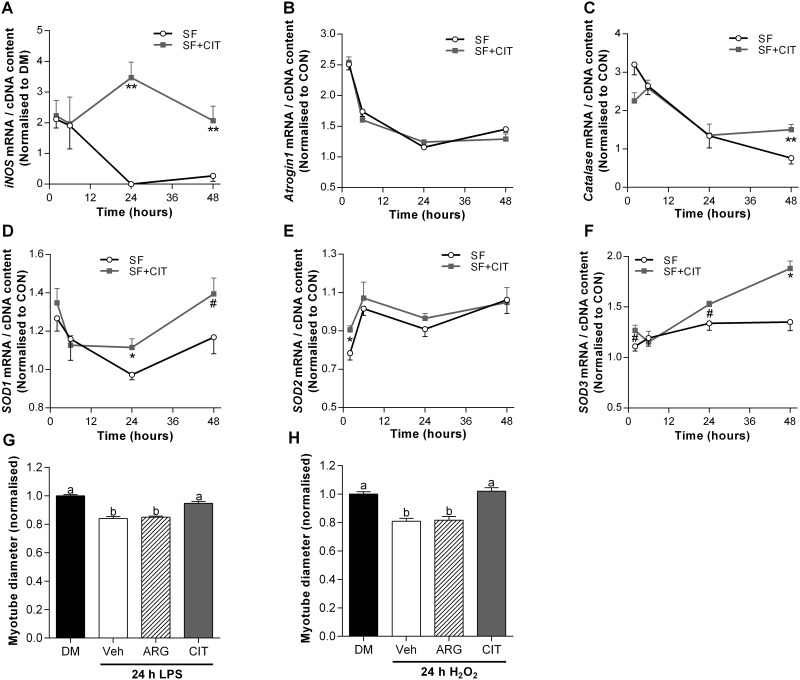
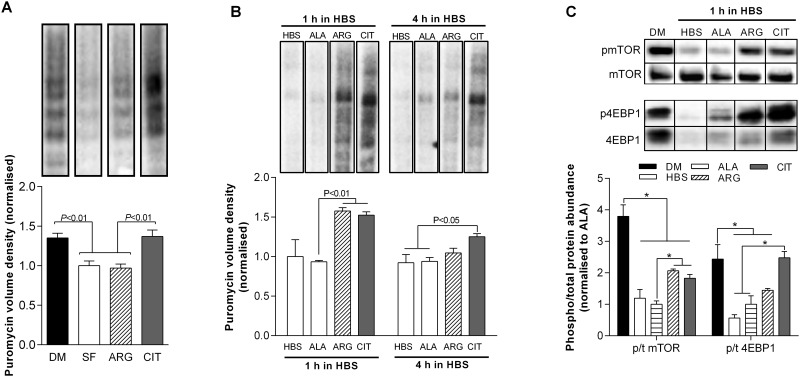
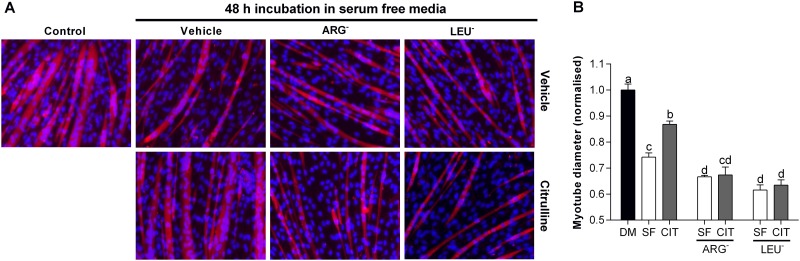
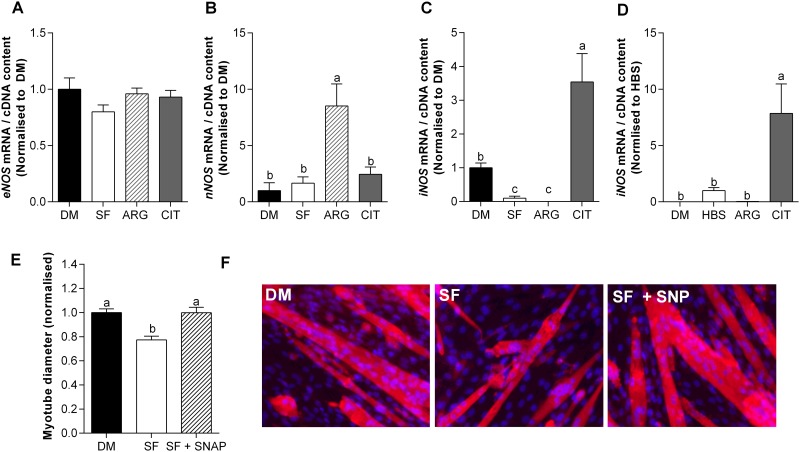
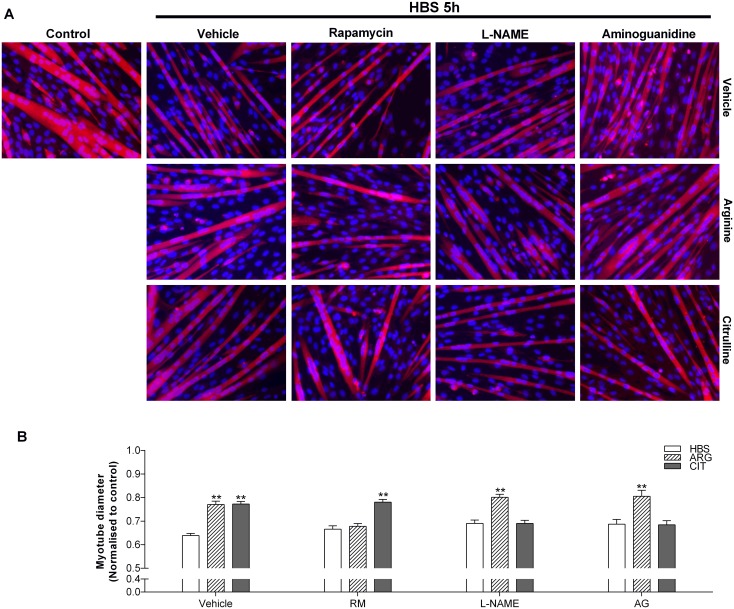
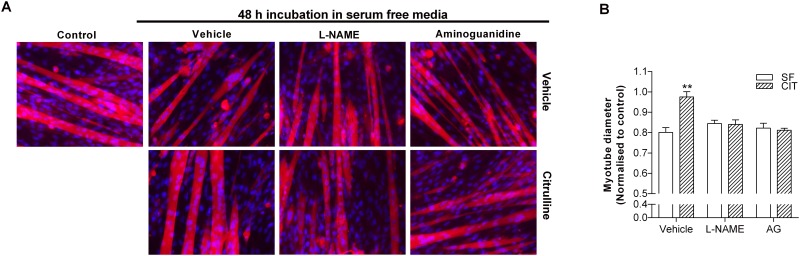
Dietary L-citrulline is thought to modulate muscle protein turnover by increasing L-arginine availability. To date, the direct effects of increased L-citrulline concentrations in muscle have been completely neglected. Therefore, we determined the role of L-citrulline in regulating cell size during catabolic conditions by depriving mature C2C12 myotubes of growth factors (serum free; SF) or growth factors and nutrients (HEPES buffered saline; HBS). Cells were treated with L-citrulline or equimolar concentrations of L-arginine (positive control) or L-alanine (negative control) and changes in cell size and protein turnover were assessed. In myotubes incubated in HBS or SF media, L-citrulline improved rates of protein synthesis (HBS: +63%, SF: +37%) and myotube diameter (HBS: +18%, SF: +29%). L-citrulline treatment substantially increased iNOS mRNA expression (SF: 350%, HBS: 750%). The general NOS inhibitor L-NAME and the iNOS specific inhibitor aminoguanidine prevented these effects in both models. Depriving myotubes in SF media of L-arginine or L-leucine, exacerbated wasting which was not attenuated by L-citrulline. The increased iNOS mRNA expression was temporally associated with increases in mRNA of the endogenous antioxidants SOD1, SOD3 and catalase. Furthermore, L-citrulline prevented inflammation (LPS) and oxidative stress (H2O2) induced muscle cell wasting. In conclusion, we demonstrate a novel direct protective effect of L-citrulline on skeletal muscle cell size independent of L-arginine that is mediated through induction of the inducible NOS (iNOS) isoform. This discovery of a nutritional modulator of iNOS mRNA expression in skeletal muscle cells could have substantial implications for the treatment of muscle wasting conditions.
膳食中的L-瓜氨酸被认为可通过增加L-精氨酸的可用性来调节肌肉蛋白质周转。迄今为止,肌肉中L-瓜氨酸浓度升高的直接影响完全被忽视了。因此,我们通过剥夺成熟的C2C12肌管的生长因子(无血清;SF)或生长因子和营养物质(HEPES缓冲盐水;HBS)来确定L-瓜氨酸在分解代谢条件下调节细胞大小的作用。用L-瓜氨酸或等摩尔浓度的L-精氨酸(阳性对照)或L-丙氨酸(阴性对照)处理细胞,并评估细胞大小和蛋白质周转的变化。在HBS或SF培养基中孵育的肌管中,L-瓜氨酸提高了蛋白质合成速率(HBS:+63%,SF:+37%)和肌管直径(HBS:+18%,SF:+29%)。L-瓜氨酸处理显著增加了诱导型一氧化氮合酶(iNOS)mRNA的表达(SF:350%,HBS:750%)。一般的一氧化氮合酶抑制剂L-NAME和iNOS特异性抑制剂氨基胍在两种模型中均阻止了这些作用。在SF培养基中剥夺肌管的L-精氨酸或L-亮氨酸会加剧消瘦,而L-瓜氨酸并不能减轻这种情况。iNOS mRNA表达的增加与内源性抗氧化剂超氧化物歧化酶1(SOD1)、超氧化物歧化酶3(SOD3)和过氧化氢酶mRNA的增加在时间上相关。此外,L-瓜氨酸可预防炎症(脂多糖)和氧化应激(过氧化氢)诱导的肌肉细胞消瘦。总之,我们证明了L-瓜氨酸对骨骼肌细胞大小具有一种新的直接保护作用,该作用独立于L-精氨酸,是通过诱导诱导型一氧化氮合酶(iNOS)亚型介导的。这一在骨骼肌细胞中发现iNOS mRNA表达的营养调节剂可能对肌肉消瘦病症的治疗具有重大意义。