Lee Youngho, Wakita Daiko, Dagvadorj Jargalsaikhan, Shimada Kenichi, Chen Shuang, Huang Ganghua, Lehman Thomas J A, Fishbein Michael C, Hoffman Hal M, Crother Timothy R, Arditi Moshe
From the Division of Pediatric Infectious Diseases and Immunology, Department of Pediatric, Infectious and Immunologic Diseases Research Center, Cedars-Sinai Medical Center, Los Angeles, CA (Y.L., D.W., J.D., K.S., S.C., G.H., T.R.C., M.A.); Department of Rheumatology, Pediatric Rheumatology, Hospital for Special Surgery and Weill Medical College of Cornell University, New York, NY (T.J.A.L.); Department of Pathology, David Geffen School of Medicine at UCLA (M.C.F.); and Department of Pediatrics, Pediatric Rheumatology, University of California, San Diego, La Jolla (H.M.H.).
Arterioscler Thromb Vasc Biol. 2015 Dec;35(12):2605-16. doi: 10.1161/ATVBAHA.115.306475. Epub 2015 Oct 29.
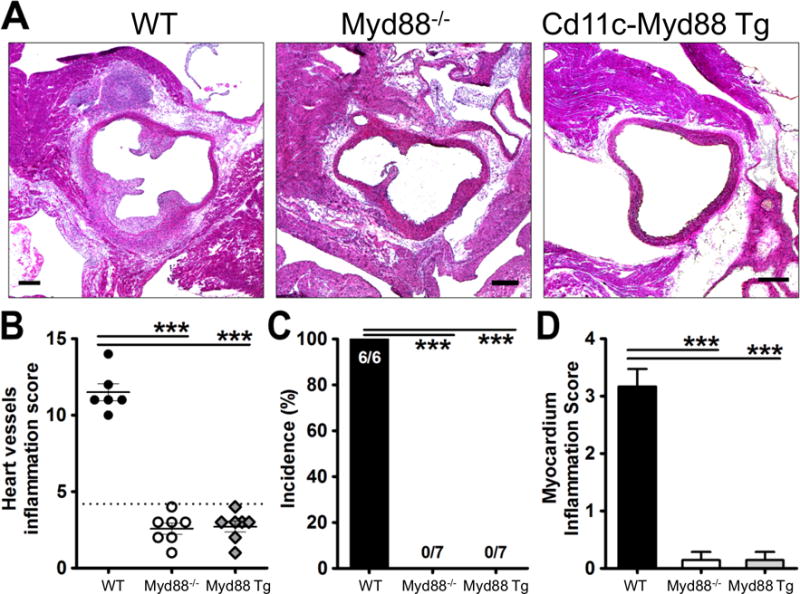
Kawasaki disease (KD) is the most common cause of acute vasculitis and acquired cardiac disease among US children. We have previously shown that both TLR2/MyD88 and interleukin (IL)-1β signaling are required for the Lactobacillus casei cell wall extract-induced KD vasculitis mouse model. The objectives of this study were to investigate the cellular origins of IL-1 production, the role of CD11c(+) dendritic cells and macrophages, and the relative contribution of hematopoietic and stromal cells for IL-1 responsive cells, as well the MyD88 signaling, in Lactobacillus casei cell wall extract-induced KD mouse model of vasculitis.
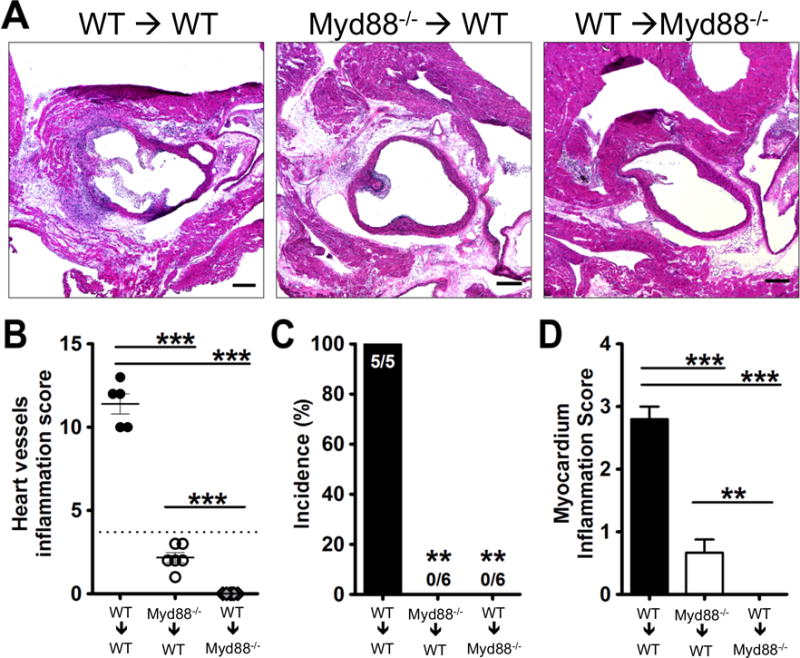
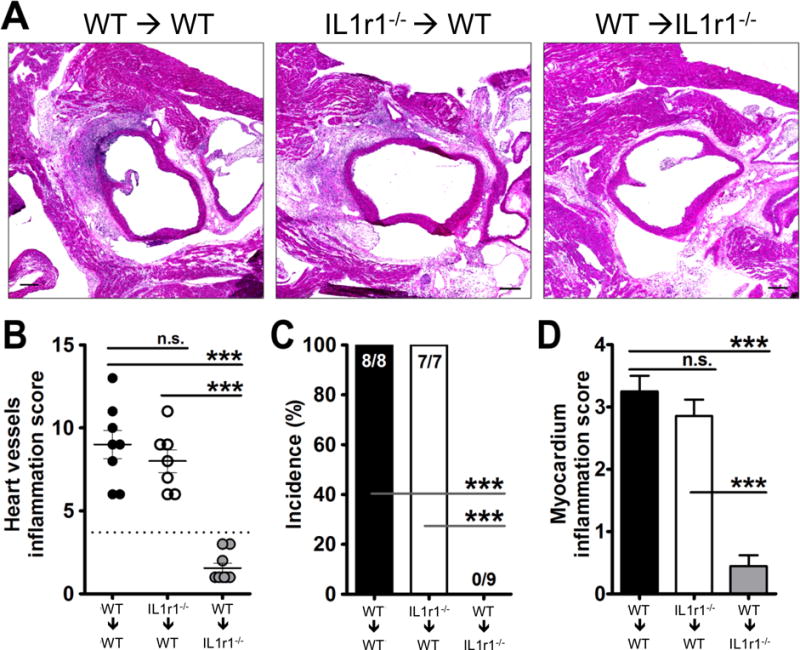
Using mouse knockout models and antibody depletion, we found that both IL-1α and IL-1β were required for Lactobacillus casei cell wall extract-induced KD. Both dendritic cells and macrophages were necessary, and we found that MyD88 signaling was required in both hematopoietic and stromal cells. However, IL-1 response and signaling were critically required in nonendothelial stromal cells, but not in hematopoietic cells.
Our results suggest that IL-1α and IL-1β, as well as CD11c(+) dendritic cells and macrophages, are essential for the development of KD vasculitis and coronary arteritis in this mouse model. Bone marrow chimera experiments suggest that MyD88 signaling is important in both hematopoietic and stromal cells, whereas IL-1 signaling and response are required only in stromal cells, but not in endothelial cells. Determining the role of IL-1α and IL-1β and of specific cell types in the KD vasculitis mouse model may have important implications for the design of more targeted therapies and understanding of the molecular mechanisms of KD immunopathologies.
川崎病(KD)是美国儿童急性血管炎和后天性心脏病的最常见病因。我们之前已经表明,在干酪乳杆菌细胞壁提取物诱导的KD血管炎小鼠模型中,Toll样受体2(TLR2)/髓样分化因子88(MyD88)和白细胞介素(IL)-1β信号传导都是必需的。本研究的目的是调查IL-1产生的细胞来源、CD11c(+)树突状细胞和巨噬细胞的作用、造血细胞和基质细胞对IL-1反应性细胞的相对贡献,以及在干酪乳杆菌细胞壁提取物诱导的KD血管炎小鼠模型中MyD88信号传导的作用。
使用小鼠基因敲除模型和抗体清除法,我们发现IL-1α和IL-1β对于干酪乳杆菌细胞壁提取物诱导的KD都是必需的。树突状细胞和巨噬细胞都是必需的,并且我们发现造血细胞和基质细胞中都需要MyD88信号传导。然而,IL-1反应和信号传导在非内皮基质细胞中至关重要,而在造血细胞中则不需要。
我们的结果表明,IL-1α和IL-1β以及CD11c(+)树突状细胞和巨噬细胞对于该小鼠模型中KD血管炎和冠状动脉炎的发展至关重要。骨髓嵌合体实验表明,MyD88信号传导在造血细胞和基质细胞中都很重要,而IL-1信号传导和反应仅在基质细胞中需要,而在内皮细胞中则不需要。确定IL-1α和IL-1β以及特定细胞类型在KD血管炎小鼠模型中的作用,可能对设计更具针对性的治疗方法以及理解KD免疫病理学的分子机制具有重要意义。