Wang Liang, Wang Hua, Chen Hao, Wang Wei-da, Chen Xiao-Qin, Geng Qi-Rong, Xia Zhong-Jun, Lu Yue
State Key Laboratory of Oncology in South China; Collaborative Innovation Center for Cancer Medicine, Guangzhou, Guangdong, 510060, People's Republic of China.
Department of Hematologic Oncology, Sun Yat-sen University Cancer Center, Guangzhou, Guangdong, 510060, People's Republic of China.
Oncotarget. 2015 Dec 1;6(38):41228-36. doi: 10.18632/oncotarget.5682.
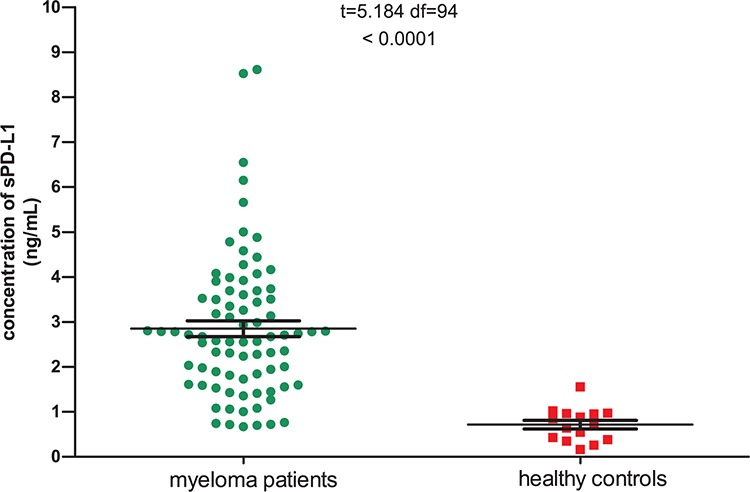
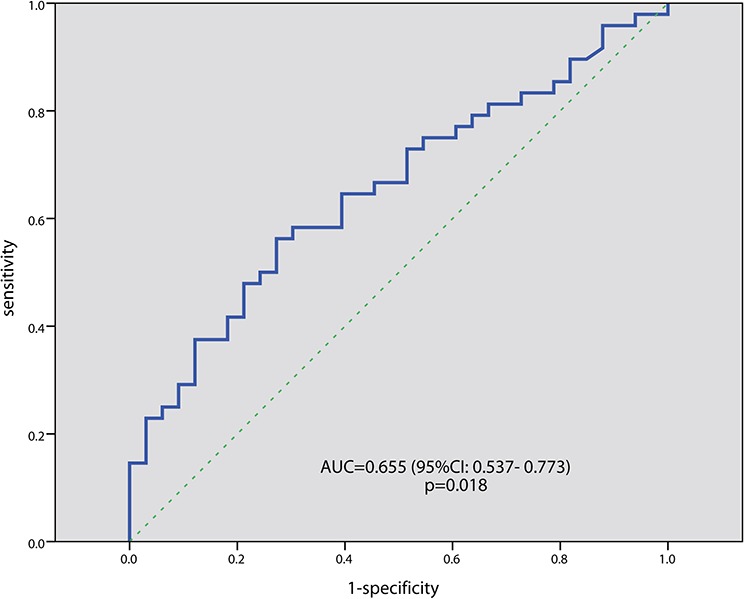
Immune checkpoint signaling plays an important role in immunosuppression in multiple myeloma (MM). Blood levels of soluble programmed death-ligand 1 (sPD-L1), a checkpoint-relevant protein, might predict treatment response and survival outcomes in MM patients. We used an enzyme-linked immunosorbent assay to measure serum sPD-L1 levels in 81 newly diagnosed MM patients. We found that myeloma patients had higher sPD-L1 concentrations than healthy controls. The best sPD-L1 cutoff value for predicting disease progression risk was 2.783 ng/mL. The overall response rate to treatment was higher in low sPD-L1 patients than in high sPD-L1 patients. The 3-year progression free survival (PFS) and overall survival (OS) rates for all patients were 16% and 64%, respectively. Multivariate survival analysis including Eastern Cooperative Oncology Group performance status score, treatment response, and sPD-L1 level showed that a less than partial treatment response (PR) and higher sPD-L1 levels (>2.783 ng/ml) were independent prognostic factors for shorter PFS; neither factor was predictive of OS. The serum sPD-L1 level is a valuable biomarker for predicting treatment response and an independent prognostic factor for PFS. PD-1/ PD-L1 blockade may be a promising novel immune-based therapeutic strategy in MM.
免疫检查点信号传导在多发性骨髓瘤(MM)的免疫抑制中起重要作用。可溶性程序性死亡配体1(sPD-L1)是一种与检查点相关的蛋白质,其血液水平可能预测MM患者的治疗反应和生存结果。我们使用酶联免疫吸附测定法测量了81例新诊断MM患者的血清sPD-L1水平。我们发现骨髓瘤患者的sPD-L1浓度高于健康对照。预测疾病进展风险的最佳sPD-L1临界值为2.783 ng/mL。低sPD-L1患者的总体治疗反应率高于高sPD-L1患者。所有患者的3年无进展生存期(PFS)和总生存期(OS)率分别为16%和64%。包括东部肿瘤协作组体能状态评分、治疗反应和sPD-L1水平的多变量生存分析表明,治疗反应小于部分缓解(PR)和较高的sPD-L1水平(>2.783 ng/ml)是PFS较短的独立预后因素;这两个因素均不能预测OS。血清sPD-L1水平是预测治疗反应的有价值生物标志物,也是PFS的独立预后因素。PD-1/PD-L1阻断可能是MM中有前景的新型免疫治疗策略。