Alp Emine, Orhan Tülay, Kürkcü Cemile Atalay, Ersoy Safiye, McLaws Mary-Louise
Faculty of Medicine, Department of Infectious Diseases and Clinical Microbiology, and Infection Control Committee, Erciyes University, Kayseri, Turkey.
Faculty of Medicine, Faculty of Medicine, Infection Control Committee, Erciyes University, Kayseri, Turkey.
Antimicrob Resist Infect Control. 2015 Aug 25;4:34. doi: 10.1186/s13756-015-0074-3. eCollection 2015.
Patients in resourced-limited neonatal and pediatric intensive care units (NICU and PICU) are vulnerable to healthcare associated infections (HAI). We report the incidence of HAI, multidrug resistant microorganisms (MDROs) and the pattern of antibiotic usage in the first six years of a surveillance program in a teaching hospital in Turkey.
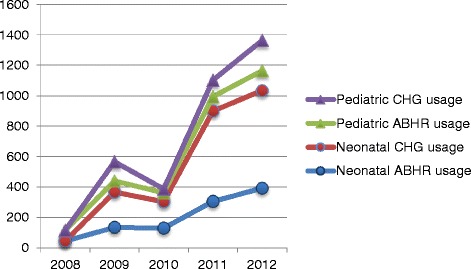
Between 2007 and 2012 surveillance data for HAI, MDROs and antibiotic usage were collected from the infection control department, pathology, hospital admissions and pharmacy. In 2009 hand hygiene auditing was introduced. Hand sanitizer usage was expressed as liters per 1000 patient-days. Antibiotic usage was presented as defined daily doses (DDD). Evidence of change in the incidence of HAI was tested using Poison regression modeling.
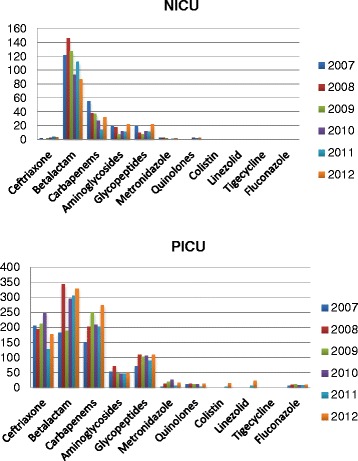
The rate of gram negative MDRO in PICU increased significant between 2007 and 2012 (IRR 1.5, P = 0.033) but remained unchanged in NICU (P = 0.824). By 2012 ceftriaxone prescribing in PICU had decreased while carbapenem prescribing increased by 80 %. In NICU carbapenem decreased by 42 % and betalactam decreased by 29 %. Hand hygiene compliance significantly improved in PICU (IRR 1.9, p < 0.001) and NICU (IRR 2.2, p < 0.001) but compliance remained modest after three years with inconsistent levels across the 5 moments.
The early years of our infection control program highlights the endemicity of HAI and MDROs in our NICU and PICU. The consistent pattern of antibiotic usage, endemic MROs in PICU and modest hand hygiene clearly provide strategic focuses for intervention.
资源有限的新生儿和儿科重症监护病房(NICU和PICU)中的患者易发生医疗相关感染(HAI)。我们报告了土耳其一家教学医院监测项目头六年中HAI的发生率、多重耐药微生物(MDRO)以及抗生素使用模式。
2007年至2012年期间,从感染控制部门、病理科、医院入院处和药房收集了HAI、MDRO和抗生素使用的监测数据。2009年引入了手卫生审核。洗手液使用量以每1000患者日升数表示。抗生素使用量以限定日剂量(DDD)表示。使用泊松回归模型测试HAI发生率变化的证据。
2007年至2012年期间,PICU中革兰氏阴性MDRO的发生率显著增加(发病率比1.5,P = 0.033),但NICU中保持不变(P = 0.824)。到2012年,PICU中头孢曲松的处方量减少,而碳青霉烯类药物的处方量增加了80%。在NICU中,碳青霉烯类药物减少了42%,β-内酰胺类药物减少了29%。PICU(发病率比1.9,p < 0.001)和NICU(发病率比2.2,p < 0.001)的手卫生依从性显著提高,但三年后依从性仍然一般,五个时刻的水平不一致。
我们感染控制项目的早期凸显了HAI和MDRO在我们NICU和PICU中的地方性流行情况。抗生素使用的一致模式、PICU中地方性MRO以及一般的手卫生情况显然为干预提供了战略重点。