Division of Clinical Chemistry, Department of Laboratory Medicine, Karolinska Institutet Huddinge, Stockholm, Sweden.
Urology Laboratory, Department of Molecular Medicine and Surgery, Karolinska Institutet 171 76, Stockholm, Sweden.
Pharmacol Res Perspect. 2015 Oct;3(5):e00171. doi: 10.1002/prp2.171. Epub 2015 Aug 19.
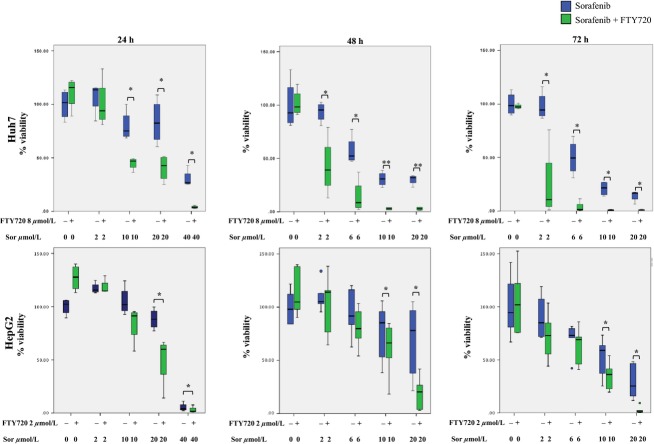
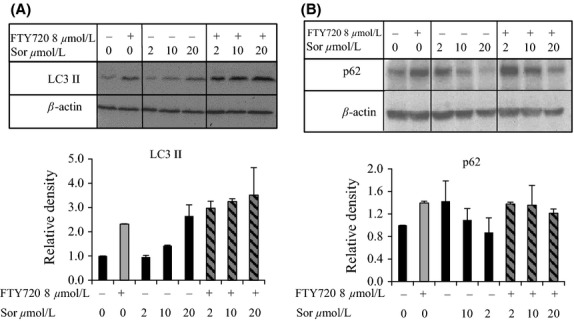
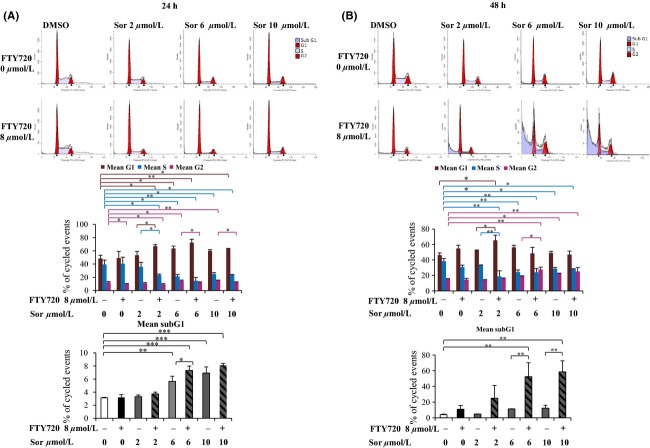
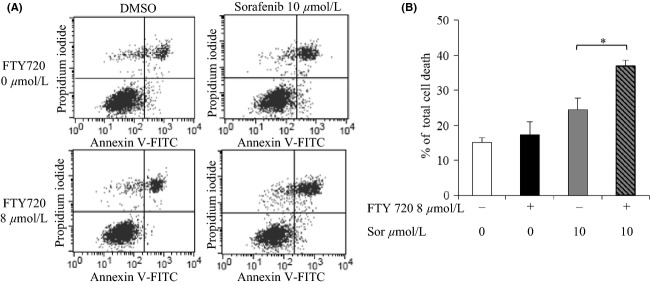
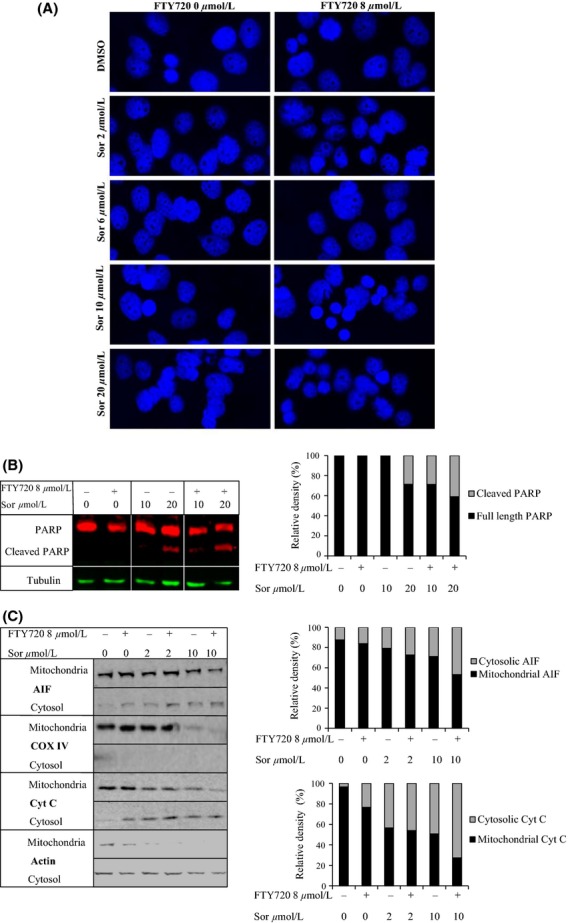
Hepatocellular carcinoma (HCC) is one of the leading causes of cancer-related death worldwide. The multityrosine kinase inhibitor sorafenib is used in the therapy of advanced disease. However, the effects of sorafenib are limited, and combination treatments aiming at improved survival are encouraged. The sphingosine analog FTY720 (Fingolimod), which is approved for treatment of multiple sclerosis, has shown tumor suppressive effects in cell lines and animal models of HCC. In the present study, we combined sorafenib with FTY720 in order to sensitize the HCC cell lines Huh7 and HepG2 to sorafenib treatment. Using the XTT assay we show that noncytotoxic doses of FTY720 synergistically enhanced the decrease in viability caused by treatment of both cell lines with increasing doses of sorafenib. Further studies in Huh7 revealed that combined treatment with FTY720 and sorafenib resulted in G1 arrest and enhanced cell death measured using flow cytometry analysis of cells labeled with propidium iodide (PI)/Annexin-V and PI and 4',6-diamidino-2-phenylindole-staining of nuclei. In addition, signs of both caspase-dependent and - independent apoptosis were observed, as cotreatment with FTY720 and sorafenib caused cytochrome c release and poly-ADP ribose polymerase-cleavage as well as translocation of Apoptosis-inducing factor into the cytosol. We also detected features of autophagy blockage, as the protein levels of LC3-II and p62 were affected by combined treatment with FTY720 and sorafenib. Together, our results suggest that FTY720 sensitizes HCC cells to cytotoxic effects induced by treatment with sorafenib alone. These findings warrant further investigations of combined treatment with sorafenib and FTY720 in vivo in order to develop more effective treatment of HCC.
肝细胞癌 (HCC) 是全球癌症相关死亡的主要原因之一。多酪氨酸激酶抑制剂索拉非尼用于晚期疾病的治疗。然而,索拉非尼的效果有限,鼓励采用旨在提高生存率的联合治疗。鞘氨醇类似物 FTY720(芬戈莫德)已获批准用于多发性硬化症的治疗,在 HCC 的细胞系和动物模型中显示出肿瘤抑制作用。在本研究中,我们将索拉非尼与 FTY720 联合使用,以使 HCC 细胞系 Huh7 和 HepG2 对索拉非尼治疗敏感。通过 XTT 测定,我们表明非细胞毒性剂量的 FTY720 与索拉非尼剂量增加协同增强了两种细胞系活力下降。在 Huh7 中的进一步研究表明,FTY720 和索拉非尼联合治疗导致 G1 期阻滞,并通过碘化丙啶 (PI)/Annexin-V 和 PI 以及细胞核 4',6-二脒基-2-苯吲哚染色的细胞流式细胞术分析测量增强细胞死亡。此外,观察到 caspase 依赖性和非依赖性细胞凋亡的迹象,因为 FTY720 和索拉非尼的共处理导致细胞色素 c 释放和多聚 ADP 核糖聚合酶切割以及凋亡诱导因子向细胞质易位。我们还检测到自噬阻断的特征,因为 LC3-II 和 p62 的蛋白水平受到 FTY720 和索拉非尼联合治疗的影响。总之,我们的结果表明,FTY720 使 HCC 细胞对单独用索拉非尼治疗诱导的细胞毒性作用敏感。这些发现证明了在体内进一步研究索拉非尼和 FTY720 的联合治疗以开发更有效的 HCC 治疗方法是合理的。