Benitez Suzana Ulian, Carneiro Everardo Magalhães, de Oliveira Alexandre Leite Rodrigues
Department of Structural and Functional Biology Institute of Biology State University of Campinas 13083-970 Campinas Sao Paulo Brazil.
Brain Behav. 2015 Sep 9;5(10):e00372. doi: 10.1002/brb3.372. eCollection 2015 Oct.
Hyperglycemia is the main cause of diabetic complications, contributing to a widespread degeneration of the nervous system. Nevertheless, the main focus has been the sensory neurons because of neuropathic pain, while the impairments associated with the spinal cord and motor deficits, mostly of those initiated at early stages of the disease, have been poorly investigated. In this way, the present study used the nonobese diabetic mouse model to evaluate the microenvironment around motoneurons at ventral horn of the spinal cord, following prolonged hyperglycemia.
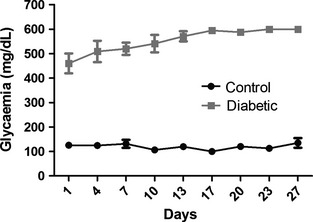
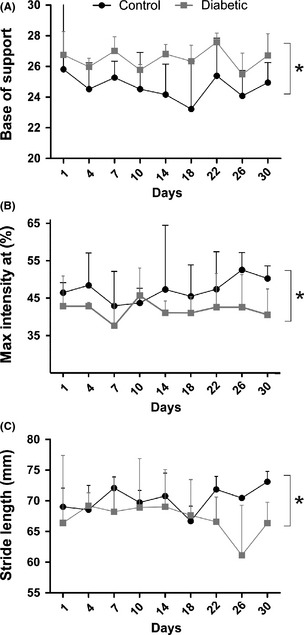
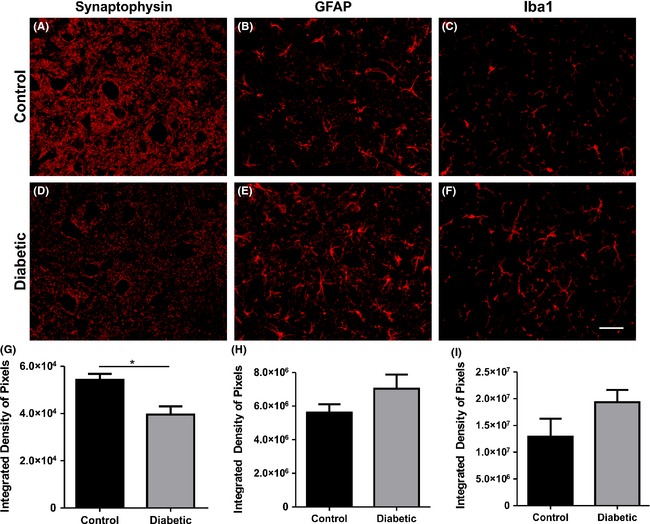
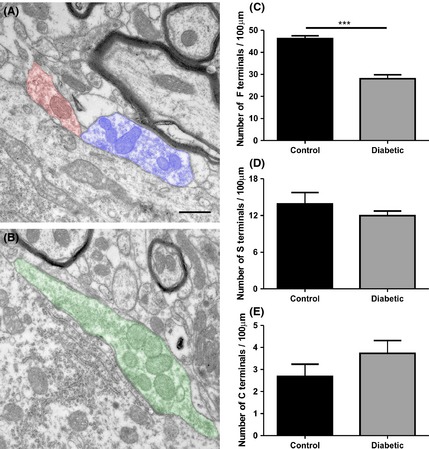
Adult female mice were divided into two groups: spontaneously diabetic (n = 33) and nondiabetic (n = 26). Mice were considered hyperglycemic when blood glucose surpassed 400 mg/dL. Following 2 weeks from that stage, part of the animals was euthanized and the lumbar intumescences were obtained and processed for immunohistochemistry and transmission electron microscopy. For immunohistochemistry, the antibodies used for integrated density of pixels quantification were anti-synaptophysin, anti-GFAP, and anti-Iba1. The functional analysis was monitored with the walking track test (CatWalk system) during 4 weeks.
The results revealed significant motor impairment in diabetic animals in comparison to the control group. Such loss of motor control correlated with a significant reduction in presynaptic terminals apposed to the motoneurons. Nevertheless, there were no significant changes in glial reaction in the spinal cord.
Overall, the results herein revealed central nervous system changes at early stages of the disease that may in turn contribute to the motor deficit. Such changes open a new window of investigation in early stages of diabetes to better comprehend motor impairment as a long-term complication of the disease.
高血糖是糖尿病并发症的主要原因,会导致神经系统广泛退化。然而,由于神经病理性疼痛,主要关注的是感觉神经元,而与脊髓和运动功能障碍相关的损伤,尤其是在疾病早期出现的损伤,研究较少。因此,本研究使用非肥胖糖尿病小鼠模型来评估长期高血糖后脊髓腹角运动神经元周围的微环境。
成年雌性小鼠分为两组:自发性糖尿病组(n = 33)和非糖尿病组(n = 26)。当血糖超过400mg/dL时,小鼠被认为患有高血糖。从该阶段开始2周后,部分动物被安乐死,获取腰膨大并进行免疫组织化学和透射电子显微镜检查。对于免疫组织化学,用于像素积分密度定量的抗体是抗突触素、抗胶质纤维酸性蛋白和抗离子钙结合衔接分子1。在4周内用行走轨迹测试(CatWalk系统)监测功能分析。
结果显示,与对照组相比,糖尿病动物存在明显的运动功能障碍。这种运动控制能力的丧失与运动神经元突触前终末的显著减少相关。然而,脊髓中的胶质反应没有显著变化。
总体而言,本研究结果揭示了疾病早期中枢神经系统的变化,这些变化可能反过来导致运动功能障碍。这些变化为糖尿病早期研究打开了一个新的窗口,以便更好地理解运动功能障碍作为该疾病的一种长期并发症。