Augustin Albert J, Kuppermann Baruch D, Lanzetta Paolo, Loewenstein Anat, Li Xiao-Yan, Cui Harry, Hashad Yehia, Whitcup Scott M
Department of Ophthalmology, Staedtisches Klinikum Karlsruhe, Moltkestrasse 90, 76133, Karlsruhe, Germany.
Gavin Herbert Eye Institute, University of California at Irvine, Irvine, CA, USA.
BMC Ophthalmol. 2015 Oct 30;15:150. doi: 10.1186/s12886-015-0148-2.
Dexamethasone intravitreal implant 0.7 mg (DEX 0.7) was approved for treatment of diabetic macular edema (DME) after demonstration of its efficacy and safety in the MEAD registration trials. We performed subgroup analysis of MEAD study results to evaluate the efficacy and safety of DEX 0.7 treatment in patients with previously treated DME.
Three-year, randomized, sham-controlled phase 3 study in patients with DME, best-corrected visual acuity (BCVA) of 34-68 Early Treatment Diabetic Retinopathy Study letters (20/200-20/50 Snellen equivalent), and central retinal thickness (CRT) ≥ 300 μm measured by time-domain optical coherence tomography. Patients were randomized to 1 of 2 doses of DEX (0.7 mg or 0.35 mg), or to sham procedure, with retreatment no more than every 6 months. The primary endpoint was ≥ 15-letter gain in BCVA at study end. Average change in BCVA and CRT from baseline during the study (area-under-the-curve approach) and adverse events were also evaluated. The present subgroup analysis evaluated outcomes in patients randomized to DEX 0.7 (marketed dose) or sham based on prior treatment for DME at study entry.
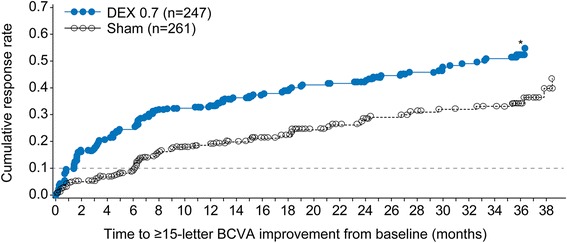
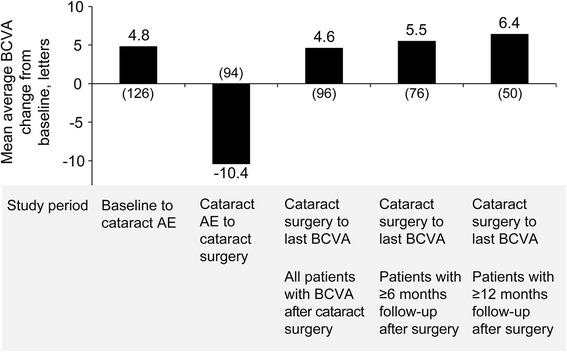
Baseline characteristics of previously treated DEX 0.7 (n = 247) and sham (n = 261) patients were similar. In the previously treated subgroup, mean number of treatments over 3 years was 4.1 for DEX 0.7 and 3.2 for sham, 21.5% of DEX 0.7 patients versus 11.1 % of sham had ≥ 15-letter BCVA gain from baseline at study end (P = 0.002), mean average BCVA change from baseline was +3.2 letters with DEX 0.7 versus +1.5 letters with sham (P = 0.024), and mean average CRT change from baseline was -126.1 μm with DEX 0.7 versus -39.0 μm with sham (P < .001). Cataract-related adverse events were reported in 70.3% of baseline phakic patients in the previously treated DEX 0.7 subgroup; vision gains were restored following cataract surgery.
DEX 0.7 significantly improved visual and anatomic outcomes in patients with DME previously treated with laser, intravitreal anti-vascular endothelial growth factor, intravitreal triamcinolone acetonide, or a combination of these therapies. The safety profile of DEX 0.7 in previously treated patients was similar to its safety profile in the total study population.
ClinicalTrials.gov NCT00168337 and NCT00168389, registered 12 September 2005.
0.7毫克地塞米松玻璃体内植入剂(DEX 0.7)在MEAD注册试验中证实其有效性和安全性后,被批准用于治疗糖尿病性黄斑水肿(DME)。我们对MEAD研究结果进行了亚组分析,以评估DEX 0.7治疗既往接受过治疗的DME患者的有效性和安全性。
一项为期三年的随机、假手术对照3期研究,研究对象为DME患者,其最佳矫正视力(BCVA)为34 - 68早期糖尿病性视网膜病变研究字母(相当于20/200 - 20/50 Snellen视力),通过时域光学相干断层扫描测量的中心视网膜厚度(CRT)≥300μm。患者被随机分为2种剂量的DEX(0.7毫克或0.35毫克)中的一种,或接受假手术,每6个月最多再治疗一次。主要终点是研究结束时BCVA提高≥15个字母。还评估了研究期间BCVA和CRT相对于基线的平均变化(曲线下面积法)以及不良事件。本亚组分析评估了根据研究入组时DME既往治疗情况随机接受DEX 0.7(上市剂量)或假手术的患者的结局。
既往接受过治疗的DEX 0.7组(n = 247)和假手术组(n = 261)患者的基线特征相似。在既往接受过治疗的亚组中,DEX 0.7组3年的平均治疗次数为4.1次,假手术组为3.2次,研究结束时,21.5%的DEX 0.7组患者相对于基线BCVA提高≥15个字母,而假手术组为11.1%(P = 0.002),DEX 0.7组相对于基线的平均BCVA变化为+3.2个字母,假手术组为+1.5个字母(P = 0.024),DEX 0.7组相对于基线的平均CRT变化为-126.1μm,假手术组为-39.0μm(P < 0.001)。在既往接受过治疗的DEX 0.7亚组中,70.3%的基线有晶状体眼患者报告了与白内障相关的不良事件;白内障手术后视力恢复。
DEX 0.7显著改善了既往接受过激光、玻璃体内抗血管内皮生长因子、玻璃体内曲安奈德或这些疗法联合治疗的DME患者的视力和解剖学结局。DEX 0.7在既往接受过治疗的患者中的安全性概况与其在整个研究人群中的安全性概况相似。
ClinicalTrials.gov NCT00168337和NCT00168389,于2005年9月12日注册。