Nigro Elisa Agnese, Castelli Maddalena, Boletta Alessandra
Division of Genetics and Cell Biology, Dibit, IRCCS-San Raffaele Scientific Institute, Via Olgettina 58, 20132 Milano, Italy.
Cells. 2015 Oct 30;4(4):687-705. doi: 10.3390/cells4040687.
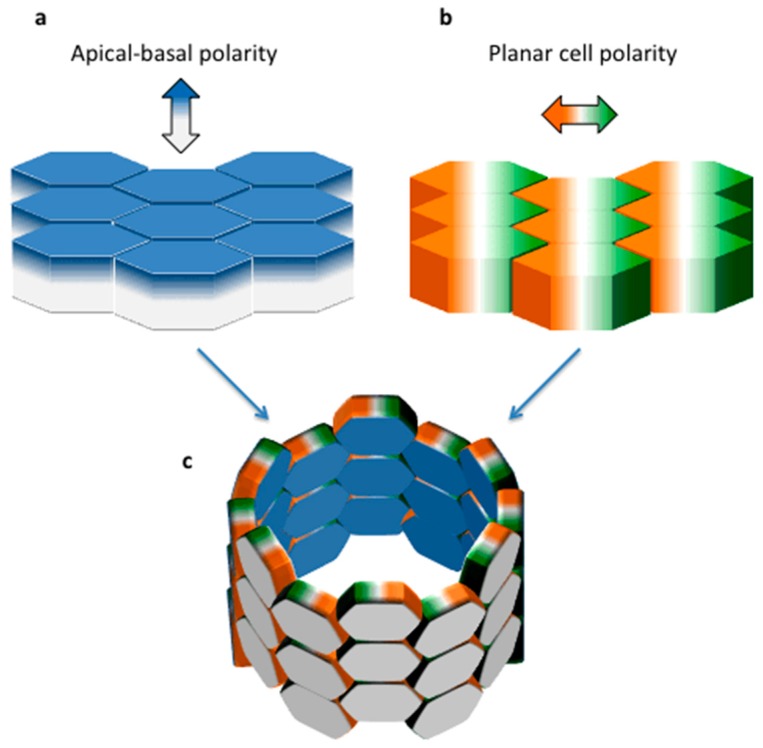
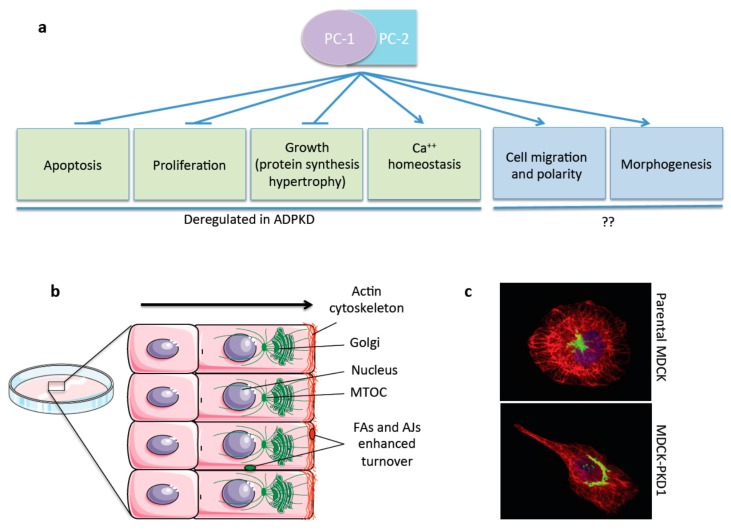
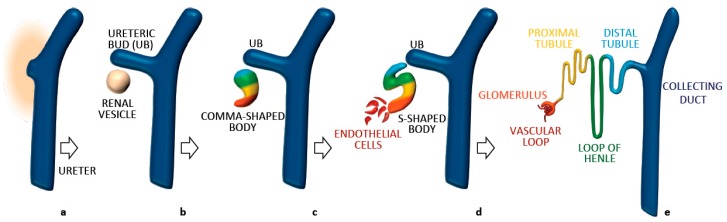
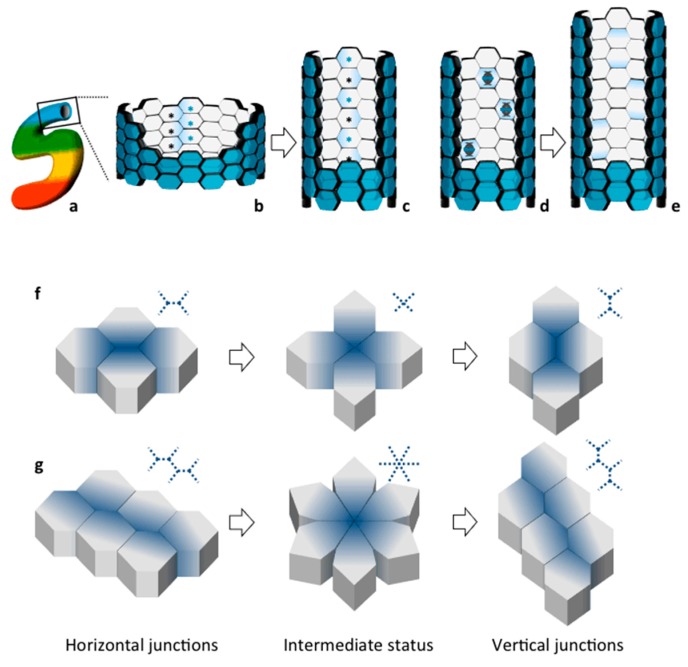
Cystic kidney diseases (CKD) is a class of disorders characterized by ciliary dysfunction and, therefore, belonging to the ciliopathies. The prototype CKD is autosomal dominant polycystic kidney disease (ADPKD), whose mutated genes encode for two membrane-bound proteins, polycystin-1 (PC-1) and polycystin-2 (PC-2), of unknown function. Recent studies on CKD-associated genes identified new mechanisms of morphogenesis that are central for establishment and maintenance of proper renal tubular diameter. During embryonic development in the mouse and lower vertebrates a convergent-extension (CE)-like mechanism based on planar cell polarity (PCP) and cellular intercalation is involved in "sculpting" the tubules into a narrow and elongated shape. Once the appropriate diameter is established, further elongation occurs through oriented cell division (OCD). The polycystins (PCs) regulate some of these essential processes. In this review we summarize recent work on the role of PCs in regulating cell migration, the cytoskeleton, and front-rear polarity. These important properties are essential for proper morphogenesis of the renal tubules and the lymphatic vessels. We highlight here several open questions and controversies. Finally, we try to outline some of the next steps required to study these processes and their relevance in physiological and pathological conditions.
囊性肾病(CKD)是一类以纤毛功能障碍为特征的疾病,因此属于纤毛病。CKD的典型代表是常染色体显性多囊肾病(ADPKD),其突变基因编码两种功能未知的膜结合蛋白,多囊蛋白-1(PC-1)和多囊蛋白-2(PC-2)。最近对CKD相关基因的研究确定了新的形态发生机制,这些机制对于建立和维持适当的肾小管直径至关重要。在小鼠和低等脊椎动物的胚胎发育过程中,一种基于平面细胞极性(PCP)和细胞插入的汇聚延伸(CE)样机制参与将肾小管“塑造”成狭窄且细长的形状。一旦建立了合适的直径,通过定向细胞分裂(OCD)会发生进一步的伸长。多囊蛋白(PCs)调节其中一些重要过程。在这篇综述中,我们总结了关于PCs在调节细胞迁移、细胞骨架和前后极性方面作用的最新研究。这些重要特性对于肾小管和淋巴管的正常形态发生至关重要。我们在此强调几个悬而未决的问题和争议。最后,我们试图概述研究这些过程及其在生理和病理条件下相关性所需的一些后续步骤。