Departments of Internal Medicine and Rheumatology , VU University Medical Centre , Amsterdam , The Netherlands.
Health Economics and Outcomes Research, AbbVie , North Chicago, Illinois , USA.
RMD Open. 2015 May 21;1(1):e000080. doi: 10.1136/rmdopen-2015-000080. eCollection 2015.
To assess the effects of treatment with antitumour necrosis factor (TNF) agents, methotrexate, or other non-biological disease-modifying antirheumatic drugs (DMARDs) on cardiovascular event risks among patients with rheumatoid arthritis (RA).
We conducted a retrospective study using data from the MarketScan claims database. Patients with RA with ≥1 prescription for an index drug were included. Each patient's use of an index drug was calculated cumulatively as a time-varying exposure. The incidence of cardiovascular events among patients with RA was determined. Associations between drug exposures and occurrence of cardiovascular events were assessed with Cox proportional hazards models.
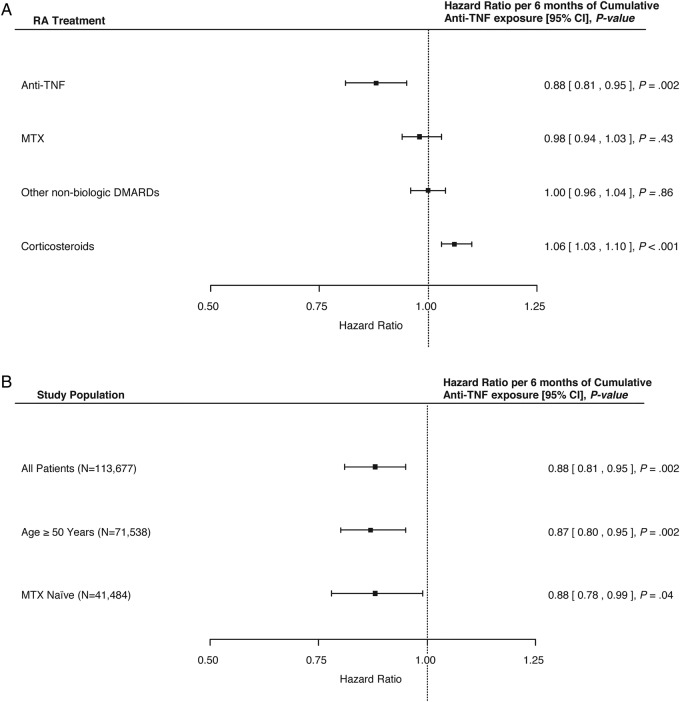
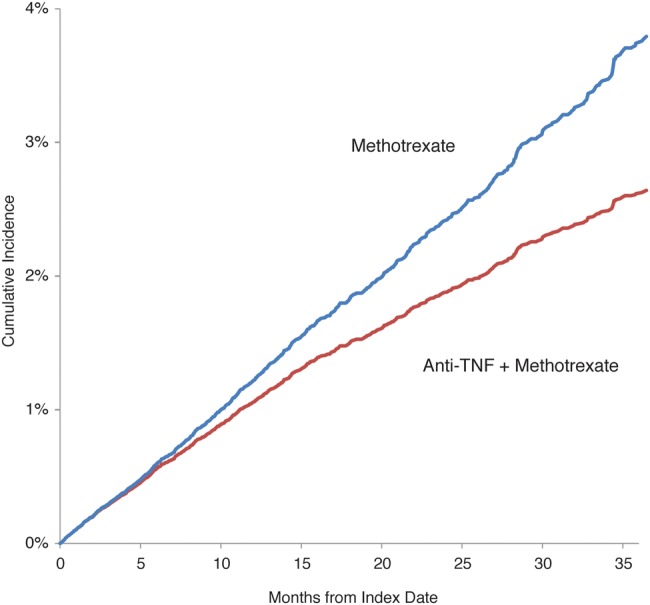
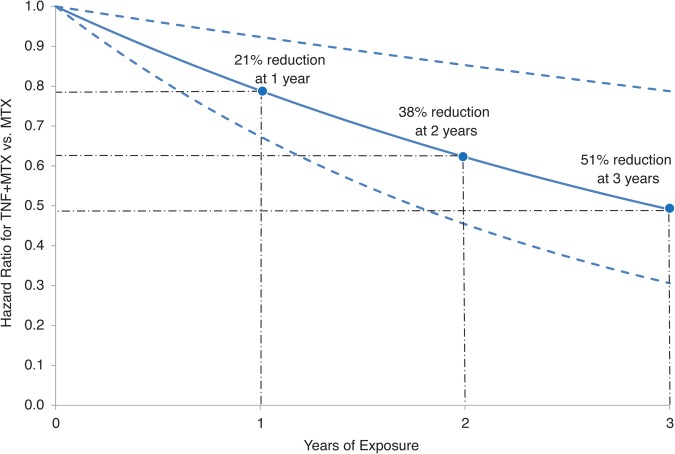
Of 113 677 patients identified, 35.8%, 41.1% and 23.1% received anti-TNF agents, methotrexate and other DMARDs, respectively. Patients were treated for an average of 7.6 months; 2138 patients (1.9%) had a cardiovascular event following their index prescription. Each additional 6 months of anti-TNF therapy use versus non-use reduced the risk (HR; 95% CI) for any cardiovascular event by 12% (0.88; 0.81 to 0.95, p=0.002). Anti-TNF therapy was associated with a 13% and 12% reduction in cardiovascular events in patients aged ≥50 years (0.87; 0.80 to 0.95, p=0.002) and in those without prior methotrexate use (0.88; 0.78 to 0.99, p=0.04), respectively. Cumulative use of 1, 2 or 3 years of anti-TNF therapy versus non-use is expected to reduce cardiovascular event risks by 21%, 38% and 51%, respectively.
Anti-TNF therapy was associated with a significantly lower risk of cardiovascular events among patients with RA, older patients with RA and patients without prior exposure to methotrexate.
评估抗肿瘤坏死因子(TNF)制剂、甲氨蝶呤或其他非生物性疾病修正抗风湿药物(DMARDs)治疗对类风湿关节炎(RA)患者心血管事件风险的影响。
我们使用 MarketScan 理赔数据库中的数据进行了一项回顾性研究。纳入至少有 1 次索引药物处方的 RA 患者。每位患者的索引药物使用情况按时间变化进行累计计算。确定 RA 患者的心血管事件发生率。采用 Cox 比例风险模型评估药物暴露与心血管事件发生之间的关系。
在确定的 113677 名患者中,分别有 35.8%、41.1%和 23.1%接受了抗 TNF 制剂、甲氨蝶呤和其他 DMARDs 治疗。患者的平均治疗时间为 7.6 个月;1938 名患者(1.9%)在索引处方后发生心血管事件。与不使用相比,每增加 6 个月的抗 TNF 治疗使用时间可降低 12%(95%CI:0.88;0.81 至 0.95,p=0.002)的任何心血管事件风险。对于年龄≥50 岁的患者(0.87;0.80 至 0.95,p=0.002)和既往未使用甲氨蝶呤的患者(0.88;0.78 至 0.99,p=0.04),抗 TNF 治疗分别降低 13%和 12%的心血管事件发生率。与不使用相比,累计使用 1、2 或 3 年抗 TNF 治疗分别预计可降低 21%、38%和 51%的心血管事件风险。
抗 TNF 治疗与 RA 患者、年龄较大的 RA 患者和既往未使用甲氨蝶呤的患者的心血管事件风险显著降低相关。