Posid Tasha, Fazio Allyse, Cordes Sara
Department of Psychology, The Ohio State University, Columbus, Ohio, United States of America.
Department of Psychology, Boston College, Chestnut Hill, Massachusetts, United States of America.
PLoS One. 2015 Nov 4;10(11):e0138928. doi: 10.1371/journal.pone.0138928. eCollection 2015.
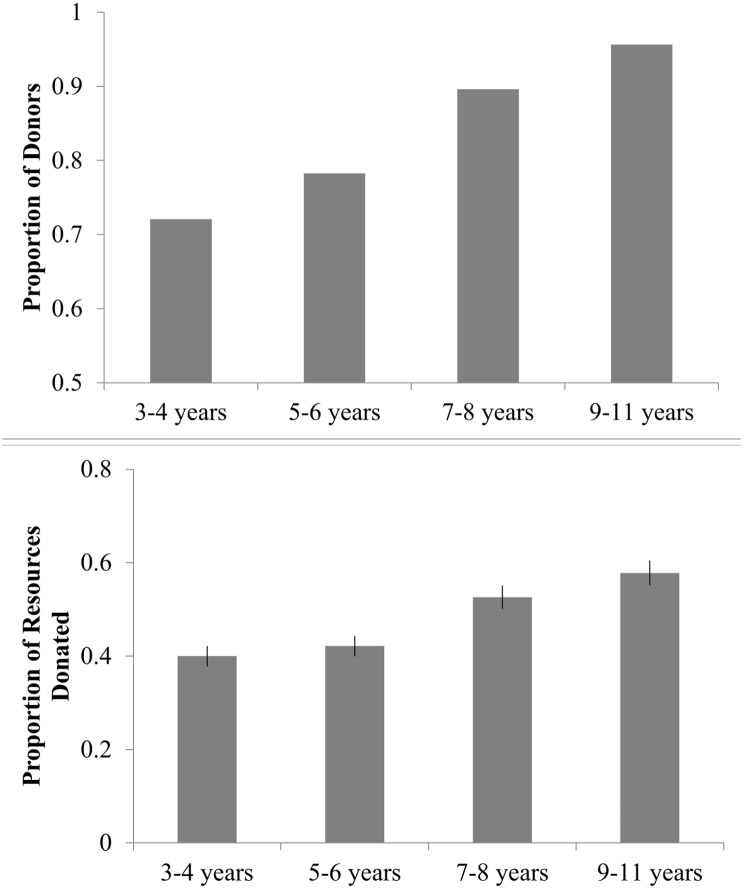
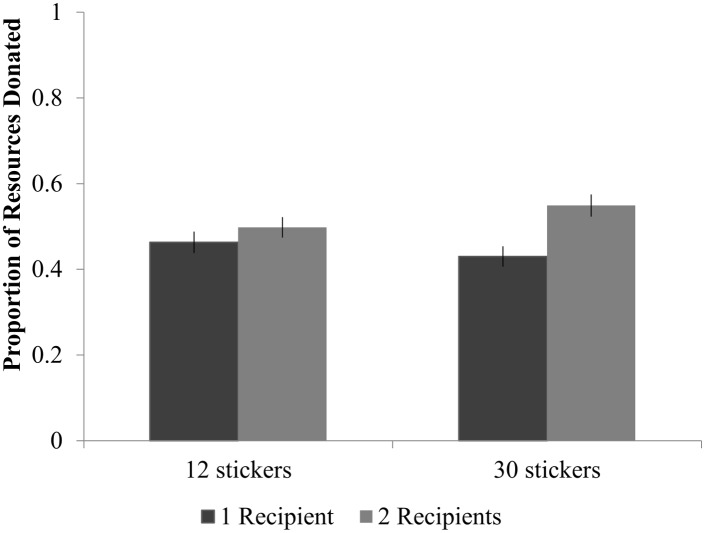
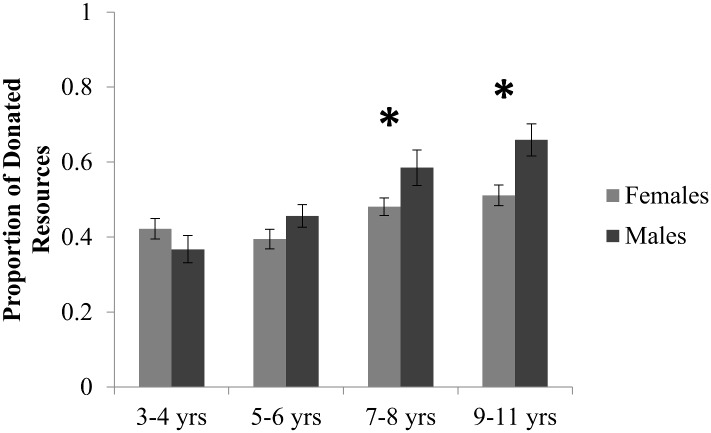
Young children spontaneously share resources with anonymous recipients, but little is known about the specific circumstances that promote or hinder these prosocial tendencies. Children (ages 3-11) received a small (12) or large (30) number of stickers, and were then given the opportunity to share their windfall with either one or multiple anonymous recipients (Dictator Game). Whether a child chose to share or not varied as a function of age, but was uninfluenced by numerical context. Moreover, children's giving was consistent with a proportion-based account, such that children typically donated a similar proportion (but different absolute number) of the resources given to them, regardless of whether they originally received a small or large windfall. The proportion of resources donated, however, did vary based on the number of recipients with whom they were allowed to share, such that on average, children shared more when there were more recipients available, particularly when they had more resources, suggesting they take others into consideration when making prosocial decisions. Finally, results indicated that a child's gender also predicted sharing behavior, with males generally sharing more resources than females. Together, findings suggest that the numerical contexts under which children are asked to share, as well as the quantity of resources that they have to share, may interact to promote (or hinder) altruistic behaviors throughout childhood.
幼儿会自发地与匿名接受者分享资源,但对于促进或阻碍这些亲社会倾向的具体情况,我们知之甚少。儿童(3至11岁)得到少量(12个)或大量(30个)贴纸,然后有机会与一个或多个匿名接受者分享他们的意外之财(独裁者博弈)。孩子是否选择分享因年龄而异,但不受数字背景的影响。此外,孩子们的给予符合基于比例的说法,即孩子们通常会捐赠他们所获资源的相似比例(但绝对数量不同),无论他们最初得到的是少量还是大量意外之财。然而,捐赠资源的比例确实因允许他们分享的接受者数量而异,平均而言,当有更多接受者时,孩子们分享得更多,尤其是当他们有更多资源时,这表明他们在做出亲社会决策时会考虑他人。最后,结果表明孩子的性别也能预测分享行为,男性通常比女性分享更多资源。总之,研究结果表明,要求儿童分享时的数字背景以及他们必须分享的资源数量,可能相互作用,在整个童年时期促进(或阻碍)利他行为。