Kang JeenJoo S, Dervan Peter B
Division of Chemistry and Chemical Engineering,California Institute of Technology,Pasadena,CA 91125,USA.
Q Rev Biophys. 2015 Nov;48(4):453-64. doi: 10.1017/S0033583515000104.
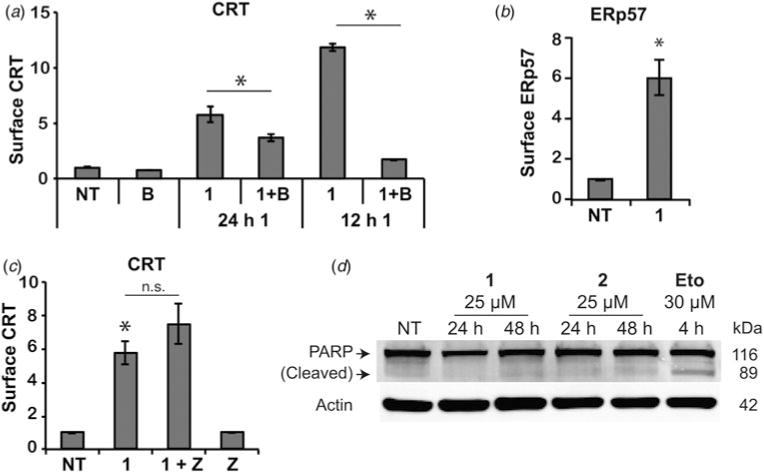
Means to cause an immunogenic cell death could lead to significant insight into how cancer escapes immune control. In this study, we screened a library of five pyrrole-imidazole polyamides coding for different DNA sequences in a model of B-cell lymphoma for the upregulation of surface calreticulin, a pro-phagocytosis signal implicated in immunogenic cell death. We found that hairpin polyamide 1 triggers the release of the damage-associated molecular patterns calreticulin, ATP and HMGB1 in a slow necrotic-type cell death. Consistent with this signaling, we observed an increase in the rate of phagocytosis by macrophages after the cancer cells were exposed to polyamide 1. The DNA sequence preference of polyamide 1 is 5'-WGGGTW-3' (where W = A/T), indicated by the pairing rules and confirmed by the Bind-n-Seq method. The close correspondence of this sequence with the telomere-repeat sequence suggests a potential mechanism of action through ligand binding at the telomere. This study reveals a chemical means to trigger an inflammatory necrotic cell death in cancer cells.
引发免疫原性细胞死亡的方法可能会使人们对癌症如何逃避免疫控制有更深入的了解。在本研究中,我们在B细胞淋巴瘤模型中筛选了一个由五种编码不同DNA序列的吡咯-咪唑聚酰胺组成的文库,以寻找表面钙网蛋白的上调情况,表面钙网蛋白是一种与免疫原性细胞死亡相关的促吞噬信号。我们发现发夹状聚酰胺1以缓慢的坏死型细胞死亡方式触发损伤相关分子模式钙网蛋白、ATP和HMGB1的释放。与这种信号传导一致,我们观察到癌细胞暴露于聚酰胺1后巨噬细胞的吞噬率增加。聚酰胺1的DNA序列偏好为5'-WGGGTW-3'(其中W = A/T),这由配对规则表明并通过Bind-n-Seq方法得到证实。该序列与端粒重复序列的紧密对应表明了通过配体结合端粒的潜在作用机制。这项研究揭示了一种在癌细胞中引发炎性坏死性细胞死亡的化学方法。