Vendrell I, Macedo D, Alho I, Dionísio M R, Costa L
Medical Oncology Department, Santa Maria Hospital, Northern Lisbon Hospital Center, Avenida Professor Egas Moniz, 1649-035 Lisbon, Portugal.
Costa Lab, Instituto de Medicina Molecular, Faculdade de Medicina da Universidade de Lisboa, Avenida Professor Egas Moniz, 1649-035 Lisboa, Portugal.
Mediators Inflamm. 2015;2015:984570. doi: 10.1155/2015/984570. Epub 2015 Oct 11.
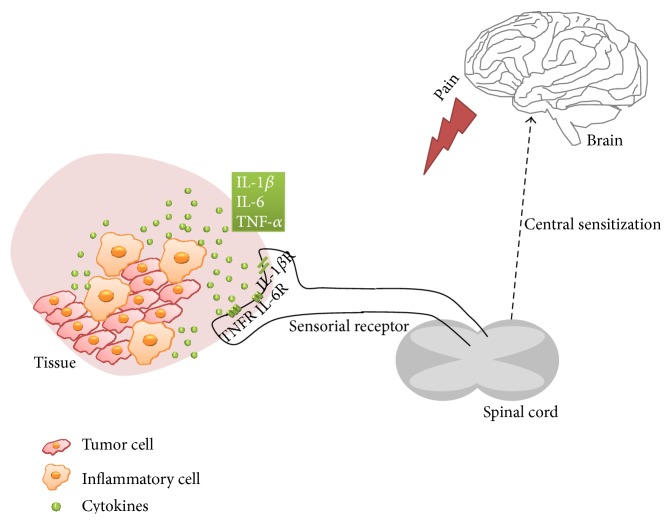
Inflammation is one of the most important causes of the majority of cancer symptoms, including pain, fatigue, cachexia, and anorexia. Cancer pain affects 17 million people worldwide and can be caused by different mediators which act in primary efferent neurons directly or indirectly. Cytokines can be aberrantly produced by cancer and immune system cells and are of particular relevance in pain. Currently, there are very few strategies to control the release of cytokines that seems to be related to cancer pain. Nevertheless, in some cases, targeted drugs are available and in use for other diseases. In this paper, we aim to review the importance of cytokines in cancer pain and targeted strategies that can have an impact on controlling this symptom.
炎症是大多数癌症症状的最重要原因之一,这些症状包括疼痛、疲劳、恶病质和厌食。癌症疼痛影响着全球1700万人,它可能由不同的介质引起,这些介质直接或间接作用于初级传出神经元。细胞因子可由癌细胞和免疫系统细胞异常产生,在疼痛方面具有特殊意义。目前,控制似乎与癌症疼痛相关的细胞因子释放的策略非常少。然而,在某些情况下,有靶向药物可用于其他疾病。在本文中,我们旨在综述细胞因子在癌症疼痛中的重要性以及可能对控制这种症状产生影响的靶向策略。