Noh Siti Munirah Md, Abdul Kadir Siti H Sheikh, Crowston Jonathan G, Subrayan Visvaraja, Vasudevan Sushil
Faculty of Medicine, Brain and Neuroscience Communities of Research, Universiti Teknologi MARA (UiTM) Shah Alam, Selangor, Malaysia.
Centre for Eye Research Australia, the University Of Melbourne, Melbourne, VIC, Australia.
Mol Vis. 2015 Oct 14;21:1191-200. eCollection 2015.
Inhibiting exaggerated wound healing responses, which are primarily mediated by human Tenon's fibroblast (HTF) migration and proliferation, has become the major determining factor for a successful trabeculectomy. Antivascular endothelial growth factor (anti-VEGF) has showed promising results as a potential antifibrotic candidate for use concurrently in trabeculectomy. Preliminary cohort studies have revealed improved bleb morphology following trabeculectomy augmented with ranibizumab. However, the effects on HTFs remain unclear. This study was conducted to understand the effects of ranibizumab on transforming growth factor (TGF)-β1 and transforming growth factor (TGF)-β2 expression by HTFs.
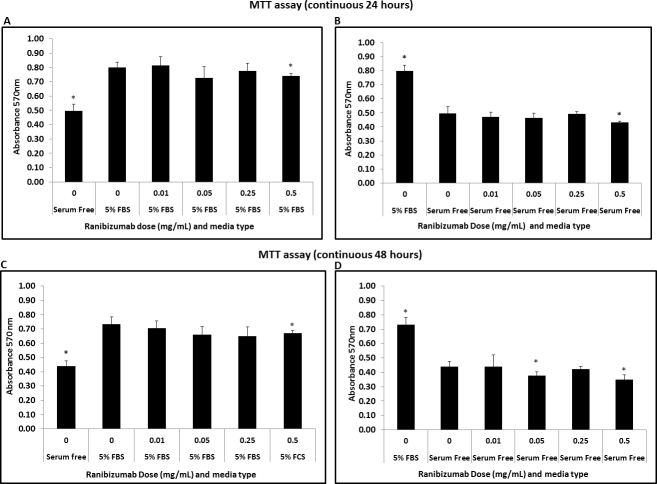
The effect of ranibizumab on HTF proliferation and cell viability was determined using 3-(4,5-dimethylthiazone-2-yl)-2,5-diphenyl tetrazolium (MTT) assay. Ranibizumab at concentrations ranging from 0.01 to 0.5 mg/ml were administered for 24, 48, and 72 h in serum and serum-free conditions. Supernatants and cell lysates from samples were assessed for TGF-β1 and TGF-β2 mRNA and protein levels using quantitative real-time polymerase chain reaction (qRT-PCR) and enzyme-linked immunosorbent assay (ELISA).
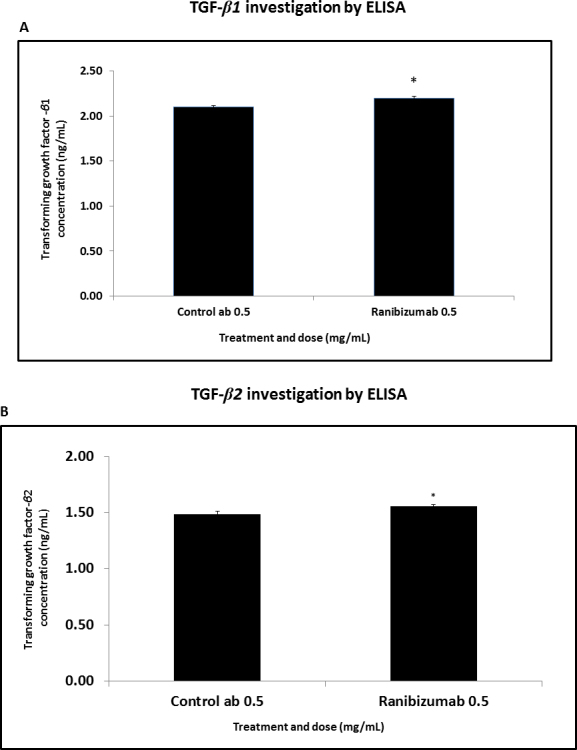
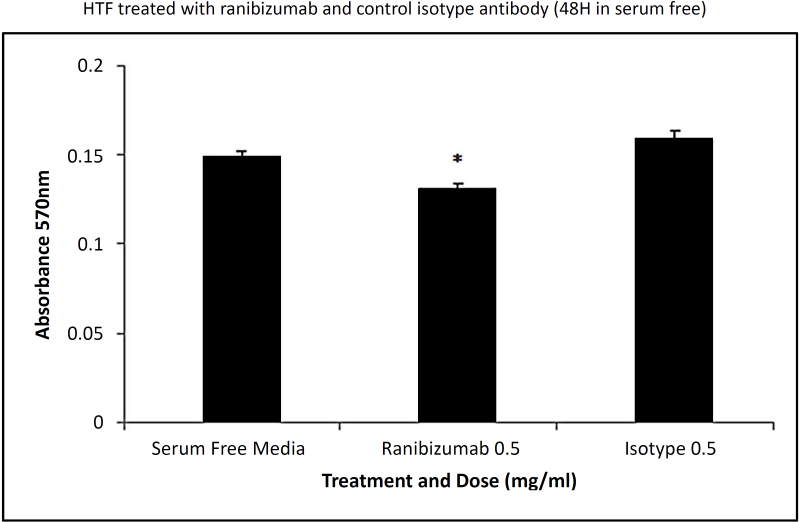
At 48 h, 0.5 mg/ml of ranibizumab significantly induced cell death under serum-free culture conditions (p<0.05). Ranibizumab caused a significant reduction in TGF-β1 mRNA, but not for TGF-β2. However, the total protein production of TGF-β1 and TGF-β2 was unaffected by this anti-VEGF treatment.
Exposure of HTFs to an intravitreal dose of ranibizumab significantly suppresses cell viability in vitro; however, the application seemed unable to affect the ultimate production of TGF-β. Therefore, we highlighted ranibizumab as a potential antiscarring agent that acts via a different mechanism when used synergistically with another antifibrotic agent. Understanding the mechanism of actions of ranibizumab offers an additional view of a possible new rational therapeutic strategy.
抑制过度的伤口愈合反应,这主要由人眼球筋膜成纤维细胞(HTF)的迁移和增殖介导,已成为小梁切除术成功的主要决定因素。抗血管内皮生长因子(抗VEGF)作为一种潜在的抗纤维化候选药物,在小梁切除术中同时使用已显示出有前景的结果。初步队列研究表明,雷珠单抗辅助小梁切除术后滤过泡形态有所改善。然而,其对HTF的影响仍不清楚。本研究旨在了解雷珠单抗对HTF中转化生长因子(TGF)-β1和转化生长因子(TGF)-β2表达的影响。
使用3-(4,5-二甲基噻唑-2-基)-2,5-二苯基四氮唑溴盐(MTT)法测定雷珠单抗对HTF增殖和细胞活力的影响。在含血清和无血清条件下,给予浓度范围为0.01至0.5mg/ml的雷珠单抗24、48和72小时。使用定量实时聚合酶链反应(qRT-PCR)和酶联免疫吸附测定(ELISA)评估样品的上清液和细胞裂解物中TGF-β1和TGF-β2的mRNA和蛋白质水平。
在48小时时,0.5mg/ml的雷珠单抗在无血清培养条件下显著诱导细胞死亡(p<0.05)。雷珠单抗使TGF-β1 mRNA显著降低,但对TGF-β2没有影响。然而,TGF-β1和TGF-β2的总蛋白产生不受这种抗VEGF治疗的影响。
将HTF暴露于玻璃体内剂量的雷珠单抗可显著抑制其体外细胞活力;然而,该应用似乎无法影响TGF-β的最终产生。因此我们强调,雷珠单抗作为一种潜在的抗瘢痕形成药物,与另一种抗纤维化药物协同使用时通过不同机制发挥作用。了解雷珠单抗的作用机制为一种可能的新合理治疗策略提供了额外的视角。