Aunan Eirik, Næss Grethe, Clarke-Jenssen John, Sandvik Leiv, Kibsgård Thomas Johan
a Department of Surgery , Sykehuset Innlandet , Lillehammer , Norway .
b Department of Physiotherapy , Sykehuset Innlandet , Lillehammer , Norway .
Acta Orthop. 2016;87(2):158-64. doi: 10.3109/17453674.2015.1111075. Epub 2015 Nov 5.
Recent research on outcomes after total knee arthroplasty (TKA) has raised the question of the ability of traditional outcome measures to distinguish between treatments. We compared functional outcomes in patients undergoing TKA with and without patellar resurfacing, using the knee injury and osteoarthritis outcome score (KOOS) as the primary outcome and 3 traditional outcome measures as secondary outcomes.
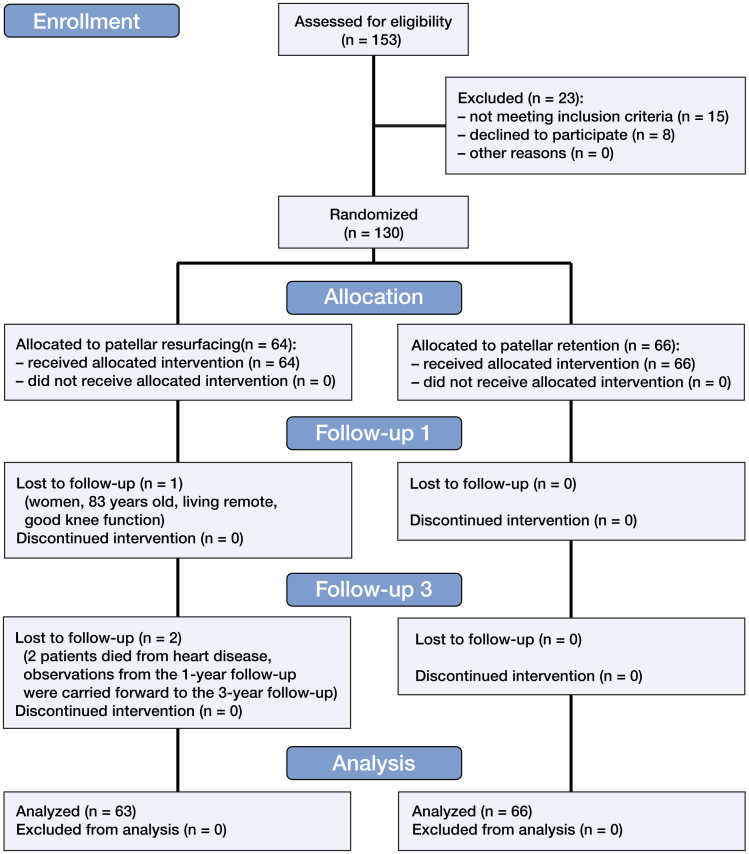
129 knees in 115 patients (mean age 70 (42-82) years; 67 female) were evaluated in this single-center, randomized, double-blind study. Data were recorded preoperatively, at 1 year, and at 3 years, and were assessed using repeated-measures mixed models.
The mean subscores for the KOOS after surgery were statistically significantly in favor of patellar resurfacing: sport/recreation, knee-related quality of life, pain, and symptoms. No statistically significant differences between the groups were observed with the Knee Society clinical rating system, with the Oxford knee score, and with visual analog scale (VAS) for patient satisfaction.
In the present study, the KOOS--but no other outcome measure used--indicated that patellar resurfacing may be beneficial in TKA.
近期关于全膝关节置换术(TKA)术后疗效的研究引发了传统疗效评估指标区分不同治疗方法能力的问题。我们比较了接受和未接受髌骨表面置换的TKA患者的功能结局,将膝关节损伤与骨关节炎疗效评分(KOOS)作为主要结局指标,3项传统结局指标作为次要结局指标。
在这项单中心、随机、双盲研究中,对115例患者(平均年龄70(42 - 82)岁;67例女性)的129个膝关节进行了评估。在术前、术后1年和3年记录数据,并使用重复测量混合模型进行评估。
术后KOOS的平均分项评分在统计学上显著有利于髌骨表面置换:运动/娱乐、膝关节相关生活质量、疼痛和症状。在膝关节协会临床评分系统、牛津膝关节评分以及患者满意度视觉模拟量表(VAS)方面,两组之间未观察到统计学上的显著差异。
在本研究中,KOOS(而非所使用的其他结局指标)表明髌骨表面置换在TKA中可能有益。