Huntington Susie, Thorne Claire, Newell Marie-Louise, Anderson Jane, Taylor Graham P, Pillay Deenan, Hill Teresa, Tookey Pat A, Sabin Caroline
aPopulation, Policy and Practice Programme, UCL Institute of Child Health bHIV Epidemiology and Biostatistics Group, UCL Research Department of Infection and Population Health, London cHuman Development and Health, Faculty of Medicine, Southampton General Hospital, University of Southampton, Southampton dHomerton University Hospital NHS Foundation Trust eSection of Retrovirology and GU Medicine, Imperial College, London, UK fAfrica Centre for Health and Population Studies, University of KwaZulu-Natal, Mtubatuba, South Africa.
AIDS. 2015 Nov;29(17):2269-78. doi: 10.1097/QAD.0000000000000826.
The objective of this study is to assess the risk of viral rebound in postpartum women on suppressive combination antiretroviral therapy (cART).
Using data from the UK Collaborative HIV Cohort (UK CHIC) study and the UK and Ireland National Study of HIV in Pregnancy and Childhood (NSHPC), women with HIV-RNA 50 copies/ml or less at delivery in 2006-2011, who started life-long cART during pregnancy (n = 321) or conceived on cART (n = 618), were matched by age, duration on cART and time period, with at least one control (non-postpartum). The cumulative probability of viral rebound (HIV-RNA >200 copies/ml) was assessed by Kaplan-Meier analysis; adjusted hazard ratios (aHRs) for the 0-3 and 3-12 months postdelivery (cases)/pseudo-delivery (controls) were calculated in Cox proportional hazards models.
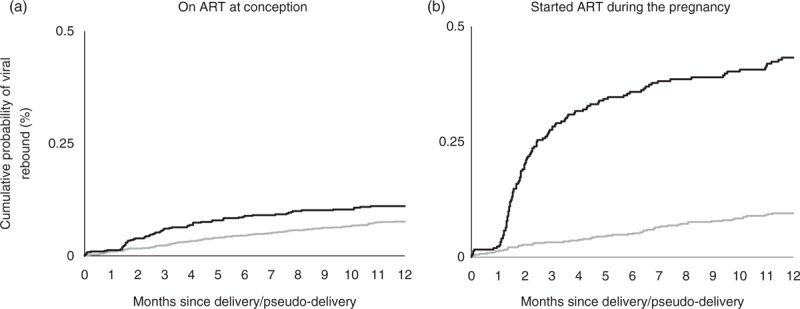
In postpartum women who conceived on cART, 5.9% [95% confidence interval (95% CI) 4.0-7.7] experienced viral rebound by 3 months, and 2.2% (1.4-3.0%) of their controls. The risk of viral rebound was higher in postpartum women than in controls during the first 3 months [aHR 2.63 (1.58-4.39)] but not during the 3-12 months postdelivery/pseudo-delivery. In postpartum women who started cART during pregnancy, 27% (22-32%) experienced viral rebound by 3 months, and 3.0% (1.6-4.4%) of their controls. The risk of viral rebound was higher in postpartum women than in controls during both postdelivery/pseudo-delivery periods [<3 months: aHR 6.63 (3.58-12.29); 3-12 months: aHR 4.05 (2.03-8.09)].
In women on suppressive cART, the risk of viral rebound is increased following delivery, especially in the first 3 months, which may be related to reduced adherence, indicating the need for additional adherence support for postpartum women.
本研究旨在评估接受抑制性联合抗逆转录病毒疗法(cART)的产后女性出现病毒反弹的风险。
利用英国协作HIV队列(UK CHIC)研究以及英国和爱尔兰国家妊娠与儿童HIV研究(NSHPC)的数据,对2006 - 2011年分娩时HIV-RNA低于50拷贝/毫升、孕期开始接受终身cART治疗的女性(n = 321)或受孕时已接受cART治疗的女性(n = 618),按照年龄、cART治疗时长和时间段进行匹配,每组至少有一名对照(非产后女性)。通过Kaplan-Meier分析评估病毒反弹(HIV-RNA>200拷贝/毫升)的累积概率;在Cox比例风险模型中计算产后0 - 3个月和3 - 12个月(病例组)/假分娩(对照组)的调整风险比(aHR)。
受孕时已接受cART治疗的产后女性中,3个月时5.9%[95%置信区间(95%CI)4.0 - 7.7]出现病毒反弹,其对照组为2.2%(1.4 - 3.0%)。产后女性在最初3个月出现病毒反弹的风险高于对照组[aHR 2.63(1.58 - 4.39)],但在产后/假分娩后3 - 12个月期间并非如此。孕期开始接受cART治疗且产后的女性中,3个月时27%(22 - 32%)出现病毒反弹,其对照组为3.0%(1.6 - 4.4%)。在产后/假分娩的两个时间段内,产后女性出现病毒反弹的风险均高于对照组[<3个月:aHR 6.63(3.58 - 12.29);3 - 12个月:aHR 4.05(2.03 - 8.09)]。
对于接受抑制性cART治疗的女性,分娩后病毒反弹风险增加,尤其是在最初3个月,这可能与依从性降低有关,表明产后女性需要额外的依从性支持。