Cheng Yi-Fang, Young Guang-Huar, Lin Jiun-Tsai, Jang Hyun-Hwa, Chen Chin-Chen, Nong Jing-Yi, Chen Po-Ku, Kuo Cheng-Yi, Kao Shao-Hsuan, Liang Yao-Jen, Chen Han-Min
Energenesis Biomedical Co., Ltd., New Taipei City, Taiwan.
Department of Life Science, Institute of Applied Science and Engineering, Catholic Fu-Jen University, New Taipei City, Taiwan.
PLoS One. 2015 Nov 6;10(11):e0142283. doi: 10.1371/journal.pone.0142283. eCollection 2015.
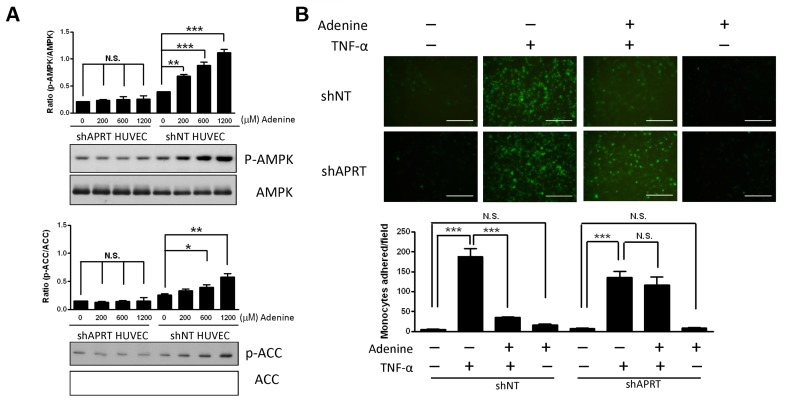
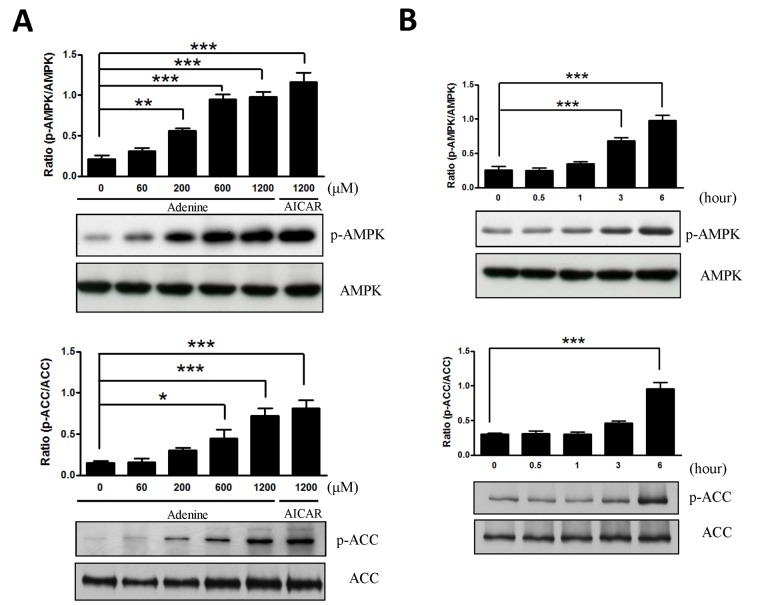
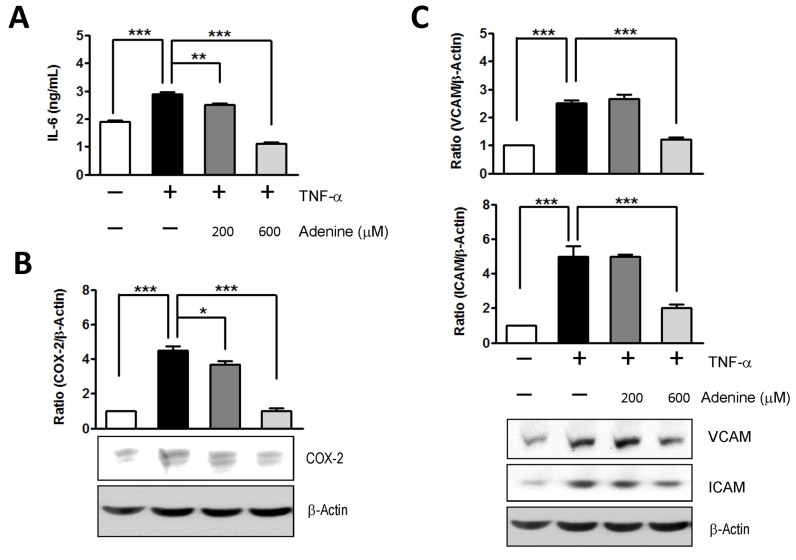
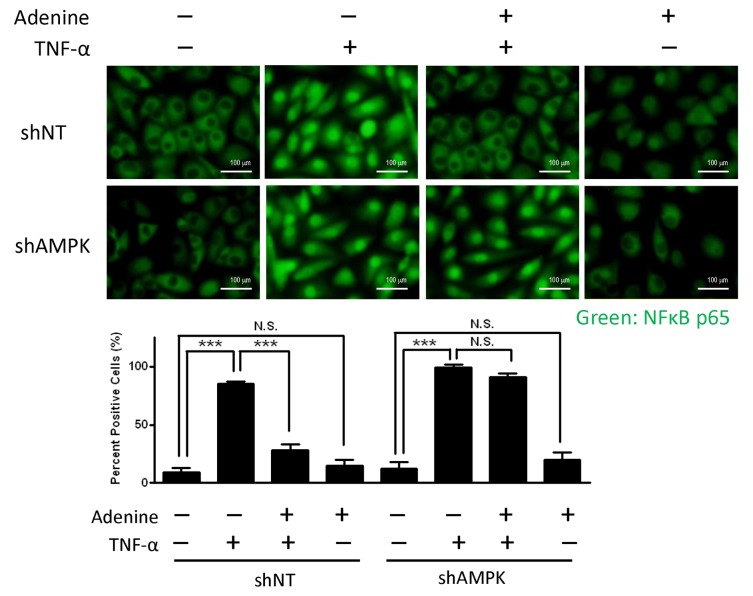
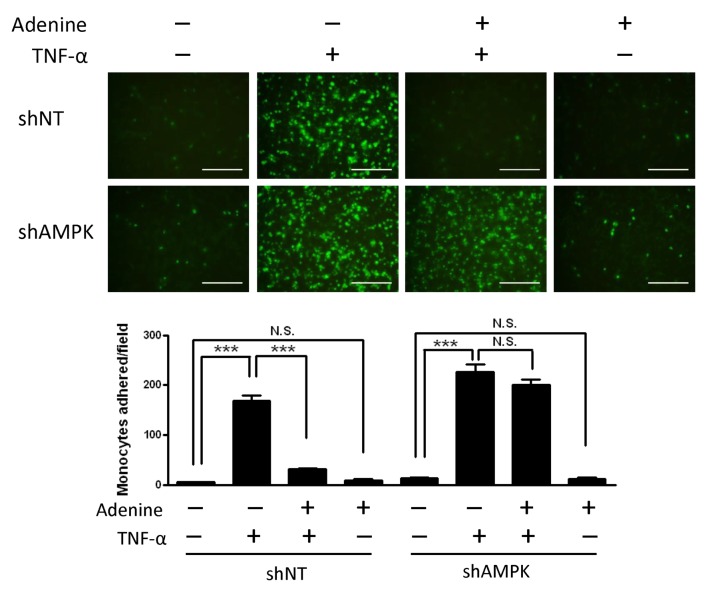
The AMP-activated protein kinase (AMPK) signaling system plays a key role in cellular stress by repressing the inflammatory responses induced by the nuclear factor-kappa B (NF-κB) system. Previous studies suggest that the anti-inflammatory role of AMPK involves activation by adenine, but the mechanism that allows adenine to produce these effects has not yet been elucidated. In human umbilical vein endothelial cells (HUVECs), adenine was observed to induce the phosphorylation of AMPK in both a time- and dose-dependent manner as well as its downstream target acetyl Co-A carboxylase (ACC). Adenine also attenuated NF-κB targeting of gene expression in a dose-dependent manner and decreased monocyte adhesion to HUVECs following tumor necrosis factor (TNF-α) treatment. The short hairpin RNA (shRNA) against AMPK α1 in HUVECs attenuated the adenine-induced inhibition of NF-κB activation in response to TNF-α, thereby suggesting that the anti-inflammatory role of adenine is mediated by AMPK. Following the knockdown of adenosyl phosphoribosyl transferase (APRT) in HUVECs, adenine supplementation failed to induce the phosphorylation of AMPK and ACC. Similarly, the expression of a shRNA against APRT nullified the anti-inflammatory effects of adenine in HUVECs. These results suggested that the role of adenine as an AMPK activator is related to catabolism by APRT, which increases the cellular AMP levels to activate AMPK.
AMP激活的蛋白激酶(AMPK)信号系统通过抑制核因子-κB(NF-κB)系统诱导的炎症反应,在细胞应激中发挥关键作用。先前的研究表明,AMPK的抗炎作用涉及腺嘌呤的激活,但其产生这些效应的机制尚未阐明。在人脐静脉内皮细胞(HUVECs)中,观察到腺嘌呤以时间和剂量依赖性方式诱导AMPK及其下游靶点乙酰辅酶A羧化酶(ACC)的磷酸化。腺嘌呤还以剂量依赖性方式减弱NF-κB对基因表达的靶向作用,并降低肿瘤坏死因子(TNF-α)处理后人单核细胞与HUVECs的黏附。HUVECs中针对AMPK α1的短发夹RNA(shRNA)减弱了腺嘌呤诱导的对TNF-α刺激的NF-κB激活的抑制作用,从而表明腺嘌呤的抗炎作用是由AMPK介导的。在HUVECs中敲低腺苷磷酸核糖转移酶(APRT)后,补充腺嘌呤未能诱导AMPK和ACC的磷酸化。同样,针对APRT的shRNA的表达消除了腺嘌呤在HUVECs中的抗炎作用。这些结果表明,腺嘌呤作为AMPK激活剂的作用与APRT的分解代谢有关,APRT增加细胞内AMP水平以激活AMPK。