Scutt Polly, Blackburn Dan, Krishnan Kailash, Ballard Clive, Burns Alistair, Ford Gary A, Mant Jonathan, Passmore Peter, Pocock Stuart, Reckless John, Sprigg Nikola, Stewart Rob, Wardlaw Joanna M, Bath Philip M
Stroke Trials Unit, Division of Clinical Neuroscience, University of Nottingham, City Hospital campus, Hucknall Road, Nottingham, NG5 1 PB, UK.
Sheffield Institute for Translational Neuroscience, University of Sheffield, 385A Glossop Road, Sheffield, S10 2HQ, UK.
Trials. 2015 Nov 7;16:509. doi: 10.1186/s13063-015-1033-2.
A common complication after stroke is development of cognitive impairment and dementia. However, effective strategies for reducing the risk of developing these problems remain undefined. Potential strategies include intensive lowering of blood pressure (BP) and/or lipids. This paper summarises the baseline characteristics, statistical analysis plan and feasibility of a randomised control trial of blood pressure and lipid lowering in patients post-stroke with the primary objective of reducing cognitive impairment and dementia.
The Prevention Of Decline in Cognition After Stroke Trial (PODCAST) was a multi-centre prospective randomised open-label blinded-endpoint controlled partial-factorial internal pilot trial running in secondary and primary care. Participants without dementia were enrolled 3-7 months post ischaemic stroke or spontaneous intracerebral haemorrhage, and randomised to intensive versus guideline BP lowering (target systolic BP <125 mmHg versus <140 mmHg); patients with ischaemic stroke were also randomised to intensive or guideline lipid lowering (target LDL cholesterol <1.4 mmol/L versus <3 mmol/L). The primary outcome was the Addenbrooke's Cognitive Examination-Revised; a key secondary outcome was to assess feasibility of performing a large trial of one or both interventions. Data are number (%) or mean (standard deviation). The trial was planned to last for 8 years with follow-up between 1 and 8 years. The plan for reporting the main results is included as Additional file 2.
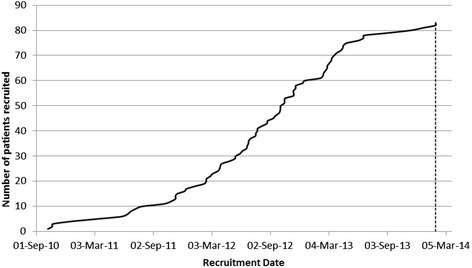
83 patients (of a planned 600) were recruited from 19 UK sites between 7 October 2010 and 31 January 2014. Delays, due to difficulties in the provision of excess treatment costs and to complexity of follow-up, led to few centres taking part and a much lower recruitment rate than planned. Patient characteristics at baseline were: age 74 (SD 7) years, male 64 (77 %), index stroke ischaemic 77 (93 %), stroke onset to randomisation 4.5 [SD 1.3] months, Addenbrooke's Cognitive Examination-Revised 86 (of 100, SD 8), Montreal Cognitive Assessment 24 (of 30, SD 3), BP 147/82 (SD 19/11) mmHg, total cholesterol 4.0 (SD 0.8) mmol/L and LDL cholesterol 2.0 (SD 0.7) mmol/L, modified Rankin Scale 1.1 (SD 0.8).
Limited recruitment suggests that a large trial is not feasible using the current protocol. The effects of the interventions on BP, lipids, and cognition will be reported in the main publication.
ISRCTN85562386 registered on 23 September 2009.
中风后常见的并发症是认知障碍和痴呆的发生。然而,降低这些问题发生风险的有效策略仍不明确。潜在策略包括强化降低血压(BP)和/或血脂。本文总结了一项针对中风后患者进行血压和血脂降低的随机对照试验的基线特征、统计分析计划及可行性,该试验的主要目标是减少认知障碍和痴呆。
中风后认知功能下降预防试验(PODCAST)是一项在二级和初级保健机构开展的多中心前瞻性随机开放标签盲终点对照部分析因内部预试验。无痴呆的参与者在缺血性中风或自发性脑出血后3 - 7个月入组,并随机分为强化降压组与指南推荐降压组(目标收缩压<125 mmHg对<140 mmHg);缺血性中风患者还被随机分为强化降脂组或指南推荐降脂组(目标低密度脂蛋白胆固醇<1.4 mmol/L对<3 mmol/L)。主要结局是修订版Addenbrooke认知检查;一个关键的次要结局是评估进行一项或两项干预措施的大型试验的可行性。数据以例数(%)或均值(标准差)表示。该试验计划持续8年,随访时间为1至8年。主要结果的报告计划见补充文件2。
在2010年10月7日至2014年1月31日期间,从英国19个地点招募了83名患者(计划招募600名)。由于提供额外治疗费用困难以及随访复杂导致延迟,使得参与的中心很少,招募率远低于计划。基线时患者特征为:年龄74(标准差7)岁,男性64名(77%),缺血性中风77例(93%),中风发作至随机分组时间4.5 [标准差1.3]个月,修订版Addenbrooke认知检查86分(满分100分,标准差8),蒙特利尔认知评估2分(满分30分,标准差3),血压147/82(标准差19/11)mmHg,总胆固醇4.0(标准差0.8)mmol/L,低密度脂蛋白胆固醇2.0(标准差0.7)mmol/L,改良Rankin量表评分为1.1(标准差0.8)。
招募人数有限表明使用当前方案进行大型试验不可行。干预措施对血压、血脂和认知的影响将在主要出版物中报告。
ISRCTN85562386,于2009年9月23日注册。