Smith Catherine M, Downs Sara H, Mitchell Andy, Hayward Andrew C, Fry Hannah, Le Comber Steven C
UCL Department of Infectious Disease Informatics, Farr Institute of Health Informatics Research, University College London, London, United Kingdom.
Animal and Plant Health Agency, New Haw, Addlestone, Surrey, United Kingdom.
PLoS One. 2015 Nov 13;10(11):e0142710. doi: 10.1371/journal.pone.0142710. eCollection 2015.
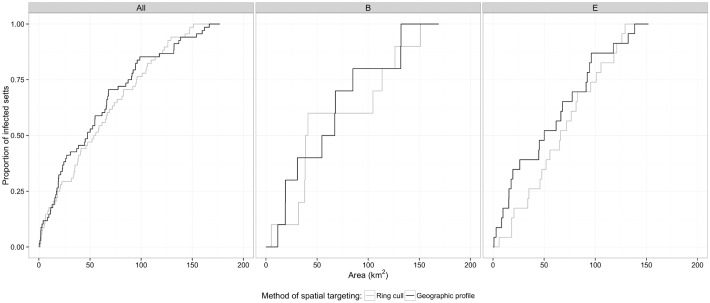
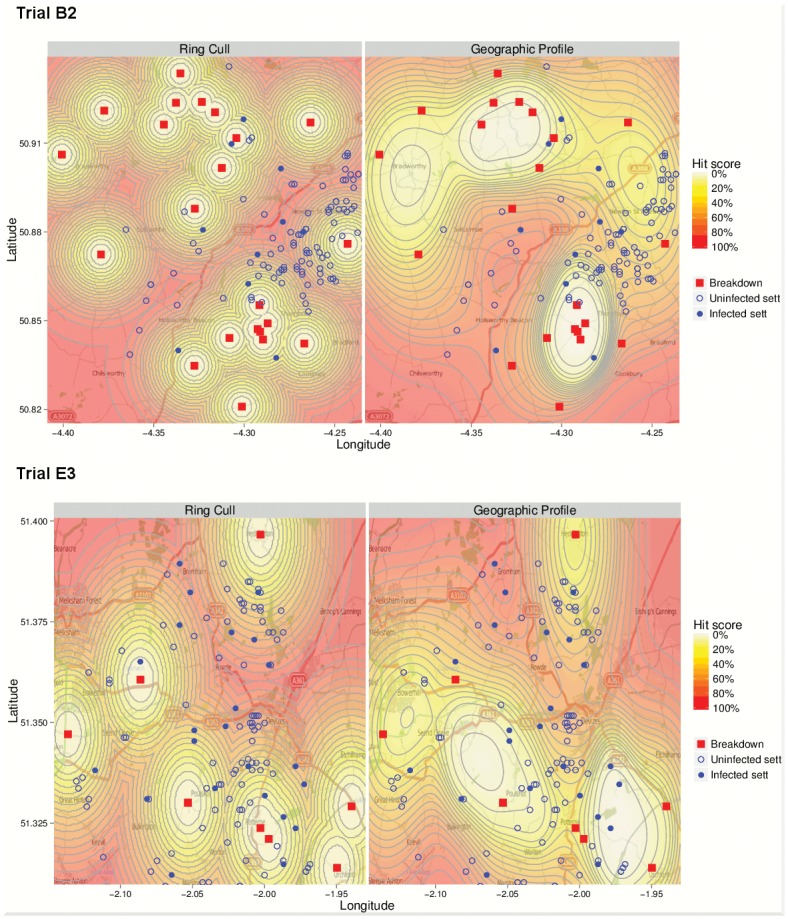
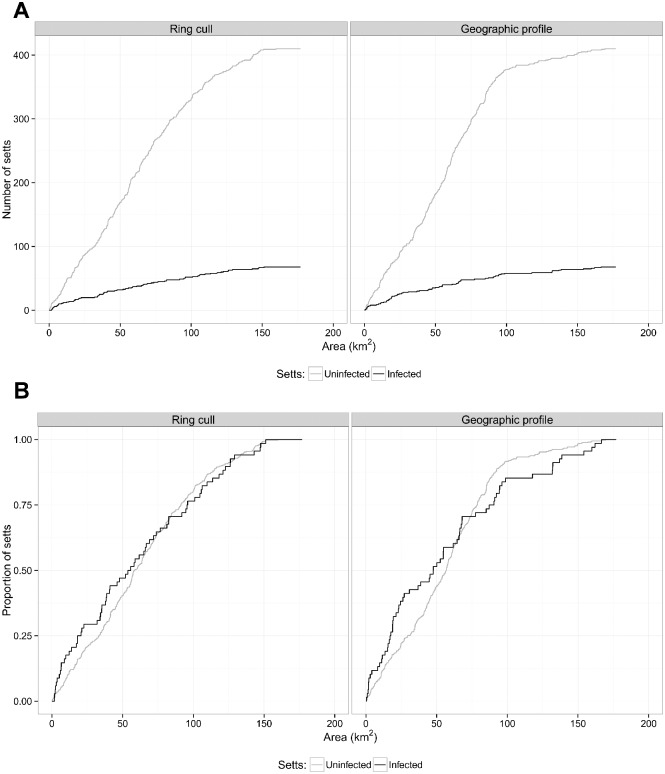
Bovine tuberculosis is a disease of historical importance to human health in the UK that remains a major animal health and economic issue. Control of the disease in cattle is complicated by the presence of a reservoir species, the Eurasian badger. In spite of uncertainty in the degree to which cattle disease results from transmission from badgers, and opposition from environmental groups, culling of badgers has been licenced in two large areas in England. Methods to limit culls to smaller areas that target badgers infected with TB whilst minimising the number of uninfected badgers culled is therefore of considerable interest. Here, we use historical data from a large-scale field trial of badger culling to assess two alternative hypothetical methods of targeting TB-infected badgers based on the distribution of cattle TB incidents: (i) a simple circular 'ring cull'; and (ii) geographic profiling, a novel technique for spatial targeting of infectious disease control that predicts the locations of sources of infection based on the distribution of linked cases. Our results showed that both methods required coverage of very large areas to ensure a substantial proportion of infected badgers were removed, and would result in many uninfected badgers being culled. Geographic profiling, which accounts for clustering of infections in badger and cattle populations, produced a small but non-significant increase in the proportion of setts with TB-infected compared to uninfected badgers included in a cull. It also provided no overall improvement at targeting setts with infected badgers compared to the ring cull. Cattle TB incidents in this study were therefore insufficiently clustered around TB-infected badger setts to design an efficient spatially targeted cull; and this analysis provided no evidence to support a move towards spatially targeted badger culling policies for bovine TB control.
牛结核病在英国对人类健康具有重要的历史意义,至今仍是一个重大的动物健康和经济问题。牛结核病的控制因存在储存宿主物种——欧亚獾而变得复杂。尽管对于牛结核病由獾传播所致的程度存在不确定性,且遭到环保组织反对,但在英格兰的两个大片区域,捕杀獾已获得许可。因此,将捕杀范围限制在更小区域,以针对感染结核病的獾,同时尽量减少被捕杀的未感染獾数量的方法,备受关注。在此,我们利用大规模獾捕杀现场试验的历史数据,基于牛结核病发病情况的分布,评估两种替代的假设方法,以针对感染结核病的獾:(i)一种简单的圆形“环形捕杀”;(ii)地理画像法,一种用于传染病控制空间定位的新技术,它根据关联病例的分布预测感染源的位置。我们的结果表明,两种方法都需要覆盖非常大的区域,以确保大量感染獾被清除,并且会导致许多未感染的獾被捕杀。地理画像法考虑了獾和牛群中感染的聚集情况,与捕杀中包含的未感染獾相比,感染结核病的獾窝比例略有增加,但不显著。与环形捕杀相比,在针对有感染獾的獾窝方面,它也没有总体上的改进。因此,本研究中的牛结核病发病情况在感染结核病的獾窝周围的聚集程度不足以设计出一种高效的空间定位捕杀方法;并且该分析没有提供证据支持转向针对牛结核病控制的空间定位獾捕杀政策。