Schummer Michèl, Thorpe Jason, Giraldez Maria D, Bergan Lindsay, Tewari Muneesh, Urban Nicole
Fred Hutchinson Cancer Research Center, 1100 Fairview Ave N, Seattle, Washington, United States of America.
Department of Internal Medicine, Division of Hematology/Oncology, University of Michigan, Ann Arbor, Michigan, United States of America.
PLoS One. 2015 Nov 13;10(11):e0142911. doi: 10.1371/journal.pone.0142911. eCollection 2015.
Breast cancer is the most frequently diagnosed cancer and the leading cause of cancer death in females worldwide. Death rates have been declining, largely as a result of early detection through mammography and improved treatment, but mammographic screening is controversial because of over-diagnosis of breast disease that might not require treatment, and under-diagnosis of cancer in women with dense breasts. Breast cancer screening could be improved by pairing mammography with a tumor circulating marker, of which there are currently none. Given genomic similarities between the basal breast cancer subtype and serous ovarian cancer, and given our success in identifying circulating markers for ovarian cancer, we investigated the performance in hormone receptor-negative breast cancer detection of both previously identified ovarian serum markers and circulating markers associated with transcripts that were differentially expressed in breast cancer tissue compared to healthy breast tissue from reduction mammaplasties.
We evaluated a total of 15 analytes (13 proteins, 1 miRNA, 1 autoantibody) in sera drawn at or before breast cancer surgery from 43 breast cancer cases (28 triple-negative-TN-and 15 hormone receptor-negative-HRN-/ HER2-positive) and 87 matched controls.
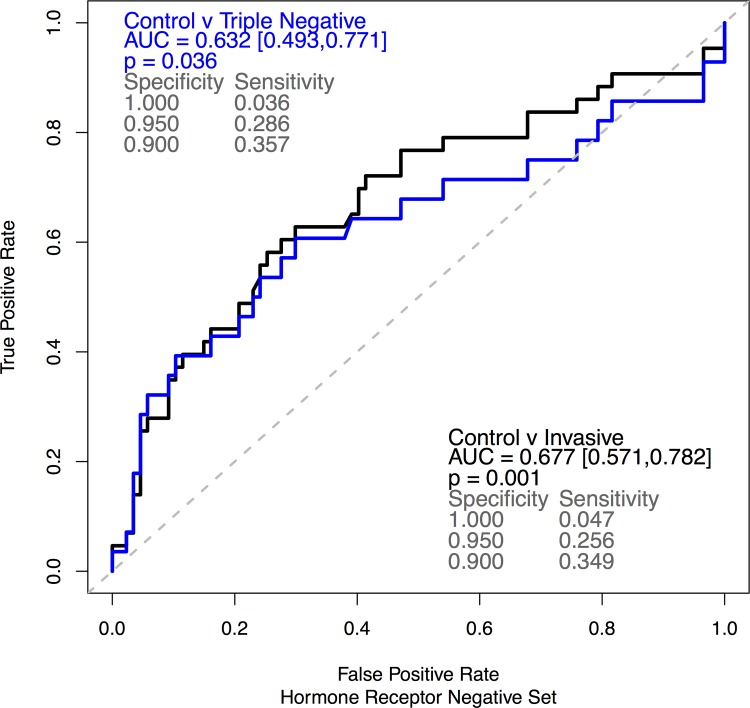
In the analysis of our whole cohort of breast cancer cases, autoantibodies to TP53 performed significantly better than the other selected 14 analytes showing 25.6% and 34.9% sensitivity at 95% and 90% specificity respectively with AUC: 0.7 (p<0.001). The subset of 28 TN cancers showed very similar results. We observed no correlation between anti-TP53 and the 14 other markers; however, anti-TP53 expression correlated with Body-Mass-Index. It did not correlate with tumor size, positive lymph nodes, tumor stage, the presence of metastases or recurrence.
None of the 13 serum proteins nor miRNA 135b identified women with HRN or TN breast cancer. TP53 autoantibodies identified women with HRN breast cancer and may have potential for early detection, confirming earlier reports. TP53 autoantibodies are long lasting in serum but may be affected by storage duration. Autoantibodies to TP53 might correlate with Body-Mass-Index.
乳腺癌是全球女性中最常被诊断出的癌症,也是癌症死亡的主要原因。死亡率一直在下降,这主要归功于通过乳房X光检查的早期发现以及治疗方法的改进,但乳房X光检查存在争议,因为可能会过度诊断出一些可能无需治疗的乳腺疾病,同时也会漏诊乳房密度较高女性中的癌症。将乳房X光检查与肿瘤循环标志物相结合可改善乳腺癌筛查,然而目前尚无此类标志物。鉴于基底样乳腺癌亚型与浆液性卵巢癌之间存在基因组相似性,并且我们在识别卵巢癌循环标志物方面取得了成功,因此我们研究了先前鉴定的卵巢血清标志物以及与乳腺癌组织中与健康乳房组织相比差异表达的转录本相关的循环标志物在激素受体阴性乳腺癌检测中的性能。
我们评估了43例乳腺癌患者(28例三阴性-TN-和15例激素受体阴性-HRN-/HER2阳性)以及87例匹配对照在乳腺癌手术时或手术前采集的血清中的总共15种分析物(13种蛋白质、1种微小RNA、1种自身抗体)。
在对我们整个乳腺癌病例队列的分析中,针对TP53的自身抗体表现明显优于其他14种选定的分析物,在特异性为95%和90%时,敏感性分别为25.6%和34.9%,曲线下面积(AUC)为0.7(p<0.001)。28例TN癌的亚组显示出非常相似的结果。我们观察到抗TP53与其他14种标志物之间无相关性;然而,抗TP53表达与体重指数相关。它与肿瘤大小、阳性淋巴结、肿瘤分期、转移或复发的存在均无相关性。
13种血清蛋白和微小RNA 135b均未识别出HRN或TN乳腺癌女性。TP53自身抗体识别出了HRN乳腺癌女性,可能具有早期检测的潜力,这证实了早期报告。TP53自身抗体在血清中持续时间长,但可能受储存时间影响。针对TP53的自身抗体可能与体重指数相关。